

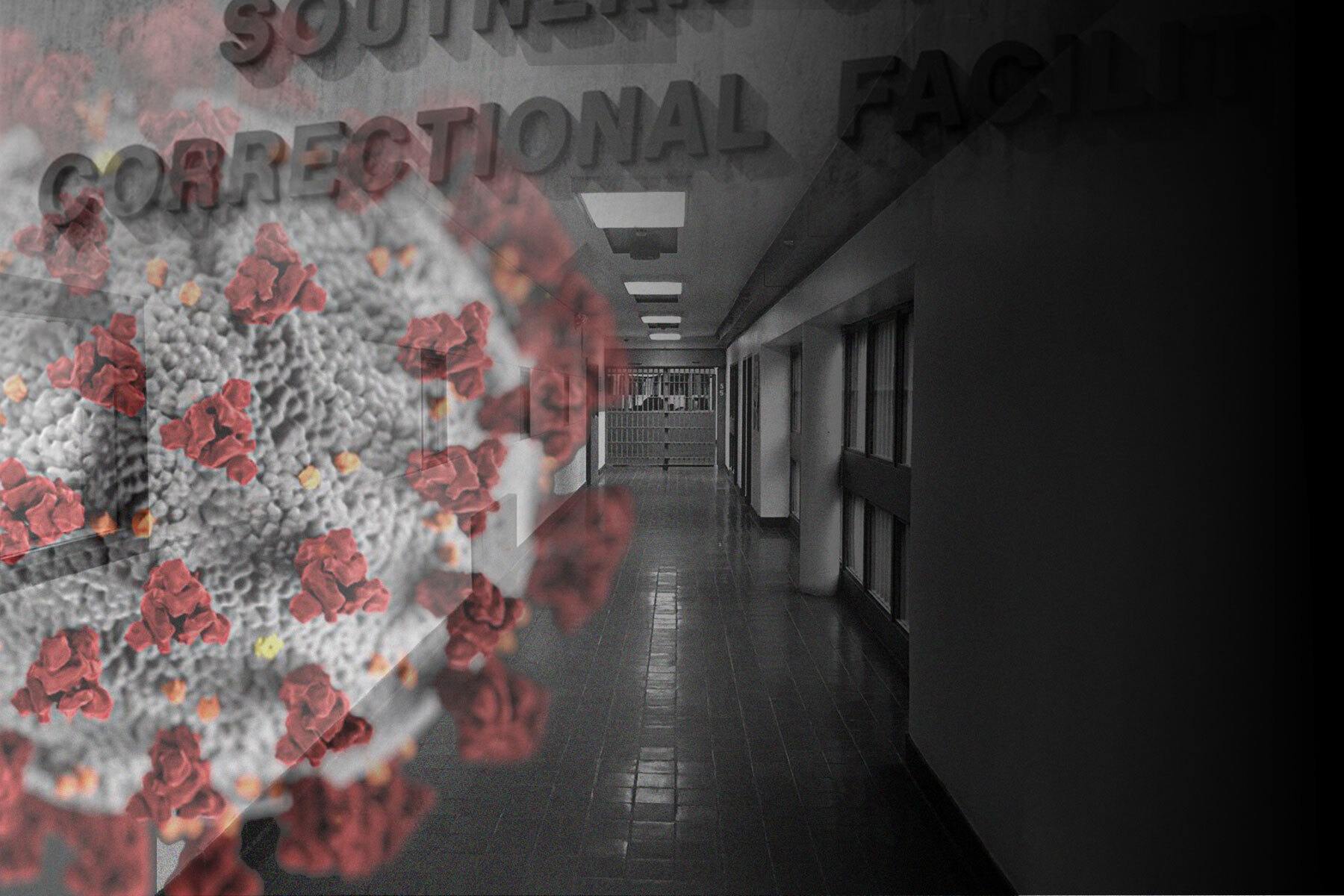
For Matt Engels, a shift supervisor at Northwest State Correctional Facility in St. Albans, managing the impacts of Covid-19 at the prison has become second nature.
On a given morning he might review test results, changes in Department of Corrections procedures or a new case for contact tracing. He might also cold-call potential job applicants in what’s become an ongoing effort to grow the facility’s staff.
“It’s a difficult question to answer,” Engels said when asked to describe changes he’s seen at the roughly 140-person prison since the start of the pandemic. “Because the changes have really enveloped every aspect of our operation.”
Since the fall — just like in other institutions across Vermont such as hospitals, courts and schools — the Omicron variant has amplified many of the challenges in the state’s prison system that already existed as a result of the pandemic.
Corrections staff such as Engels have worked long hours to keep facilities running amid increased case counts and a staffing crisis. At the same time, incarcerated people have felt the impacts of repeated lockdowns in efforts to reduce outbreaks of the virus.
Prior to the Omicron wave, the agency was focused on Covid-19’s impact on incarcerated people more than its impact on staffing, according to Nicholas Deml, the Department of Corrections commissioner. But amid a more transmissible variant, he said, that’s changed.
“It’s the same thing we’re seeing in our hospitals around the state — we were losing so many staff because the variant was so prolific,” Deml said. “Then, we had to address what happens if we don’t have enough staff to keep a facility up and running.”
In January, many Vermont prisons reported higher numbers of positive cases among staff and incarcerated people than at any point in the six months prior.
The most dramatic outbreak of cases was first detected Jan. 8 at Northeast Correctional Complex in St. Johnsbury. By Jan. 24, 61 incarcerated people and 31 staff members had tested positive for the virus over the course of a month, according to the corrections department.
The number of cases at the Caledonia County facility has since dropped to single digits, according to the department’s most recent data as of Feb. 3.
Al Cormier, the state agency’s chief of operations, said the outbreak was in Northeast Correctional Complex’s work camp building, which has dormitory-style beds and communal bathrooms rather than individual cells. He believes this lack of separation among incarcerated people allowed the outbreak to grow so rapidly.
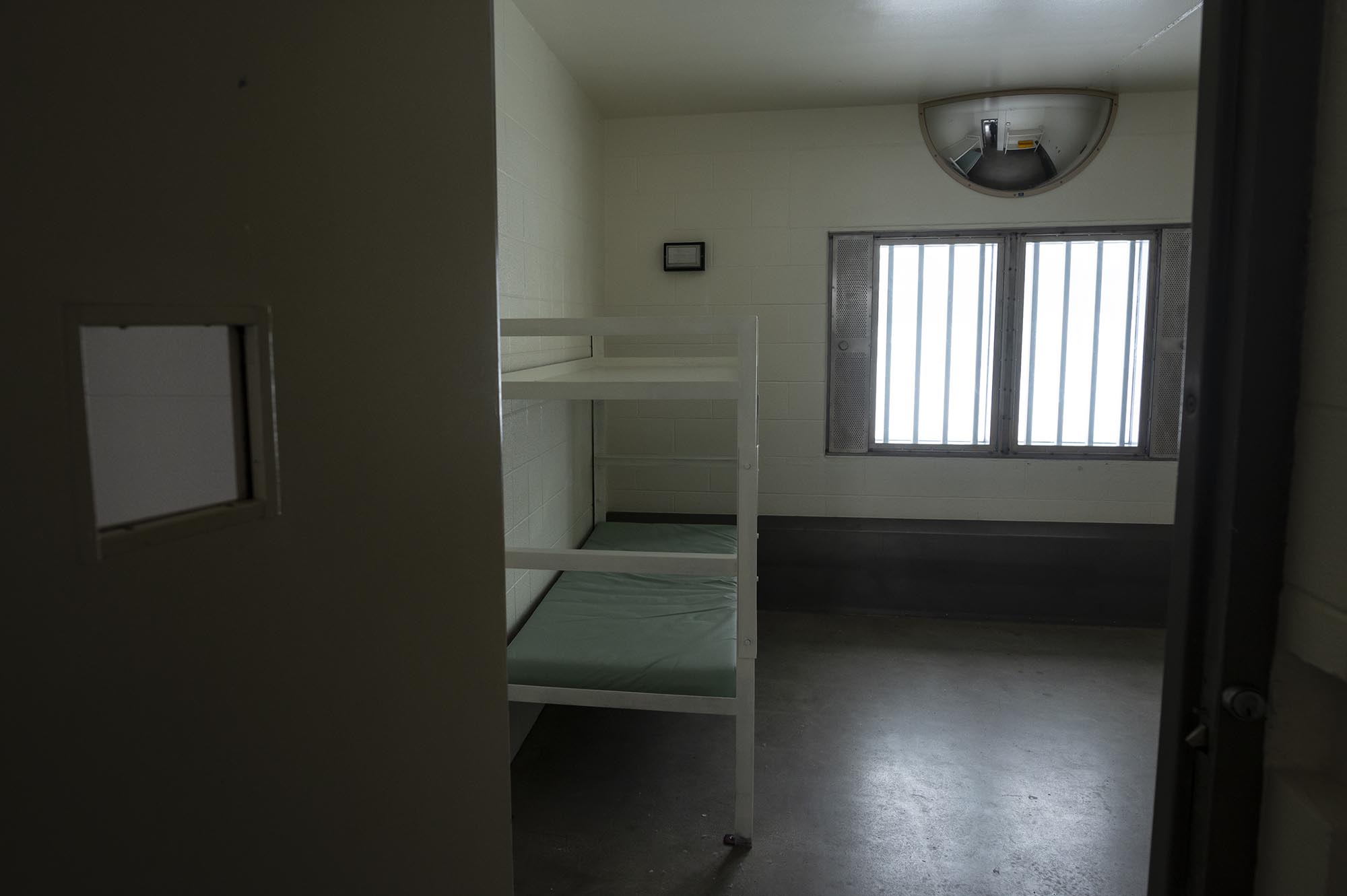
The facility was put on full lockdown at the beginning of the outbreak. In units that aren’t communal, Cormier said, lockdowns mean incarcerated people generally leave their cells only to shower. Food and medications are delivered on carts, Engels said.
And although coronavirus cases have recently dipped across the prison system, new cases still are being detected. On Friday, an outbreak first discovered earlier in the week at Northwest State grew to 12 people after testing revealed nine new cases. That facility was locked down as well.
Lockdowns also close a prison to the public. Gov. Phil Scott said at a press conference last week he thinks it’s time to increase visitation at these facilities, and the corrections department is now assessing its policies to try and make that happen without burdening staff, agency spokesperson Rachel Feldman told VTDigger.
“There is some movement, but it is very limited. We understand it’s not the best-case scenario,” said Cormier, who has overseen the department’s Covid-19 response. “We also know it’s what’s working to keep our staff and our population safe.”
In addition to limiting the spread of the virus, Cormier said, another goal of locking down a unit or entire facility is to make it easier for staff to conduct contact tracing.

Once a staff member or incarcerated person has tested positive for the virus, Engels said, staff use the prison’s network of security cameras to piece together where they traveled in the facility, who they came into contact with, and whether those people were vaccinated or wearing masks. Then, staff send a report to administrators.
There’s been a significant increase in the number of lockdowns at Northwest State Correctional Facility since the Omicron wave hit in Vermont, Engels said.
“It’s frustrating both for staff and the incarcerated population,” Engels said.
Annie Manhardt, a staff attorney in the state’s Prisoners’ Rights Office, has been in contact with multiple people who were incarcerated at Northeast Correctional Complex during the recent outbreak.
She said it was better that the lockdown happened in a communal unit because they were able to go through the isolation period together. The Department of Corrections “has taken a lot of really positive steps” to mitigate the spread of Covid-19, she said, though the incarcerated people she has spoken to remain frustrated and scared.
“Those restrictions have definitely taken a toll for people who are in and out of lockdown on a daily basis,” Manhardt said. “That is definitely a stressful situation to be in.”
Deml said despite a relatively large number of cases, no staff or incarcerated people at the St. Johnsbury facility got seriously ill or needed to be hospitalized during the outbreak. He said that although restrictions can be difficult, they’re worthwhile, noting that no one working or housed in Vermont prisons has yet died as a result of Covid-19.
When the outbreak happened in St. Johnsbury, the department switched the facility from operating three eight-hour shifts to two 12-hour shifts, so more staff were available at a given time if needed, Deml said. He said 12-hours shifts won’t become the norm, but staff welcomed the temporary change and it allowed the department to reduce overtime.
“They're doing unbelievable work under the most austere circumstances that I can imagine for this state,” Deml said. “And so I think they deserve a lot of credit.”

Staffing woes
Deml said the department also filled some deficits in staffing at facilities across the state with probation and parole officers — many of whom are former corrections officers, so they have the necessary training and experience.
Probation and parole officers without that background can still manage other prison functions that do not involve direct contact with incarcerated people, he said.
“All the facilities are understaffed,” Engels said. “There’s a lot of overtime. I won't lie about that.”
Steve Howard, executive director of the Vermont State Employees Association, called the corrections department’s staffing crisis “a five-alarm fire” at a Jan. 25 hearing before the Senate Government Operations Committee.
The department is facing a 44% turnover rate for corrections officers, Howard said, whereas for three years prior, it had been about 30% annually.
He estimated that getting the entire corrections system on the right track would require an ongoing investment on the order of $10 million to $20 million.
“When I asked our members to describe some of the words that I should use in my testimony here when I'm talking with the Legislature, the words that I hear are ‘crisis,’ ‘urgent,’ ‘dangerous,’ ‘help,’” Howard said.
Low staffing levels also can negatively impact staff and incarcerated people’s mental health, according to results from a University of Vermont study released Jan. 27. Researchers surveyed both groups at Southern State Correctional Facility in Springfield in June 2021.
The survey found many of the prison’s staff and incarcerated population believe the facility lacks services to promote prisoners’ rehabilitation and reentry into society, and that the pandemic has further limited prisoners’ options for staying busy.
When incarcerated people are unable to access rehabilitation programs, it can delay their release, said Thomas Powell, a forensic psychologist who, for 18 years, was the clinical director for the Department of Corrections. Many of those programs are run by people contracted from the outside who cannot come in as often, or at all, during the pandemic, he said.
“You've got a lot of people sort of in programmatic stall mode,” Powell said. “And they can't get out because that's usually a condition on their releases.”
Powell said limits on visitation, which have been a constant throughout the pandemic, take a toll for many reasons — not the least of which is that getting to see children and loved ones often motivates people to get out of prison.
As a psychologist, he and his colleagues go into the state’s prisons regularly to conduct evaluations of incarcerated people. Powell said mental health issues such as depression and anxiety have always been high among prisoners, but now there are fewer options for help that are accessible from the inside.
“If you do start to feel either more depressed or more helpless because of the conditions you're in, there's not a lot of resources right now to be able to help you tamp that down,” he said.
Overall, Powell said he feels the corrections department is taking the pandemic seriously and trying its best to limit the spread of the virus.
Engels, the supervisor at the St. Albans prison, said even with the challenges of the pandemic so far, he feels more people are seeing work in corrections as part of a career. The UVM study found that despite the plethora of issues identified at Southern State Correctional Facility, most staff members took pride in their jobs.
“I'm being honest with you — I find these guys to be incredibly dedicated to their jobs, and the safety of the people around them,” Engels said of his colleagues.
Covid coming in
Manhardt said one frustration she’s heard from incarcerated people in St. Johnsbury is that the virus is being brought into the facility by staff and contractors, while the incarcerated population has nowhere to go.
Tracy Nichols, whose boyfriend Jason Muxlow is currently incarcerated at Southern State Correctional Facility, said Muxlow and his peers also feel that frustration.
Due to repeated lockdowns, Muxlow has not been able to go to physical therapy for his hip following surgery he had in November, said Nichols, who lives in Westminster. She worries that if her boyfriend does not get the care he needs, he will develop further complications and could become disabled.
Nichols said she read about the results of the UVM study, and it all rings true.
“You have a feeling of hopelessness because you don't have anything else to do,” she said of the people incarcerated at the Springfield facility.
Since December, total positive cases have often been higher for corrections staff than for incarcerated people, according to department data analyzed by VTDigger.
About 73% of Vermont’s incarcerated population eligible for a Covid-19 booster shot have received one since the Department of Corrections rolled out its program early in December, according to the latest available numbers kept by the department.
As of Jan. 31, of the 1,301 incarcerated people in Vermont’s six correctional facilities and housed out-of-state at a Mississippi prison, 963 were vaccinated, or 74%.
Of those 1,301 who are incarcerated, 898, or about 93%, are “booster eligible,” meaning they have received earlier vaccination shots long enough ago to qualify for a booster.
For comparison, according to the state Department of Health, 64% of eligible Vermonters 12 and older have received the booster shot.
Booster shot rates for incarcerated people vary among the state’s six prisons. Southern State Correctional Facility has the highest rate: 79%. Northwest State Correctional Facility has the second-highest, at just over 78%. The lowest, just over 61%, is at Marble Valley Regional Correctional Facility in Rutland City.

Among corrections staff, just over 78% have received at least two vaccine doses, according to Feldman, the agency spokesperson. She said this data is self-reported, and the department does not have figures broken down by facility.
Staff who are not vaccinated are required to take two Covid-19 tests per week, Feldman said. She added that everyone is required to wear a mask inside the prisons.
“What strikes me as unfortunate is the number of correctional officers who appear to be getting Covid on the outside and bringing it in,” Powell said.
Deml said throughout the pandemic, high case counts in prisons have corresponded to high case counts in the communities they’re located in.
“It really does go both ways,” Manhardt said, “because there's people who move between the facility and the community every day.”
Manhardt continues to believe what she has throughout the pandemic: Since congregate living situations are prone to disease outbreaks, the best solution is to limit the number of people who are incarcerated in the first place.
“I think it gets to a point — especially with these very transmissible variants — that it becomes almost inevitable,” she said. “And the priority at that point needs to be reducing the number of people who are exposed to that risk.”
Get the latest statistics and live updates on our coronavirus page.
Sign up for our coronavirus email list.
Tell us your story or give feedback at coronavirus@vtdigger.org.
Support our nonprofit journalism with a donation.
