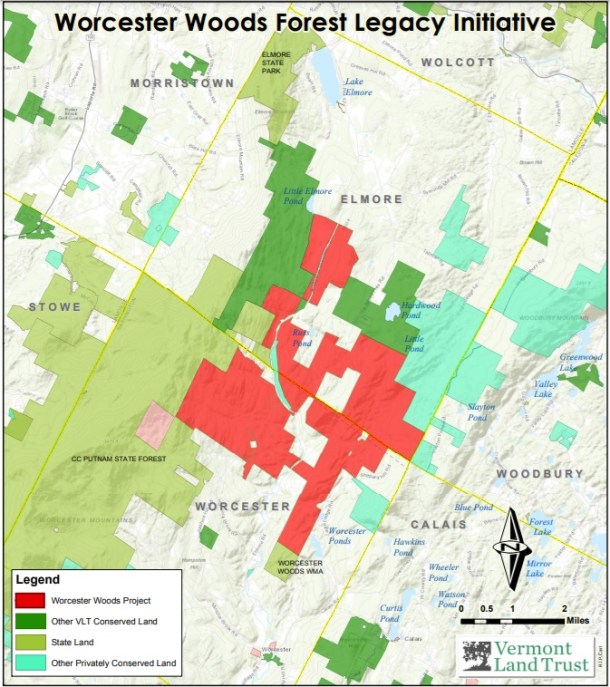
Thousands of acres of Vermont forest will be permanently preserved as a part of a Vermont Land Trust conservation project.
Split by Route 12, “Worcester Woods” in Worcester and Elmore will be sold to private owners by the Vermont Land Trust while still maintaining public access for recreational activities and environmental preservation through a conservation easement.
The property is currently owned by the Vermont Land Trust. The land is set to be sold to private owners, with a conservation easement that sets permanent limits on how the land can be used. For Worcester Woods, these guidelines prioritize public recreational access and environmental preservation. Future recreational activities on the property could include mountain biking trails, hunting, fishing and camping, according to a joint press release from the Vermont Land Trust and the Department of Forests, Parks and Recreation.
The forests department has already met with potential buyers to explain the easement means.
The project was a major accomplishment for Carl Powden, former president of the Vermont Land Trust; he died before the deal was finished. However, a land trust press release quoted his view of the acquisition: “It’s a rare opportunity to be able to protect a large swath like this — one that is part of a regionally significant block of forestland.”
This arrangement was created through the forests department purchasing conservation easements. These easements were funded by $5 million from the U.S. Forest Service’s competitive Forest Legacy Program, as well as private funding from the Open Space Institute Transborder Fund. It is unclear how much additional money the Transborder Fund contributed.
U.S. Sen. Patrick Leahy, D-Vt. said in the release the acquisition is “exactly the kind of project I envisioned when we wrote the Forest Legacy Act” back in 1990. “I could not be more pleased and proud than to see this large swath of rich and diverse forestland in the heart of Vermont forever conserved to the benefit of future generations and the planet.”
The Forest Legacy Program has permanently protected over 76,000 acres of forestland in Vermont alone, and over 2 million acres nationwide, according to Leahy’s office.
The Worcester Woods acquisition will not only preserve the habitat for more than 100 species, but is also a key part of an international corridor for migrating wildlife that stretches between Vermont’s Green Mountains to Nova Scotia in eastern Canada.
Lynx, moose and bobcats among other species and plants all use this corridor to migrate in response to seasonal weather patterns.
“Because wildlife carry no passports and observe no manmade jurisdictions, we must work together to protect the last wild places near the border that they call home,” said Peter Howell, executive vice president of the Open Space Institute.

While 6,500 acres is relatively small, it is a critical location to preserve in the face of climate change. Its ecological and geological makeup make it more likely to withstand the forces of climate change. The Worcester Wood’s multifaceted landscape, which makes it extremely attractive for recreational activities, also gives wildlife the ability to quickly respond to rising temperatures and climate change events.
Howell gave the example of when it gets warmer, wildlife being able to move along a river to stay cooler. “You want to find these landscapes that offer escape hatches for wildlife when those shocks occur, so that when the climate gets wetter and warmer, wildlife has options to adjust, and to reconfigure,” Howell said.
“This linkage is really essential in the face of growing development, particularly in Vermont,” Howell said as increasing development of the state’s lands threatens these migratory passages.
The parcel has more than 200 acres of wetlands that act as a sponge in floods, naturally keeping water in and letting it trickle out. As a result of climate change, floods are projected to sharply increase in Vermont throughout the next 100 years, and wetlands are a major asset in limiting flood damage.
The Meyer family, owners of the Deer Lake Timber Company, acquired the land from a lumber company and kept it productive for more than six decades. They sold it in 2014 for less than market value to the Vermont Land Trust to support its conservation. The trust then took on the risk of waiting for the Department of Forests, Parks, and Recreation to receive federal government funding to buy the easements, the release stated.
The vision of conserving these forests has been critical in the Vermont Land Trust’s current negotiations with landowners throughout the region to also preserve their land, which is also former Deer Lake Timber property.
The impacts of this project have been felt already in Worcester, where a 72-acre donation in 2018 by the Vermont Land Trust to the Vermont River Conservancy created a more accessible trail to the North Branch Cascades swimming spot.
The parcels also have led to a proposal for the 5,400-acre Woodbury Forest Preserve.
An additional 750 acres, sold to the Vermont Land Trust by the Meyer family, is set to be sold to private landowners with conservation protections in place, but not a conservation easement.