

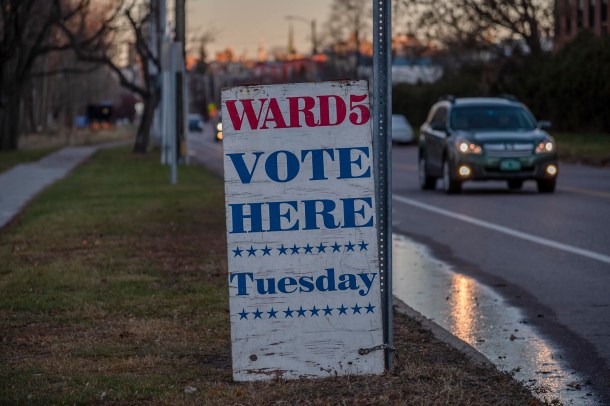
With Burlington voters rejecting a plan that would have borrowed $40 million for infrastructure upgrades, city officials are looking at other ways to address projects on its long-term to-do list.
Mayor Miro Weinberger’s plan to inject cash into the city’s roads, sidewalks and fire department, among other items, was dashed in a special city election Tuesday after voters denied the plan the two-thirds approval it needed to pass.
About 57% of those who turned out supported the measure, and 70% of voters approved a $20 million bond for the city’s electric department that also was on the ballot.
Weinberger was not pleased with the result of the election, telling reporters Tuesday night that it could lead to negative consequences down the road.
“I was hoping we would have the bond and be able to have another very active construction season in 2022,” Weinberger said. “This will definitely limit what we can build.”
By not funding the maintenance, Weinberger and his allies argued, the city would end up spending more to fix its infrastructure later on.
Voters who opposed the bond said they did so to avoid an increase in property taxes after a property reappraisal this year saddled many homeowners with higher tax bills.
In addition, the prospect of constructing a new high school — something Burlington school officials still plan to do — left some voters reluctant to approve more spending.
To Weinberger, however, the failed bond was a missed opportunity to capitalize on historically low interest rates. Even if voters approve a trimmed-down version of the bond at the city’s March 1 Town Meeting Day election, an increase in interest rates designed to counter inflation may make the project harder to finance, the mayor said.
If the mayor sees any positive to the capital bond’s failure, it’s that city officials can now calculate more precisely how much local spending will be needed to obtain federal funds for the projects.
When Weinberger first proposed the capital bond, a $1 trillion bipartisan infrastructure package had not yet passed Congress. Now that it’s law, the mayor said his administration can make a “clearer case” to voters how much money Burlington needs to contribute to draw down those funds.
“That will certainly be one of the things we’re assessing between now and Town Meeting Day,” Weinberger said.
The failed bond vote did not surprise City Councilor Joe Magee, P-Ward 3, who said they understand some residents’ hesitancy to increase their property taxes.
“Any tax increase is a lot to ask right now,” Magee told VTDigger on Wednesday.
While city leaders could have made more of an effort to whip up support for the capital bond, Magee said, they understood the financial constraints faced by Weinberger’s administration.
“I don’t know that there were even the resources to run a campaign more than what the administration used for outreach,” Magee said.
While Progressive-led wards like Magee’s approved the capital bond by the two-thirds margin it needed to pass, meager turnout in those precincts did not help staunch a wave of opposition to the bond in neighborhoods such as the New North and South ends.
Magee said they did not know why turnout was significantly lower in wards 1, 2, 3 and 8, though they wondered if — because a number of residents in the renter-dominated wards might remain on voter rolls after moving away — registered voter counts were inflated in those precincts.
The capital bond’s demise leaves uncertain the future of Memorial Auditorium, the city-owned, structurally unsound building on Main Street that was slated for a $10 million pick-me-up under Weinberger’s plan.
The mayor, who was criticized by city councilors for not detailing how he would spend the $10 million allocated to the building, expressed hope that the building could still get a reboot instead of a razing.
“I don’t think tonight’s result was definitive,” Weinberger said Tuesday night. “I am interested in talking to my colleagues on the council and Burlingtonians and looking for a way for that building to have one more chance.”
