

Editor’s Note: This article by Claire Potter was originally published in the Valley News on Nov. 27.
STRAFFORD — In 2002, the Environmental Protection Agency presented plans to clean up the abandoned Elizabeth Mine to the public for comment. It estimated that the project would cost as much as $16 million, or almost $25 million in today’s dollars.
Twenty years later, the cleanup at the former copper mine in Strafford is complete, and the final cost came in at $103 million.
The EPA finished work on the project earlier this month and provided a final tally of costs this week.
Ed Hathaway, the EPA project manager at the Elizabeth Mine, said Wednesday that “cost increases are very common” in the Superfund program. The estimates presented to the public in 2002, he explained, were based on an engineering firm’s “conceptual” assessment, rather than a detailed “design” that would have worked out the technical side of the project.
“We’re not building a house. We essentially are unwrapping the site as we clean it up. … As we excavate and as we do work, we uncover more of the challenges,” he said.
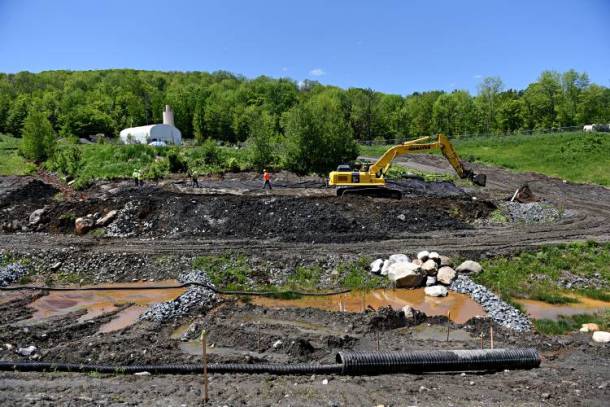
The technical complexity, the volume of material moved — in the Elizabeth Mine’s case, this included 400,000 cubic yards of waste rock — and the duration of the project all drove up the cost, he said.
The EPA designated the abandoned 250-acre copper mine a Superfund site in 2001, which put it on a national list of severely polluted sites prioritized for cleanup. Acid- and metal-contaminated water had leached out of the waste rock and tailings into the streams that feed the west branch of the Ompompanoosuc River since the mine closed in 1958. Contaminated water endangered aquatic life and an unstable tailing dam threatened nearby homes.
Federal taxpayers footed the $103 million bill.
In Superfund cases, the EPA looks for “potentially responsible parties” to pay for the cleanup, and as of 2016, the Superfund enforcement program negotiated settlements and issued orders that covered almost 70% of ongoing cleanup work across the country, according to the EPA.
But in the case of the Elizabeth Mine, mining work ceased in 1958, and the mining companies were long out of business by the time the pollution in Strafford came to the EPA’s attention.
“Owners and operators past and present are liable,” Hathaway said. But “as a practical matter” at such so-called orphan sites “we essentially get that the average person doesn’t have the money to deal with this,” he added.
The EPA worked with the private owners of the Elizabeth Mine — which have included the Cook family, the Zagaeski family and the recently formed Elizabeth Mine Historic Preservation Trust — so that the agency had unrestricted access to their property and could use resources on their land, but it did not hold them financially responsible.
When Congress passed the Comprehensive Environmental Response, Compensation and Liability Act in 1980, which instituted the Superfund program, lawmakers established a tax on the chemical and petroleum industries to fund the program.
But that tax expired in 1995 and federal taxpayers took on that financial burden. Superfund’s revenue has declined by more than a billion dollars since the 1990s, according to a 2021 report from The Public Interest Network.
The EPA’s list of “Superfund sites with new construction projects awaiting funding” climbed to a record 37 in 2021, and includes the nearby Ely Copper Mine in Vershire. The Biden administration has allocated $328 million to Superfund cleanups in 2022 and is attempting to resurrect the “polluter tax.” But industry representatives argue that would hurt the economy and that companies already clean up where they are directly responsible, according to reporting from Bloomberg Tax.
Ongoing projects take priority in Superfund’s allocations, but the cleanup at the Elizabeth Mine still dragged on for over 20 years in part because of funding holdups, Hathaway said.
“We had to pace the work so that money would be available,” he said.
Former Strafford Selectboard member John Freitag said the final $103 million cleanup turned out to be “in some ways the best that money could buy,” but he also questioned whether it should have been that extensive.
The Government Accountability Office estimates that there are about 500,000 abandoned hardrock mines in the U.S., although most are much smaller than the Elizabeth Mine.
“There’s no way we can spend $10 million remediating every site that has acid mine drainage,” he said. Freitag also argued that the carbon impact of the cleanup itself — which involved tens of thousands of trips by heavy trucks moving material and equipment to and from the site — should have been considered.
Asked about the cleanup’s final bill, Hathaway said “the cost ultimately is proportional to the nature of the site.”
The “time-critical removal action” between 2003 and 2005 stabilized a precarious dam and cost $8 million, according to a document provided by the EPA. Between 2006 and 2021, the EPA spent an additional $60 million on “non-time critical removal action,” which included installing a cover system over mine waste and diverting surface water away from contaminated soil.
The human health hazards were already addressed by 2006, but environmental hazards remained. Remedial actions to prevent damage to the cleanup or any future consumption of contaminated groundwater cost $16 million, environmental investigations cost $17 million, and 22 years of EPA personnel work cost $2 million.
“If the project has never been built, you can choose whether it’s worth it or not,” he said. But a cleanup is more like a “wound,” he argued, and a doctor has to deal with an open wound no matter what. He also described how the EPA limited the environmental footprint of the cleanup by using biodiesel and using clean soil from the property rather than trucking it in.
And cost is not the only consideration, he emphasized. Superfund entails a “statutory mandate to address human health and the environment,” Hathaway said.
Hathaway emphasized that the EPA’s priority was to ensure that a Superfund site is safe and stable once the agency leaves. He listed various successes of the project: Without the EPA cleanup, a 20,000-panel solar array could not have been built on the site. The cleanup withstood the torrential downpours from Tropical Storm Irene in 2011, and so will likely withstand the intense storms that climate change is predicted to bring to the region.
“If you’re going to spend that much money, you have to do it right,” he said.
