


President Franklin Roosevelt wasn’t messing around. A month after taking office in 1933, he had already persuaded a cooperative Congress to pass legislation creating the Civilian Conservation Corps, a key part of his New Deal programs.
The CCC achieved two goals at once: It was a major jobs bill, helping alleviate the heavy unemployment triggered by the Great Depression, and also a massive infrastructure initiative, upgrading the nation’s roads, bridges and other facilities.
Perry Merrill, Vermont’s forest service commissioner, saw an opportunity and moved swiftly. As soon as he learned of Roosevelt’s plans, Merrill started drafting proposals for work camps in Vermont.
Within a week of the CCC’s creation, Merrill had won approval for the first of those camps, which would bring much-needed employment to Vermont. According to one estimate, out of a total state population of about 360,000 in 1933, roughly 50,000 Vermonters were jobless.
During its lifetime, spanning 1933 to 1942, the CCC would employ more than 11,000 young men from Vermont on public works projects. Vermonters would comprise more than a quarter of the in-state CCC workforce, which managed state and municipal forests; constructed roads up some Vermont peaks, including Mount Philo, Mount Ascutney and Burke Mountain; created hiking and skiing trails; and built many state parks.
Fortunately for some Vermonters, the CCC had another mission: building dams.
After the flood of 1927, people living in the Winooski River basin could never look at the river quite the same way. The river had helped the area prosper, but it had also shown it could kill. Of the 84 deaths Vermont suffered during the flood, 55 were in the Winooski River basin. In addition to the deaths, the flood inflicted an estimated $30 million in property damage.

Meteorologists labeled the series of weather events that triggered the flood a once-a-century storm. That did little to ease people’s fears. That meant that sometime, if nothing were done, the river was destined to wash them out again.
Vermont looked to the remedy preferred by other New England states, which urged power companies to build dams to create reservoirs. In 1930, the state’s Public Service Commission identified five areas in the Winooski River basin where reservoirs could be constructed, and the Vermont Legislature took up the issue.
But the idea faced powerful opposition. Gov. Stanley Wilson criticized the plan for giving power companies “under the guise of flood control, rights in our valleys, without adequate compensation” to Vermonters and the state. Eight years later, George Aiken, who was by then a U.S. Senator from Vermont, wrote that the plan would have given power companies nothing less than “control of the destiny of the State.”
With that plan dead, the U.S. Army Corps of Engineers proposed the construction of seven reservoirs along the Winooski and its tributaries. The price tag, $10 million, killed that plan.
Flooding the villages
That’s where the Civilian Conservation Corps came in. The CCC took on many projects in Vermont, but none was larger than the three dams it would be tasked with building in the Winooski River basin.
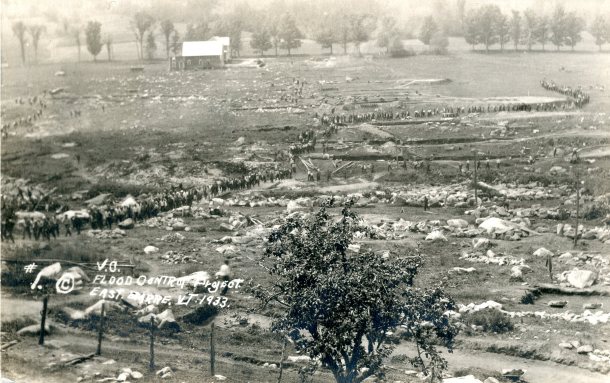
First came dams in East Barre, across the Jail Branch of the Winooski, and at Wrightsville village in Middlesex, across the North Branch. When completed, the East Barre dam was 1,460 feet long and 65 feet tall. The Wrightsville dam was slightly longer (1,525 feet) and nearly twice as tall.
That dam flooded a once-prosperous village, parts of which were in Middlesex, Montpelier and East Montpelier. The community, which was also known as Wrights Mills, owed its existence to an initial mill that Medad Wright had built there in the 1830s. When it became clear that Montpelier needed protection from future floods, the north end of Wrightsville was sacrificed.
The road between Montpelier and Worcester ran through the center of what would become Wrightsville Reservoir. Workers constructed a new road, current-day Route 12, just to the west of the reservoir. Part of the old road north from Montpelier is still visible today. Mill Street branches off Route 12 and dead ends abruptly at the tall, stone-strewn embankment that forms the reservoir’s southern end.
Before construction began in 1933, buildings were either disassembled and reconstructed elsewhere, or salvaged for lumber.
Once the East Barre and Wrightsville projects were completed, workers began construction on the largest of the three CCC dams, this one on the Little River in Waterbury.
Locals remembered seeing several train cars pull into town piled high with wheelbarrows. Since CCC projects were meant to create jobs for as many unemployed people as possible, workers relied more on muscle than machines (though Merrill noted that the CCC in Vermont had more bulldozers than the state highway department).
More than 2,000 men worked on the Waterbury dam, which created the Waterbury Reservoir. When it was completed, it was the largest earth-filled dam east of the Mississippi, measuring nearly 1,845 feet long and standing 187 feet high.
In addition to building the three dams, CCC workers made other flood-control improvements, including rebuilding the old clothespin factory dam in Montpelier and clearing the channel that ran through the gorge at Middlesex village.
Tough test
The Wrightsville and East Barre dams faced their first test in mid-March 1936, when the state was hit with two days of heavy rain. Ice-choked rivers overflowed their banks, flooding roadways and rail lines around the state. Fast-moving floodwaters killed two men — one in Groton, the other in West Windsor. Cellars flooded in St. Johnsbury. Road access to Waterbury was cut off for a day, as the dam there was not yet complete.
Ice jams just below Montpelier caused water to back up and seep into the basements of some downtown businesses. Just north of the city, the water in the Wrightsville dam rose more than 22 feet, flooding a nearby house that was within the flood basin. But the dam did its job.
Without it, officials said, downtown streets would have been flooded with at least 2 feet of water. “The big dams at Wrightsville and East Barre did all that was expected of them, holding back the augmented waters and releasing them in scarcely more than normal volume,” the Bethel Courier reported.
President Roosevelt visited the dams in August 1936. By then, Roosevelt’s critics were often deriding his public works projects as boondoggles. Now the president seized the opportunity to rebut their charges.
Crowing over the recent success of the Wrightsville dam, he told assembled reporters that here “is an excellent illustration of the cooperation between the government and the state in boondoggling!”


