


The decision was just what the country didn’t need. America was already torn by sectional conflict when in 1857 the U.S. Supreme Court issued its now-infamous ruling in the Dred Scott case.
The ruling hardened the positions of both sides in the struggle over slavery and pushed the country closer to civil war. In Vermont, it even triggered passage of a law that directly challenged the court’s decision.
The case gets its name from Dred Scott, an African American man who sued for his freedom after his enslaver moved with him from the slave state of Missouri to parts of the country where the practice was outlawed. Scott argued that he had become free when he was taken into these areas.
But the court ruled 7-2 against Scott, and by extension with the institution of slavery. The majority declared that Scott didn’t even have the constitutional right to file the lawsuit, finding that people of African descent, whether free or enslaved, could not be American citizens.
Furthermore, the court found that, by prohibiting slavery in some parts of the country, Congress had deprived slaveholders of a fundamental right to keep African Americans as property.
The court’s ruling was perhaps not completely surprising: Seven of the nine justices had been appointed by pro-slavery presidents and five were from slaveholding families. Still, the language of the ruling is shocking to read today.
Writing for the majority, Chief Justice Roger Taney made the explicitly racist argument that African Americans were “altogether unfit to associate with the white race, either in social or political relations; and so far inferior that they had no rights that the white man was bound to respect; and that the Negro might justly and lawfully be reduced to slavery for his benefit. He was bought and sold, and treated as an ordinary article of merchandise and traffic, whenever a profit could be made by it.”
The court also ruled that federal laws restricting slavery in certain new western territories were unconstitutional. In doing so, the court destroyed a delicate national compromise about where slavery could and couldn’t expand. Southern slaveholders cheered the decision, while Northern abolitionists condemned it.
The decision helped lead to Abraham Lincoln’s election as president and perhaps made sectional violence inevitable.
Vermont’s ban was only partial
Like people in every state, Vermonters debated the impact of the controversial court ruling. In the midst of this political turmoil, a Baltimore man named J.J. Grindall wrote a letter to Vermont Secretary of State Charles W. Willard, asking an intriguing question: How would the court decision affect the voting rights of Black Vermonters?
This was apparently the same Josiah J. Grindall who would be charged with treason for his role in the Pratt Street Riot of 1861, during which an armed mob blocked and threw paving stones at Massachusetts troops as they were changing trains in Baltimore a week after the start of the Civil War. They were headed to Washington, where they were to help defend the capital. Grindall eventually swore allegiance to the United States and won a pardon from President Lincoln.
We can’t know for certain why Grindall wrote Willard, but he surely knew of Vermont’s reputation for being strongly antislavery. Vermont had been the first state to ban slavery in its constitution, back when it was written in 1777.

Although significant, that ban was only a partial measure. The document contained a significant loophole: It only banned slavery for men over the age of 21 and women over the age of 18. The state constitution also had no mechanism for enforcing the ban on slavery. As a result, historian Harvey Amani Whitfield has found, some people were enslaved in Vermont for several decades into the 1800s.
One of those slaveholders was Lucy Caroline Hitchcock, the daughter of Ethan Allen, who enslaved Lavinia Parker and her son Francis in Burlington until 1841. When Frederick Douglass spoke at an antislavery event in Middlebury in 1843, much of the newspaper coverage was hostile toward the renowned African-American writer and speaker.
Vermonters’ attitudes shifted further against slavery later in the 1840s when some members of Congress tried, unsuccessfully, to ban the practice from any territories the country might take during the Mexican-American War. Events during the 1850s only strengthened Vermonters’ resolve and made the state a leading antislavery force.
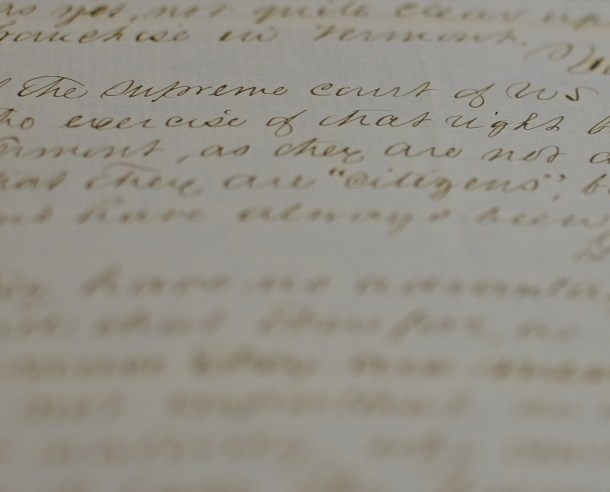
Vermont State Archives holds only one letter written by Grindall in his exchange with Willard, but does not have a copy of how Willard replied. We have a sense of the forcefulness of the secretary of state’s response, however, because of the follow-up letter Grindall wrote to Willard: “You say that the late decision of the Supreme Court of the U.S. can have no bearing upon the exercise of that (voting) right by the coloured citizens of Vermont, as they are not allowed to vote (simply) on the ground that they are ‘citizens,’ but because they are men, and have always been treated as such.”
Vermont strengthens its stand
In response to the Dred Scott decision, Vermont legislators reaffirmed the rights of African-Americans by passing an Act to Secure Freedom to All Persons Within this State. The 1858 law stated that: “Neither descent, near or remote, from an African whether such African is or may have been a slave or not, nor color of skin or complexion, shall disqualify any person from being, or prevent any person from becoming, a citizen of this state, nor deprive such person of the rights and privileges thereof.”
Moreover, anyone caught trying to enslave someone within Vermont, on the pretense that this person had been or was still enslaved, was subject to one to 15 years in prison and a fine of up to $2,000.
The Legislature left no doubt that the act was a response to the Dred Scott decision when it declared that any enslaved person who reached Vermont “with or without the consent of his or her master or mistress … shall be free.” The Legislature was affirming that Vermont would protect people fleeing slavery.

The next year, 1859, Vermont abolitionists continued their assault on slavery, this time by attacking a section of the U.S. Constitution that gave Southerners disproportionate power in presidential elections. Abolitionists wanted to block the election of a Southern president who would support slavery by taking such actions as appointing Supreme Court justices like those who ruled in the Dred Scott case.
The way to weaken the South’s political power was to abolish the Electoral College, the system by which electors from each state select the president. The number of electors each state possesses was intended to be roughly proportional to its population. But ever since the nation’s founding, the system had given Southern states disproportionate power because of the way enslaved people were counted.
Although enslaved people could not vote, and according to the Supreme Court could never become citizens, the “3/5ths rule” in the Constitution said they did count as 3/5ths of a person when it came time to assign Electoral College delegates, as well as representation in Congress. The 3/5ths rule was part of a compromise hammered out in 1787 at the Constitutional Convention. Without it, slave holders like Thomas Jefferson probably could never have been elected president. With it, Southerners held the presidency for 49 of 61 years between George Washington’s election and 1850.
Vermont abolitionists felt so strongly that they were even willing to part with the advantage the Electoral College gave to small states such as their own, guaranteeing them a number of electors that outweighed their share of the national population. In place of the Electoral College, abolitionists in Vermont and elsewhere pushed to institute the direct election of the president. In other words, whoever won the popular vote would win the election. The effort failed.
No amount of legal wrangling or political activity was able to settle the issues raised by the Dred Scott decision and the existence of the 3/5s rule. Those issues weren’t resolved until, in the wake of the Civil War, the states ratified the 13th, 14th and 15th Amendments. Among other things, the amendments banned slavery, granted citizenship to anyone born or naturalized in the United States, thereby overturning the Dred Scott decision, and prohibited governments from denying the right to vote for adult males based on race or past enslavement.
Together, those amendments rewrote the U.S. Constitution to say what Vermont legislators had already reaffirmed in 1858 by passing the Act to Secure Freedom to All Persons: that Black people had the same legal rights as white people.
But amending the Constitution and passing laws is one thing, and guaranteeing those rights is quite another, as the nation has discovered ever since. As for the Electoral College, that’s still with us, and it remains controversial.
