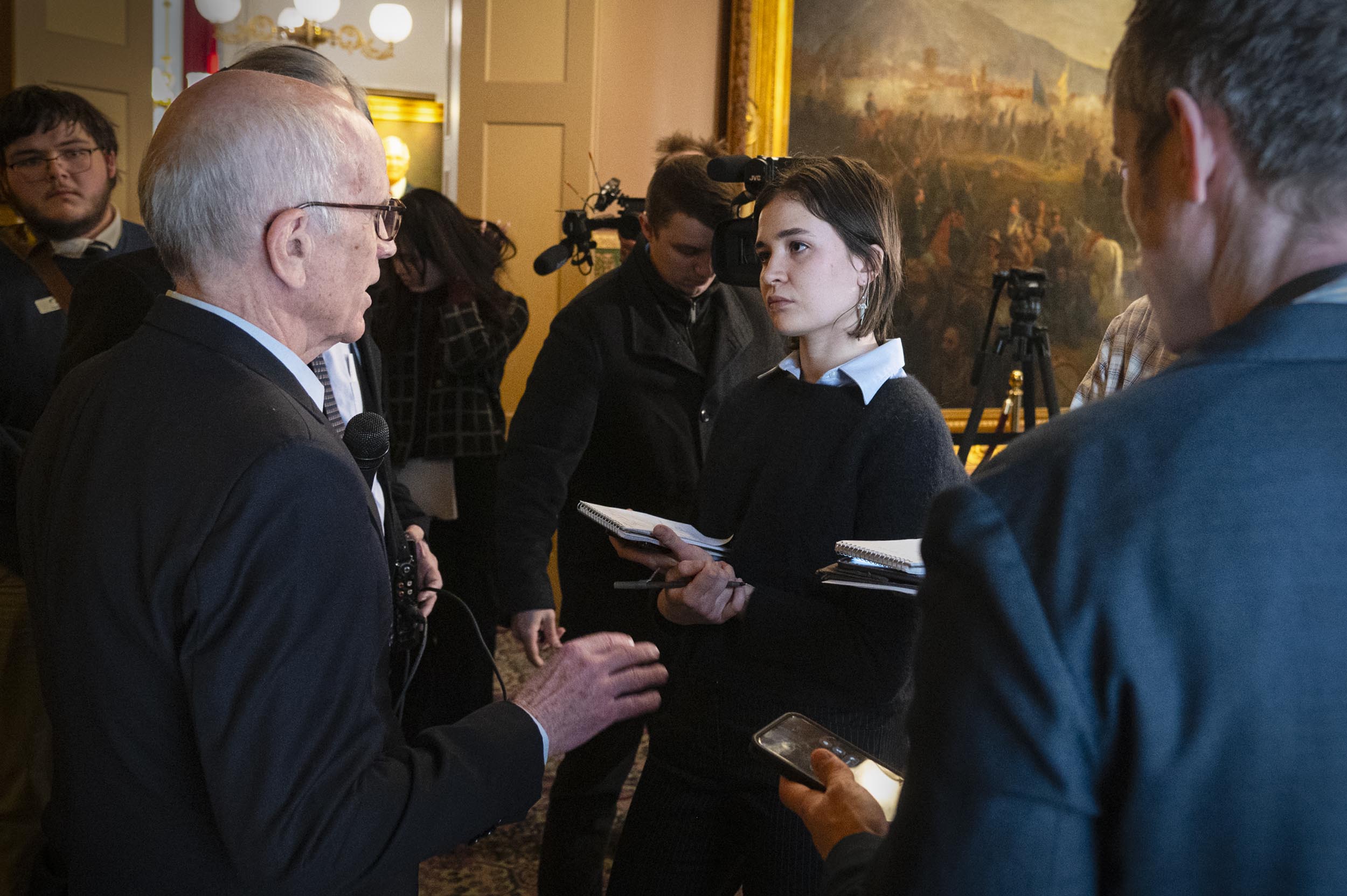

Facing pressure to take action on Vermont’s coronavirus spread fueled by the contagious Delta variant, Republican Gov. Phil Scott took aim at other states in the country that have responded to mounting caseloads by reinstating indoor mask mandates.
“There’s seven states across the country that still have a state of emergency and mask mandate,” he said at a news conference Tuesday. “Their data doesn’t look any different than ours; in fact it’s worse than ours. So their mitigation measures haven’t worked.”
Scott’s statements have drawn backlash from both medical experts and officials from states that have masking orders in place.
The governor’s remarks were “incredibly irresponsible,” said Anne Hoen, an associate professor of epidemiology at Dartmouth’s Geisel School of Medicine. The scientific evidence does indicate that masks work to slow the virus’s spread, she said, and mask mandates make more people likely to use facial coverings.
“For someone who has promoted his policy as being grounded in science and data, it is so disappointing to hear him make the conclusion that mask mandates are not effective, a statement that has no scientific basis,” Hoen wrote in an email to VTDigger.
Joshua Santarpia, an associate professor of pathology and microbiology at the University of Nebraska Medical Center, called the governor’s argument “bizarre.”
The states cited by Scott may indeed have similar or worse hospitalization and death rates than Vermont. But that’s not a meaningful comparison — plenty of factors, including vaccination rates, contribute to viral spread and its outcomes. The question is how much worse those states would be without mask mandates in place, he said, and plenty of studies show mask mandates reduce overall transmission.
“I don’t understand why people continue to fight this. I mean, I get it. I don’t want to wear a mask either. But I do,” said Santarpia, whose research focuses on aerosol transmission of different diseases.
The seven states with current mask mandates are Hawaii, Illinois, Louisiana, Nevada, New Mexico, Oregon and Washington, where most people are required to wear masks in indoor public places, regardless of their vaccination statuses.
Anne Sosin, a policy fellow at Dartmouth’s Nelson A. Rockefeller Center, notes that right now, some of those seven states actually have slightly lower case rates than Vermont. So does San Francisco, a heavily vaccinated city, which also imposed a mask mandate.
But Sosin cautions it’s an overreach to simply look at case rates, hospitalizations and deaths in localities with and without mask mandates and to make causal assumptions in either direction. Multiple factors impact transmission.
“Eyeballing states, which are at different places and their epidemics, we just can’t do that,” she said. Instead, Sosin says to look at peer-reviewed studies — which consistently show, across several settings, including schools, that mask policies make a difference.
Jan Carney, the associate dean for public health at UVM’s Larner College of Medicine, who has previously said she supports a short-term mask mandate, agreed it’s challenging to compare current outcomes across states based simply on whether they have a mandate in place.
“They differ in one or more factors that will also influence their Covid-19 infection burden, such as differences in vaccination rates, which is our primary prevention strategy. As an example, Louisiana has only 52% of the population fully vaccinated,” Carney wrote.
Jason Maulucci, a spokesperson for the governor’s office, defended Scott’s comments, noting that many studies on mask mandates predate widespread vaccination. And despite dropping its mask mandate, Vermont has maintained among the lowest — if not the lowest — hospitalization and death rates in the nation throughout the Delta surge.
And he cast doubt, as many on the governor’s team have in recent days, on the idea that a mandate would substantially affect mask usage, especially where it matters most. Evidence from contact tracing suggests most transmission is occurring in private settings and workplaces, not public places like grocery stores, retail shops and gas stations, Maulucci said.
Maulucci added that private employers “have every right” to require their employees to be masked. (Local governments also can require municipal employees to be masked. However, they cannot impose broader mandates within their borders without approval from the state. Scott struck down a mask mandate in Brattleboro earlier this summer.)
“This is a reality the governor’s critics are failing to consider, and — frankly — are misleading the public by positioning a mask mandate as a standalone silver bullet to slowing transmission,” Maulucci wrote.
Pam Berenbaum, director of the Global Health Program at Middlebury College, said she didn’t exactly agree with the governor’s statement about the states with mandates in place. But she’s sympathetic to the larger argument that a mandate is being cast as a “silver bullet,” and skeptical that it would actually substantially improve use.
“To say: ‘Well, our transmission is high, so we should have a mask mandate’ is too oversimplified. And I think we need an endpoint,” she said.
Asked by VTDigger to respond to Scott’s statements on Tuesday, several of those states’ health departments and governors’ offices stood by their states’ respective policies.
In Oregon, where a mask mandate was reinstated in late August, Health Authority spokesperson Robb Cowie noted that a decrease in cases had followed the state’s decision to reimpose masking requirements.
“Mask-wearing has played a significant role in containing the spread of the SARS-CoV-2 virus,” he wrote.
“If there’s anything we’ve learned in the pandemic, it’s that masking combined with vaccination reduces the spread of the Covid-19 virus. Period,” said David Morgan, a spokesperson for the New Mexico Department of Health.
“The number of serious illnesses and deaths in our state would have been higher had we not taken action as early as we did to require masking,” he said.
Clarification: This story has been updated to clarify the powers of municipalities to require the use of masks.