

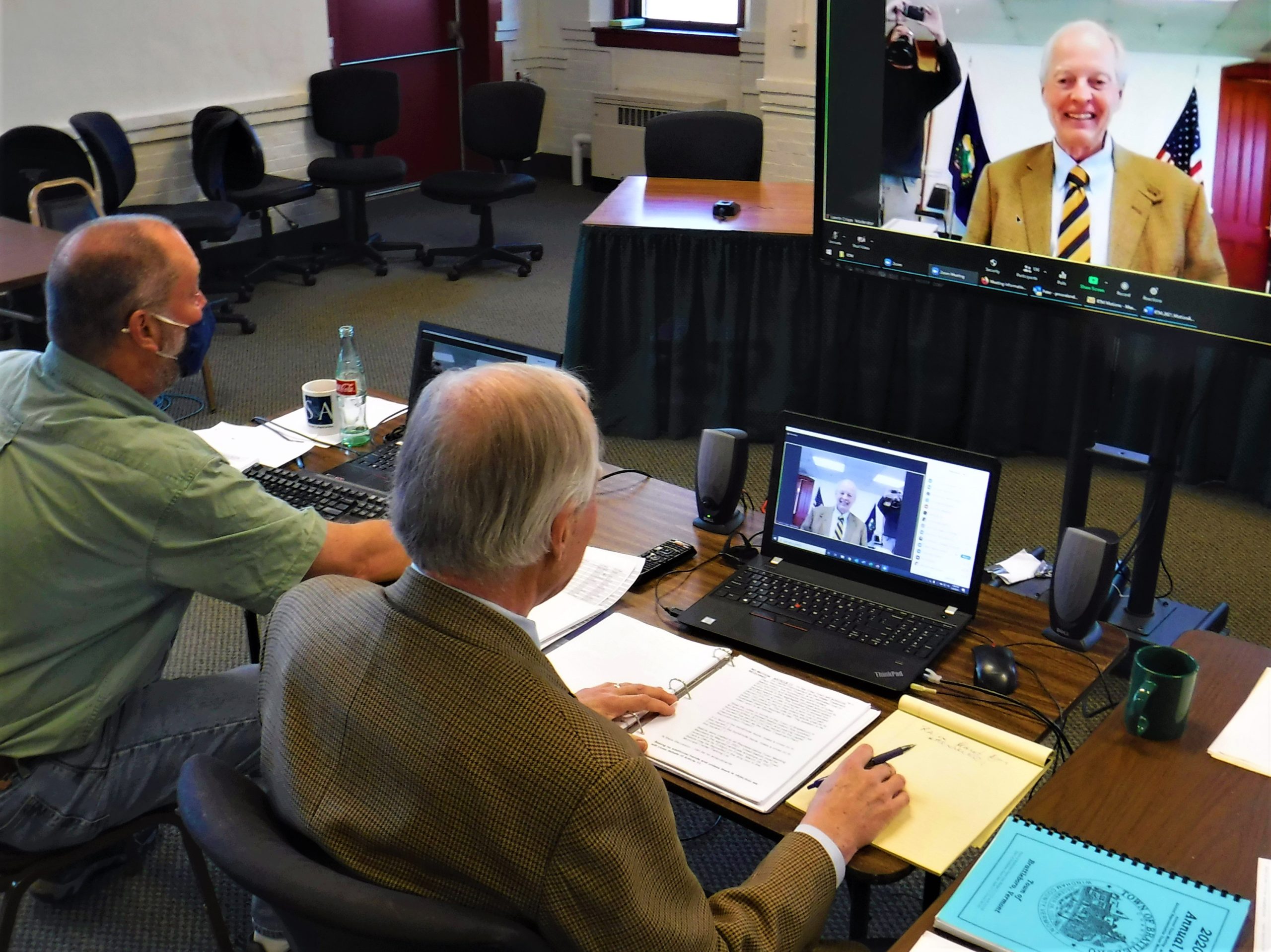
As Covid-19 continues to shift, some local governments plan to keep conducting hybrid meetings — the kind where people can attend in person or virtually — but others say they will revert to in-person meetings, according to Ted Brady, executive director of the Vermont League of Cities and Towns.
Under state law, communities have to provide an in-person meeting place for public participation, although they may also have a virtual option, according to Secretary of State Jim Condos.
Although the evidence is largely anecdotal, many town leaders say the opportunity for virtual meetings has drawn more residents to government proceedings than usual, while in-person meetings are favored by less tech-savvy residents.
The virtual option has definitely increased access, Brady said, but there is no data showing it increased statewide participation in local government.
“It’s not a magic bullet,” he said.
And now, as towns choose between in-person-only meetings or a combination of in-person and virtual meetings, “there is no clear connective tissue as to why one group of towns is sticking with hybrid and another is going to in person,” Brady said. “If there is a selectboard chair that doesn’t like using technology, then they might want to do it in person. That’s the neat thing about local government. It’s influenced heavily by the personalities of the local leaders.”
In Jericho, the opportunity to attend meetings virtually has brought in new participation, said Wayne Howe, who’s been on the Jericho Selectboard for five years.
“We’re bringing in new people and, if you’ve ever been to these meetings, we’re desperate for people to participate. So if we’re getting even a few more people, that’s great,” Howe said.
However, in the depths of the pandemic, the move to virtual meetings deterred some older people in Jericho.
“It’s made it hard on the oldest people, of which I’m almost in that crowd,” Howe said. “It’s just too much effort and too difficult to use Zoom.”
But with the either-or choice, Jericho residents can choose whether to head to the town hall for a meeting conducted the old-fashioned way or call them up on their computers.
To improve the quality of virtual meetings, Jericho has invested in things such as new microphones, a new camera and a speaker system.
Brady said communities are making their own decisions, based on their sense of what residents prefer.
“What we’re finding is that some towns really like hybrid and the additional access it provides. Others are finding it hard to balance the needs of board members and the public with hybrid, so they are going to in-person,” Brady said, although he could not think of any specific towns that have decided to return fully to in-person meetings.
The Vermont League of Cities and Towns has issued an extensive toolkit for holding hybrid meetings, outlining how to best hold a hybrid meeting to make sure that in-person and virtual participants have the best possible experience.
“We’re not recommending one way or another,” Brady said. “But we are saying that hybrid meetings can be effective, so we are trying to put as many tools forward as possible for both formats.”
Brady said that ultimately, when an issue is really important to people, they will find a way to have their voice heard.
“If it’s a selectboard or planning board meeting, people will find a way to show up if it’s hybrid, in person or remote,” Brady said, “if there is a really particular issue that they care about.”

