

Editor’s note: Douglas Phinney is a reporter with Community News Service, a collaboration with the University of Vermont’s Reporting & Documentary Storytelling program.
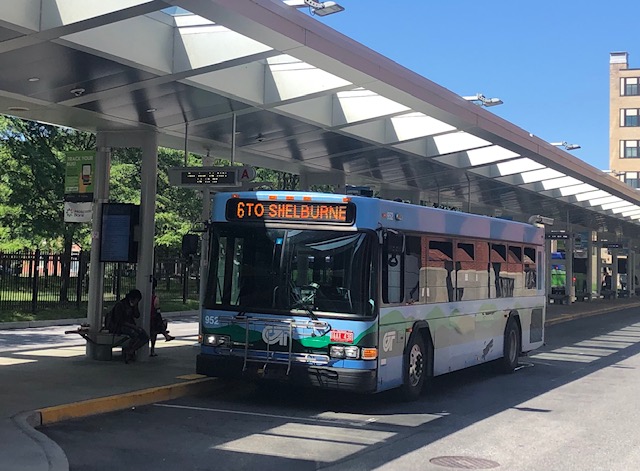
Bus drivers from Green Mountain Transit’s Urban service could be headed toward a strike in the fall if negotiations fail to produce a new contract.
The urban drivers are responsible for covering routes in Chittenden County, including Williston, which is by far the busiest service area covered by GMT. The Teamsters Local 597 union voted to authorize a strike July 11, and it comes after months of failed negotiations between the union and GMT management.
On its own, the strike vote in early July does not guarantee an actual work stoppage is imminent. According to union members and GMT management, this is one of the first steps in a process that, at earliest, would lead to an actual strike sometime in the fall.
“There was a strike authorization. The company and the Teamsters local 597 are still actively negotiating for a new labor contract, we have some mediation sessions scheduled for August, there may be additional negotiation sessions before,” says GMT General Manager Jon Moore.
The previous contract between GMT and their drivers officially expired June 30. According to Curtis Clough, recording secretary for Teamsters Local 597 and one of the members responsible for handling negotiations on behalf of the union, the union started reaching out to GMT in March of this year to begin negotiations for the new contract.
Drivers essentially wanted to maintain the existing contract that they had with GMT, with just a slight wage increase, union members said. The final offer the drivers rejected from GMT included a 7.5% rise in wages over three years.
But, as Clough explained, with inflation being higher than usual — over 5% so far this year — this number is not as high as it may seem.
“So that [7.5%] wasn’t looking really good to the drivers with the way inflation has been going,” said Clough. “We actually made an offer to the company, the first thing after we negotiated ground rules, to just leave the rest of the contract the same and only negotiate on wages.”
Workers say they were largely happy with their previous contract.
“People said it was the best that this place has ever seen. People were happy, people were coming to work. Now, people could care less right now,” says GMT driver Rob Slingerland.
GMT management rejected this initial offer from the union, and the union balked at management’s counter offer.
Slingerland said that the contract the drivers had been working under included what he considered to be fair compensation and time-off benefits.
New offers from management seemed to be stripping away at those benefits, Slingerland said, in part by putting a cap on lifetime hours of paid time off that can be accumulated by workers, and also by the 7.5% pay increase during a year when inflation was over 5%.
These months of failed negotiations ultimately culminated in the union voting to authorize a strike. The strike vote passed 47-3 in July.

Since this vote was taken, GMT management have agreed to meet at least twice more with the union, this time with a mediator present, per the union’s request. These meetings are scheduled for Aug. 24 and 25, and the results could ultimately determine whether a strike occurs.
So far, union members say the public, and regular passengers, have been receptive to the news of a potential strike, much as they were the last time the drivers went on strike in 2014.
“I haven’t had one negative comment from a passenger,” says Slingerland.
“[The public] know we’re not out there looking to get rich driving a bus, you know what I mean. We just want a fair contract, you know, a competitive wage, and to let us do our jobs. But that doesn’t seem to be the way with Mr. Moore, so here we are,” says Slingerland.
For their part, GMT management say they are willing to continue negotiating with the drivers. Moore said that he felt the company’s offers so far have been fair.
“We do offer what we would consider very generous time-off benefits,” says Moore.
According to Moore, the company provides up to 10 weeks of paid time off per year.
Moore says that the average compensation package for the Burlington area drivers is competitive, and that management is offering to increase those wages.
“We are proposing to implement a cap of how many lifetime hours can be banked, partially to promote the use of the time-off benefits,” so people can create stronger work-life balance, says Moore.
Union members say they’d rather keep working under a good contract than strike, but will follow through if they feel it’s necessary.
“The drivers, they don’t want to strike. But if we have to, we will,” says GMT driver and union steward Farhan Ahmed.
Fare moratorium to continue
GMT has offered fare-free service throughout the Covid-19 pandemic, and plans to continue it at least through the end of the next fiscal year, according to Moore.
Both GMT management and Teamsters Local 597 are supportive of the fare-free service. This service is made possible through a combination of outside funding, including from the state.
“In our rural service areas of Franklin and Washington counties, the state of Vermont has actually provided the fare replacement,” said Moore.
GMT has been able to use Covid relief funds to fund the fare-free service in the much busier Chittenden county area, which according to Moore, the state was unable to do.
Neither GMT management or Teamsters Local 597 say that the free bus service has an impact on contract negotiations.
Correction: The final offer the drivers rejected from GMT included a 7.5% rise in wages over three years. An earlier version of this story misstated the proposal.
