

Charles Fairbanks never forgot the moment when word of war came to his family’s farm in Bethel.
“I remember that my brother John was milking one of the cows on the eve of April 12, 1861, when we heard the news of the fall of Fort Sumter,” Fairbanks wrote nearly four decades later. “He did not finish milking the cow, but started for the nearest recruiting station where he, together with my brother Luke, enlisted.”
The image of the half-milked cow and the young men running off to the Civil War comes at the start of Fairbanks’ memoir. Fairbanks, 15 at the time, wanted to go with his brothers and begged his father, Lorenzo, to let him enlist as a drummer boy. But his father refused, saying Charles was too young.
As Fairbanks later remembered that day, his father wanted to finish haying and walked off with a scythe slung over his back. Charles and his 18-year-old brother, Alfred, trailed behind.
“Instead of following him,” Fairbanks wrote, “Alf and I took a turn around the hill and left our scythes in the bushes and ran as fast as we could go to Bethel village.” There, they found the local recruiting office, where Charles was again informed he was too young.
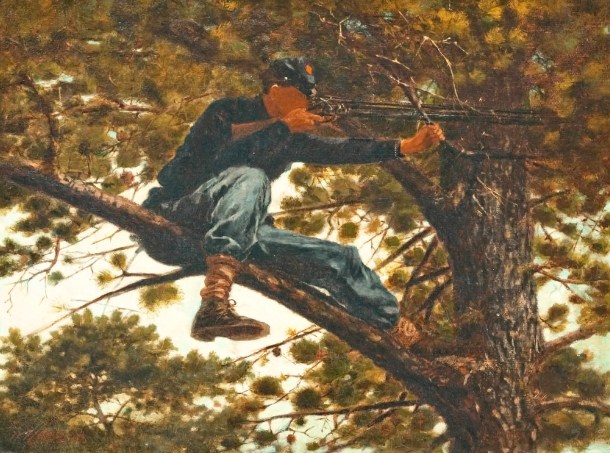
But he also learned that the recruiter was looking for sharpshooters. “(A)s each of us was born with a gun in his hands, we decided to try to enlist,” he wrote. Put 10 shots out of 10 through a 10-inch ring from a distance of 100 yards, they were told, and they were in.
Fairbanks’ confidence proved well founded. Both he and his brother were accepted, but because he was so young, Charles still had to persuade his father to give his permission in writing. He returned to the farm and found his father resting in the hayfield. Charles asked him to sign the paperwork, but told him that he would run away anyway if he didn’t. So, Lorenzo Fairbanks with “trembling hand signed the death warrant, as he called it.”
Charles Fairbanks was one of 34,238 Vermonters to serve in the Civil War but one of the few to write a memoir of his experiences. He did so in 1899 at his daughter’s urging. He printed a few copies of the slender volume and presumably gave them to friends and family.
A copy ended up at the Bethel Historical Society, where Janet Hayward Burnham found it. She and her husband, George, decided the memoir was worth reprinting. They republished Fairbanks’ “Notes of Army and Prison Life 1862-1865” in 2004, and also created an audio CD of a condensed version of the book read by Vermont Civil War historian Howard Coffin.
Fairbanks’ memoir details the grueling, often frightening and occasionally joyous moments of his service, which spanned most of the war. He describes marching through Harper’s Ferry, West Virginia, site of John Brown’s failed effort to arm a slave uprising, and the troops singing “John Brown’s Body” as they marched; feeling the exhaustion of carrying his rifle, 60 rounds of cartridges, a woolen blanket and tent while marching long miles; suffering through a bout of jaundice; and experiencing delight and fear upon visiting his brothers Luke and John just before an assault.
For months, Fairbanks and his brother Alf marched through the cold and mud of Virginia. Alf eventually contracted what a doctor diagnosed as typhoid pneumonia and was taken off active duty. Alf, Fairbanks wrote, never really regained his health but never regretted his service. Fighting at the second battle of Fredericksburg, their brother John was shot in the neck, a wound doctors suspected would prove fatal.

In 1863, Fairbanks’ unit pursued the army of Gen. Robert E. Lee as it crossed into Pennsylvania. Marching quickly in hot, dry weather, Fairbanks and his fellow soldiers soon outdistanced their baggage train. Marching 32 miles without rations, they reached the battlefield at 8:30 p.m. on July 1, the first day of the Battle of Gettysburg. Waking the next morning, July 2, Fairbanks still had no rations. In desperation, he boiled the bag in which he had carried his coffee and created a “high colored but not palatable cup of coffee.”
At 2:30 p.m., a group of sharpshooters, including Fairbanks, was ordered to advance in hopes of drawing out the Confederates, whose position was hidden. After advancing several hundred yards, Fairbanks’ unit was overrun by Confederates. He and others were captured and taken to the rear, near Lee’s headquarters.
Sitting in the darkness that night and listening to the groans of injured and dying men “made the night more dreadful than any I have ever experienced,” he wrote.
The next morning, he witnessed Gen. George Pickett’s division prepare for its now-famous charge. “In less than an hour after that, they were engaged in one of the most deadly conflicts of that or any other war,” Fairbanks reported. More than 1,100 Confederate soldiers were killed in the assault.
At about 2 p.m. on July 4, Fairbanks and the other prisoners were marched from the battlefield by the retreating Confederates. Desperate for food, Fairbanks traded his shoes for some corncakes.
During the march, the retreating column passed through the Union town of Martinsburg, West Virginia. It was, Fairbanks wrote, “without exception the most patriotic place I ever saw. The whole population were out and bade us have good cheer as the Stars and Stripes were following us, not far in the rear.” Women in town cut and buttered baskets of bread and put them by the road to be handed to passing prisoners.
Fearing a food riot, Confederate officers told townspeople that the prisoners would be camping just outside town and they could bring food there.
“(Marching) 200 miles over a turnpike road, through rain and shine, for 14 days barefoot was an experience which I hope no one will ever be called upon to endure,” he wrote. Fairbanks soon found himself imprisoned on Belle Island in Virginia with 4,000 others in a 4-acre field surrounded by earthworks.
The prisoners had few tents so most were constantly exposed to the elements. They died in droves. Each day, Fairbanks reported, a trench was dug along the edge of the camp and “each morning a score or more of the brave lads were laid to rest with no more ceremony than the work required to cover up the naked forms.”
Fairbanks suffered scurvy. His skin swelled and cracked at the joints. Confederate doctors listed him among those not expected to live. But, he wrote, “I did not give up or weaken in mind as I felt sure that to give up was death.”
On Sept. 28, 1863, word came that 186 of the sickest men would be paroled. “My heart almost stopped its action when the thought came, ‘What if I am left behind this time?’” As the names were read aloud, two men helped Fairbanks stand. A man nearby kept track of the number of names called.
“(A)s the number increased and my name was not called, I began to grow weak. When 180 had been called, 181, 182, (183) and I knew there were only three more, I heard my name and that was the last I knew until we reached City Point, where I heard faint cheers from the men and while being carried on a stretcher I saw the Stars and Stripes floating from the mast of a steamer.”
But Fairbanks’ war experiences weren’t over. He was nursed back to health — he was down to 96 pounds, having weighed 145 when captured — and to his surprise and relief was reunited with his brother John, who had survived his wound.
After visiting home for about 40 days, Fairbanks asked to be returned to the front, where he served until shortly after Lee’s surrender. “It was a happy day …” he wrote. “Hats were thrown high in the air and it did not matter whether they came down or not.”

