



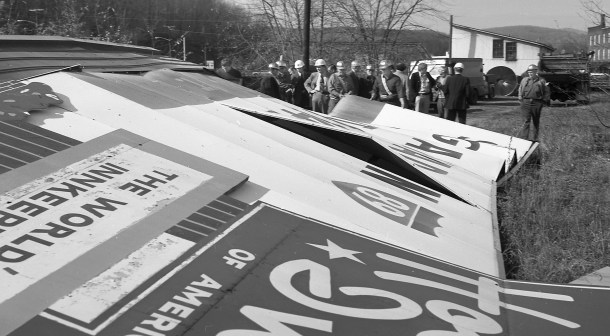
The Vermont environmental movement owes a debt to Ted Riehle, which might seem a little odd given today’s political landscape. Riehle was a Republican, which meant something different when he joined the Vermont House in the late 1960s. Riehle was also quite wealthy, owning a Lake Champlain island, complete with private landing strip.
Riehle might not fit our current image of an environmentalist, but when he joined the Legislature in 1965, he was fired up about an environmental issue. Riehle wanted to rid Vermont of what he regarded as a blight on the landscape: the hundreds of billboards that lined the state’s roadsides. It was an ambitious undertaking, particularly for a freshman lawmaker. Perhaps Riehle was new enough to politics that he didn’t realize the challenges he faced.

The debate over billboards wasn’t new. During the early decades of the 20th century, as American culture became increasingly car-centric, businesses hit upon roadside advertisements as a way to connect with potential customers, particularly tourists. Writer Vrest Orton railed against the negative effects of Vermont’s tourism boom. He took aim at “national advertisers, who have an urge to plaster all the roads retaining the least vestige of adjacent beauty with massive, gaudy and hideous sign-boards, so that it might truly be said, ‘Behind the signboard lies Vermont.’”
By 1936, roughly 750 full-sized billboards and thousands of smaller advertising signs lined the state’s roadsides. Seven of those billboards were in Springfield and drew the ire of a group of residents who fought to have them removed. Using petitions, posters, handbills and threats of boycotts against advertisers, the group managed to have the billboards taken down.
The Springfield drive grew into a statewide effort known as the Vermont Association for Billboard Restriction. The Rotary Club, the Grange and the Daughters of the American Revolution, some of the most influential social institutions of the era, protested what they saw as a commercial infringement on the public’s right to view the landscape. They also argued that billboards were dangerous distractions for drivers.
Renowned journalist Dorothy Thompson, a part-time resident of Barnard, summarized the anti-billboard arguments in a letter to the Rutland Herald in 1937: “If aesthetic considerations do not move us, let us consider the matter from the standpoint of cold cash. Vermont has beauty to sell. Thousands and thousands of tourists come here every summer, for no other reason than that Vermont is lovely. They can see billboards from Connecticut to California. The absence of them is a positive asset.”
The debate over billboards quickly became a question of natives versus out-of-staters, according to scholar Blake Harrison in his 2006 book, “The View From Vermont: Tourism and the Making of an American Rural Landscape.” Opponents called out-of-state billboard companies parasites, arguing that they were destroying the beauty of the state for their own profit. Vermont businesses that advertised on the signs were also criticized for putting their financial interests before the interests of the state. Vermont must be left “unspoiled,” billboard opponents argued. Doing so made economic sense, they said, since tourists visited the state to see its beauty, not its billboards.
Billboard supporters, mainly advertisers and billboard companies, noted that opponents also relied on out-of-state support, in this case coming from tourists and part-time residents, like Thompson. Weren’t billboard opponents putting the interests of people who could afford to travel above the interests of Vermont business people trying to make a living? Besides, billboards sometimes provided tourists with useful information, they argued. Without the signs, tourists wouldn’t be able to find their destinations.
The Vermont State Chamber of Commerce found itself stuck between competing business interests, but it ended up opposing billboards. Tourism in Vermont was unmistakably on the rise during the 1930s, and the chamber took the position that removing the billboards would benefit the state’s economy, its residents and its visitors.
The Legislature tried to find a compromise. Rep. Horace Brown, of Springfield, successfully championed a bill in 1939 that, while keeping billboards legal, limited their size and location. The closer to the road a sign was, the smaller it had to be. The law was challenged, but the Vermont Supreme Court found that property owners had no inherent right to place signs on land adjacent to public roadways.
After the law’s passage, the number of roadside signs fell roughly 50 percent between 1938 and 1943, but hundreds of billboards still lined the state’s roadsides. Legislative efforts to further curb billboards continued through the ’40s, ’50s and ’60s, but to no effect, until Ted Riehle took up the issue.
Riehle, who represented South Burlington, told state Sen. Jim Jeffords that he planned to introduce a bill banning billboards. Jeffords replied that if Riehle could get the bill through the House, then he would work to get it through the Senate. Riehle rallied support the old-fashioned way. This being an era when politicians and the press socialized freely, Riehle hosted parties at his Montpelier apartment for legislators and journalists, and may have won some over at these gatherings.
The billboard industry hired lobbyists to fight the proposed ban. But, as historian Michael Sherman writes in “Vermont State Government Since 1965,” “The press dragged the lobbyists and, by implication, their legislative friends out of the comfortable, dark recesses of the State House and made them fair game for front-page exposure.”

Billboard opponents found lighthearted ways to make their case. They popularized a poem riffing on a famous bit of verse by Ogden Nash:
“I think I shall never see,
A billboard as lovely as a tree.
Perhaps unless the billboards fall,
I shall never see a tree at all.”
The issue remained hot during the 1968 session. Billboard companies and advertisers labeled efforts to ban the signs “communist.” Who was going to compensate them for removing the signs and giving up this inexpensive means of advertising, they asked. And what about all the lost and confused tourists if there were no signs to direct them?
Riehle and other billboard opponents suggested a compromise. The bill would phase out off-premises billboards over the next five years and would strictly regulate the size, location and lighting of on-premises signs, but the state would pay to post more discreet signs for local businesses. The bill passed both chambers with strong Republican support and was signed into law by Gov. Phil Hoff, though many of his fellow Democrats failed to support the legislation.
Vermont became the first state in the continental United States to ban billboards. Hawaii prohibited the advertising signs back in the 1920s. Maine and Alaska are the only other states to outlaw billboards.
Over the first five years after the law took effect, billboards disappeared and Vermont began again to look much as it had in the days before the car. Over the next decade, the Legislature passed a series of laws aimed at further preserving Vermont’s environment — dealing with a serious litter problem with the bottle bill, rampant ill-conceived building projects with a development review law, and polluted rivers and streams with tighter regulations. Advocates of the billboard law had made the case that scenic beauty is essential to both Vermont’s identity and its economy.
