


History would have been better off without Thomas Anburey. I don’t mean that as a personal attack. I never met Anburey; nor has anyone alive. The man died a couple of centuries ago. What I mean is that the study of the past would have been better off if Anburey had never picked up a pen, or rather a quill.
Anburey’s “contribution” to history was to write an account that muddied the facts surrounding the Battle of Hubbardton during the Revolution, and then to drag the reputation of American troops who fought there through that mud. Anburey’s errors in describing the battle would be comical if others hadn’t taken them as facts and tracked them through the historical record.
Vermont historian Ennis Duling has tried to clean up Anburey’s mess. He wrote about Anburey and his account of the battle in an intriguing essay for Vermont History, the journal of the Vermont Historical Society, in 2010.
Anburey, who said he served under British Gen. John Burgoyne during his ultimately failed campaign in New England and New York, makes mistakes of chronology and geography, and, more seriously, adds details that defame the abilities and honor of American troops who fought at Hubbardton.
The battle occurred on July 7, 1777, as the Americans were trying to fend off a British invasion from Canada. The British had just recaptured Fort Ticonderoga on the New York shore of Lake Champlain and then seized Mount Independence on the Vermont shore. The British then turned their attention to crushing the fleeing American forces.
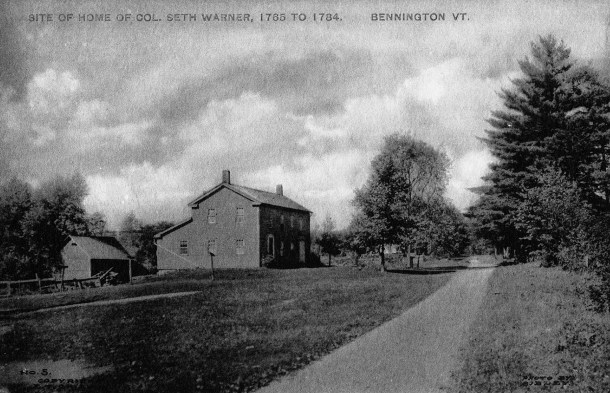
Col. Seth Warner, leader of the Green Mountain Continental Rangers, commanded about 1,100 soldiers fighting a rearguard action to give the bulk of Americans forces time to retreat. At Hubbardton, Warner lost roughly 40 men killed, 100 wounded and more than 200 captured, but his men enabled the army to survive to fight another day.
Those troops would help harry Burgoyne’s forces at the Battle of Bennington a month later. (Despite its name, the Battle of Bennington was actually fought in New York; the British had hoped to attack Bennington, thus the name. Hubbardton was the only Revolutionary War battle fought in Vermont.) Burgoyne ultimately had to surrender his entire army at Saratoga that October.

But let’s get back to Hubbardton. In his account, Anburey invented the notion that Warner failed to post sentries on the night before the battle — a major breach of basic battlefield tactics — and accused American soldiers of feigning surrender before suddenly raising their muskets and firing into a group of stunned British troops. Though Anburey was discredited by some of his contemporaries, some present-day historians still mistakenly include his invented details in describing the battle.
Among the many suspicious things that Duling found in Anburey’s account, which appeared in his book “Travels Through the Interior Parts of America,” is the very circumstances under which it was supposedly written. Anburey passed himself off as an eyewitness, and a miraculous one at that. Duling noted that at times Anburey managed to be in two places at once.
Anburey claimed that his accounts were originally written shortly after the battle as letters to an unnamed recipient, who he addressed simply as “my dear friend.” The letters mixed detailed descriptions with thoughtful reflection on events, just as a gifted letter writer would.
Anburey explained that starting in September 1776, he traveled through Canada, sailed down Lake Champlain as part of Burgoyne’s invasion force, and fought at Hubbardton, before being taken prisoner during the British defeat at Saratoga. He wrote that later he was able to see the country as far south as Virginia.
Anburey published his accounts in two volumes in London in 1789. On the face of it, the timing would have made sense. Here was a veteran returning home and, at the request of friends and acquaintances, taking the time to organize his correspondence into book form.
The upper reaches of British society certainly bought it. Anburey’s 600 subscribers included military officers, ladies and at least one earl. Even Burgoyne, leader of the British invasion, was among his subscribers.
But parts of the book must have seemed awfully familiar to Burgoyne. Anburey had borrowed and slightly rewritten entire sections of Burgoyne’s memoirs. Anburey also plagiarized mercilessly from numerous other works. As Duling explained: “Anburey’s borrowings were wholesale; this was not petty theft, but grand larceny.”
From the start, some people had doubts about Anburey’s accounts. The Monthly Review, a literary journal in London, said the author’s take on events were distinctly anti-American, and noted that one of the passages had been lifted from another work.
That was just the start. Another English publication, The Critical Review, found more purloined prose and stated that “we can pronounce this work, in its most essential parts, to be an ill-digested plagiarism from general Burgoyne’s Narrative” and from other contemporary sources. That Anburey’s plagiarism was caught so quickly suggests just how blatant his copying must have been.
Despite his excuses that they were “the rapid effusions of a confessedly inexperienced Writer,” Anburey’s brazen borrowing helps prove that he didn’t write the letters during the period they describe. Indeed, works from which Anburey plagiarized were written as late as 1787.
In further nailing down the case against Anburey, Duling notes that his numerous plagiarisms of other earlier works couldn’t have been done on the battlefield either, unless we imagine Anburey lugging a considerable library as he trekked with the British army through the wilderness and later when he was a prisoner of war.
Duling might have left Anburey alone if his account had remained obscure. Unfortunately, a number of his fabrications have been picked up as fact, even by some noted historians, and repeated. Once a lie gets into the historical records, it can be hard to remove.
Anburey’s description of a mad scramble by British grenadiers at Hubbardton up a life-threateningly steep incline has left historians scratching their heads. Pittsford Ridge, which Burgoyne mentioned in his narrative, isn’t as steep as it appears from a distance, Duling noted, and certainly not dangerous to climb. Hoffman Nickerson, a historian writing about the battle in 1928, surveyed the scene and decided that Anburey must have meant that the troops had climbed nearby Mount Zion. Nickerson’s theory, which according to Duling makes no military or geographical sense, has become part of the battle narrative.
Worse, historians continue to repeat Anburey’s mistaken claim that Warner failed to post pickets the night before the battle, which has unfairly tarnished Warner’s reputation ever since.
Perhaps worst of all is Anburey’s claim that American troops slaughtered British soldiers after pretending to surrender. Duling found it inconceivable that, in the heat of a fierce battle, a large group of troops could have hatched the scheme and that the experienced British troops toward whom they marched would have fallen for it.
Anburey’s work isn’t without charm, however. Duling referred to it as the “most readable” account of the battle. Still, he found little value in it. Even if you took out all the known cases of plagiarism — and Duling found new examples during his research — can we really trust what’s left? Duling suggested we consider the source.
Anburey even got details wrong about immutable bits of geography, which suggests that he never visited at least some of the places in his book. Furthermore, he apparently didn’t even bother to consult a map. How else can you explain his description of Lake Champlain as being too wide in places to see across, or of the stretch of lake between Thompson’s Point in Vermont and Split Rock on the New York side (a distance of three-quarters of a mile) as being almost too narrow for a British warship to navigate?
With all these discrepancies, Duling took nothing for granted about Anburey, even his identity. British military records of the period show no Thomas Anburey, but there is a Thomas Anbury and an Ensign Hanbury (no first name listed), who might have been the same man, his name perhaps misspelled by a clerk. Duling theorized that Anbury or Hanbury may have written a fictionalized version of events to curry favor with members of the upper class. Or perhaps he was a “London hack, borrowing the ensign’s name just as he borrowed innumerable sources.”
Whoever Anburey was, he left his mark on history, to the chagrin of historians like Duling, who would like to keep the record straight.
