

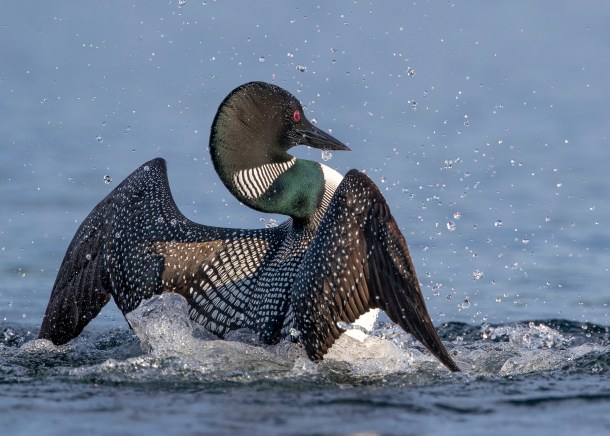
The Vermont Center for Ecostudies has received a five-year grant totaling more than $400,000 to support the Vermont Loon Conservation Project.
The funds provided by the U.S. Fish and Wildlife Service will be used to help replace loons that were killed in 2003 during the Bouchard B-120 oil spill in Rhode Island and Massachusetts.
The organization headquartered in White River Junction was one of six organizations in New England and New York to receive funding following a competitive application process, according to a Vermont Center for Ecostudies press release.
This grant is “part of a larger settlement” from the oil spill that killed more than 500 wintering loons.
Fewer than seven known breeding pairs existed in Vermont in the early 1980s. Seven years later, loons were classified as “state endangered.”
Ryan Rebozo, director of Conservation Science Vermont Center for Ecostudies, said that a loon biologist at the time created a “robust recovery plan” for the species. In the early 2000s, loons were delisted.
“With so few mating pairs left at the time [in the 1980s], it’s a testament to what a formal recovery plan can do for species,” Rebozo said.
A yearly average of 95 breeding loon pairs are present in Vermont, and 96 were reported last year. However, the work to sustain the population isn’t over.
“We’re primed for an opportunity to continue to do a lot of the work that has been successful for these populations to really bring them over to the edge so that they’re stable and that we can maintain the number of nesting pairs we’ve seen in the recent past,” Rebozo said.
Plans to advance formal approaches to loon recovery will focus on establishing management activities such as placing nesting rafts and nest warning signs in vulnerable areas.
“These include both territories with low productivity and high-risk sites where we have found management highly effective in reducing the negative effects of flooding and human disturbance,” loon biologist Eric Hanson said in the press release.
Rebozo said Hanson and other scientists have demonstrated their methods’ effectiveness over the years: Through creating artificial nests, public outreach, reducing mortality by increasing rescues, and limiting lead exposure and fishing tackle, loon recovery had succeeded.
“We’re hoping to leverage this to keep the program strong for another decade. It’s unfortunate that it took an oil spill for this to happen, but grateful for the progress we’re making,” Hanson said.
The grant will allow the Vermont Center for Ecostudies to implement programs to buy back lead tackle and collect monofilament — material used in fishing line — in the state, according to the press release.
Although fewer loons have been dying from lead poisoning each year, some are still affected. Over the past three years, six have died from ingesting lead fishing gear.
To ensure the five-year grant has lasting impact, the center will continue to engage volunteers, community stakeholders, and the public in raising awareness about loon and lake conservation and partaking in management activities.
Each year, several volunteers across Vermont participate in lake surveys and the center’s annual “July LoonWatch” to aid conservation efforts.

“Volunteers make loon conservation happen. Loons are a great way to get people involved and get them to care, which is one reason why I’m happy to keep this program going strong,” Hanson said. He also noted that opportunities for learning can stem from volunteering.
“It’s incredible how many volunteers we have for our loon program,” Rebozo said. The species is a popular favorite among many who live on the lake.
“People just love their loons,” he said.
