


Editor’s note: The Underground Workshop is an open platform for student journalism from across Vermont. For more information please contact Ben Heintz, the workshop’s editor, at ben@vtdigger.org.
by Bruce Pandya, U-32 High School
One morning this spring, five service providers gathered for what would turn out to be the last “door knocking” event at Barre’s Quality Inn. There was an intake coordinator for Good Samaritan Haven, a housing coordinator from Capstone Community Action, a nurse from Central Vermont Home Health and Hospice, and two counselors from Washington County Mental Health.
After a brief discussion in the parking lot, they all went to go and speak to the motel’s residents, people who had been homeless and were housed at the Quality Inn during the pandemic.
One of these service providers was Katy Leffel, a nurse from Central Vermont Home Health and Hospice. She asked residents whether they needed help with housing or access to healthcare, and whether they knew where to be tested for Covid-19. She also handed out copies of the motel rules.
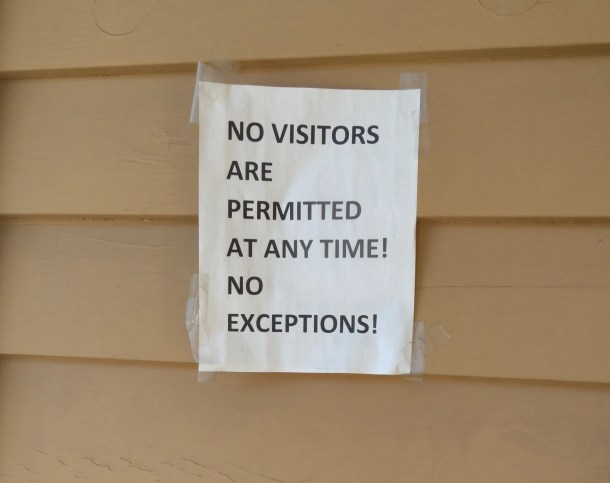
“We’re just kind of going door to door and having conversations with people around their health and safety,” Leffel said. “Our goal is to interface directly with as many residents as we can and to explain to them the services, the support services that are available to them.”
Residents’ responses were varied. “What is this for?” one man asked when approached at the door. One resident refused to take a copy of the motel rules, saying they had been shoved down his throat for months.
There was one resident who needed help with getting food. Another had waited months for housing with no success. Leffel said that one family had been moved out of their room due to an ant infestation.
One resident, Samuly Borthwick, had been homeless for three years. When he was 17 he dropped out of Essex High School. The treatment facility he was living in for anger management issues required residents to go to school everyday. Samuly said that he could not go to school because of bullying, and this is why he lost his place at the treatment facility.
As of this spring, he was living in the Quality Inn, one of 75 motels the state has used in their General Assistance Housing Program. For Samuly, finding permanent housing has been difficult for a number of reasons.
“Getting accepted for Section 8 kind of stuff, finding an apartment that can fit my budget monthly, that kind of stuff,” he said.
The General Assistance Housing program, which helps Vermont residents in need of temporary housing, is normally a short-term solution. In a typical year, the program is only available during cold weather, and residents are limited to 28 days at a time.
A major windfall for Vermont came last March, when the U.S. Congress passed the CARES Act relief bill. In total, private and governmental institutions in Vermont received more than $5 billion from the legislation.
The relief bill fueled an unprecedented expansion of General Assistance Housing. Before Covid, around 500 people would have been housed in motels, mostly during the winter. This spring there were nearly 3,000 people living in motels across the state.
The General Assistance Housing approach is based on a model of wraparound services. Service providers including nurses, substance abuse counselors, and housing coordinators work with clients to provide individualized support.
The expansive wraparound services that Borthwick and others have received will be short-lived. On the first of July eligibility requirements will begin to tighten. By late September, most residents will become ineligible. Those who leave motels this year will be stepping into a housing market with increasingly scarce supply, and the second highest affordability gap of any state in the country.
At the Quality Inn this spring, many residents wanted to know when the expanded housing aid would end. It was such a common question that the service providers gathered agreed on a response in advance: we don’t know.
Tami Thygesen coordinates housing services with Capstone, a nonprofit organization dedicated to “helping to break the poverty cycle in Vermont.” She was also at the Quality Inn visit this spring.
Thygesen said that there are multiple barriers for residents seeking permanent housing. “If you have a felony, you can’t get housed,” she said. “If you have no income, you can’t get housing. You don’t have good credit, can’t get housed.”
Even filling out housing applications, in some instances, can be a challenge. Thygesen gave the example of a resident who needed to send in a current driver’s license. His had expired, and he had over $1,000 in tickets.
Vermont’s lack of available housing stock has also made it more difficult to move residents from motels into permanent housing.
“We don’t have enough housing,” Thygesen said. “It’s going to be tough to move people into places, into apartments, and from the motel.”
In some cases, programs meant to help people who struggle with finding affordable housing can cause problems. The Section 8 housing voucher program subsidizes a portion of a tenant’s rent, limiting the share must pay to between 30-40% of their income. Even with this limit, there is still a problem for many residents, called the “benefits cliff.” When they get a full-time job, many become ineligible for other assistance programs.
All of the service providers who work with Vermont’s unhoused population see similar issues.
“So now we’re in the situation of people actually finally have the ability to pay for their housing, but there’s no housing available,” Katy Leffel said. “It’s like whack-a-mole. Next problem pops up.”

Despite all of the obstacles, there have been many successes. Many have been moved from the motels to permanent housing. Recently, Leffel visited with a young mother and her baby who had been moved out of the motels. Both are now living in transitional housing.
With the wraparound services that Samuly and other residents at the Quality Inn received winding down, the question is what happens next.
Leffel said that funding for the motels would likely end in October, and “the plan is pretty shaky right now about what will happen next fall.”
Though the future is uncertain, multiple organizations are working to provide services to the homeless population still in motels and planning for the end of expanded General Assistance Housing.
Good Samaritan Haven and Washington County Mental Health have hired employees to provide such services as vaccine clinics and Covid-19 surveillance testing on a routine basis. Good Samaritan Haven is also leading an effort to establish a new homeless shelter, which would be located at the Twin City Motel in Berlin.
Despite the difficulties, Leffel said that the General Assistance Housing Program could end up being a success story.
“It will actually be a major impact on homelessness in central Vermont,” Leffel said. “Just because the resources were amplified so much in the last year.”
