

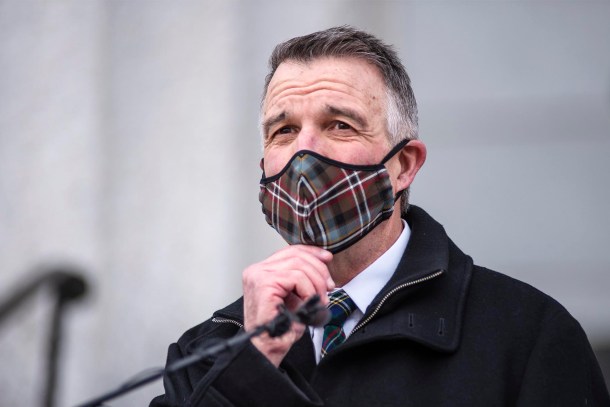
With just days left in the legislative session, lawmakers and Gov. Phil Scott are attempting to reach an agreement on a state budget proposal that will invest hundreds of millions of federal Covid-19 funds throughout the state.
Legislative leaders and the Scott administration are hopeful that they will reach consensus — and avoid a veto battle — on this year’s spending bill before the Legislature is scheduled to adjourn at the end of the week.
The tension in this year’s budget negotiations stems from a disagreement over how to spend money from the recently passed American Rescue Plan.
The governor believes that the federal dollars should be spent only on infrastructure projects. In April, he outlined a $1 billion plan to spend funds over the next several years on broadband expansion, climate change mitigation, water and sewer projects, affordable housing, and other sectors.
However, in addition to infrastructure, the budget passed by the Senate last month harnesses American Rescue Plan dollars to fund a broader array of initiatives.
Lawmakers, for instance, have set aside about $16 million of the federal funds to help reopen the state’s justice system, $53 million to stabilize Vermont’s strained higher education system and $23 million to fund workforce development initiatives. They’ve also included spending on human services, including funds for the mental health system and parent child centers.
Scott believes that these and other initiatives should be paid for using surplus state dollars, not federal Covid-19 relief money.
“It’s not as though we disagree on a lot of the content,” Scott said during his press conference last Tuesday. “It’s just where the money comes from, because if we spend it on a programmatic needs, we won’t have it to transform Vermont in the way I envision it.”
Democratic Statehouse leaders highlight the broad agreement between the governor and the Legislature about what major investments the state should make. Both sides want to pour millions of dollars into projects around broadband, affordable housing and climate change, for example.
“I think we share the common goals,” House Speaker Jill Krowinski, D-Burlington, said in an interview last week. “It’s just a question of what are the money pots that pay for those that we’re having back-and-forth with the administration on.”
Among the disagreements between Scott and lawmakers: how the state budget should address Vermont’s beleaguered pension system.
The Legislature has proposed using $150 million of one-time state surplus dollars to help pay down the system’s growing debt. That’s on top of the $343 million the state will owe in pension and health care liabilities next year.
Legislators argue that buying more debt down now will save the state money in the long run and help preserve its bond rating.
But Scott has said that he opposes using the additional $150 million to buy down the unfunded liability unless they also advance “structural changes” to the pension system to bring down long-term costs of running the system.
In April, however, lawmakers opted to push off conversations about major pension reforms until next year.
Senate President Pro Tempore Becca Balint, D-Windham, said last week that she was concerned the pension plan could be a “sticking point” in budget negotiations.
Nevertheless, she said she believes that Scott and the Legislature will reach a budget agreement without a veto.
“The executive branch is engaged with the conference committee, and I feel like we’ll get there,” Balint said, referring to the panel of House and Senate legislators working on finalizing the state budget proposal.
The proposal is expected to emerge from the conference committee in the coming days, before passing both the House and Senate again and heading to Scott’s desk.
Adam Greshin, commissioner of the Department of Finance and Management, said he also believes lawmakers and the governor can reach an agreement on the budget before the legislative session is over.
“I think there’s good reason to believe that we can all go home happy,” he said.
But he said Scott was clear that the budget as passed by the Senate in late April “would not have his signature on it.”
In a letter to lawmakers responding to the Senate budget, Susanne Young, Vermont’s secretary of administration, highlighted more than $170 million of proposed spending that the administration believes should be covered by state instead of federal funds.
The Scott administration is also pushing lawmakers to allocate a larger portion of the American Rescue Plan funds this year, in line with his $1 billion plan for spending the federal money in the coming years.
For example, Young’s letter notes that the governor would like the Legislature to invest an additional $92 million in housing initiatives and $27 million in spending related to climate change, including weatherization and electric vehicle incentives.
The Legislature has preferred a slower approach to allocating the federal money.
Lawmakers have said they want to know whether Vermont will receive additional funding from President Joe Biden’s proposed infrastructure package before they use up all of the American Rescue Plan Act money.
The Senate’s proposed budget would spend $478.5 million of the federal funds, leaving roughly $500 million to be spent in the 2022 legislative session.
Lawmakers have also had to contend with guidance recently released by the federal government that will set parameters for how the American Rescue Plan funds can be spent.
Legislators have said that guidance, which came out last week, may prohibit spending in some areas such as affordable housing but makes clear that spending on social services is permitted.
Balint said last week that the federal guidance “strengthens” the Legislature’s position for its proposed use of American Rescue Plan funds.
Greshin noted that the guidance has yet to be set in stone. The document released last week is an interim final rule, and Greshin said that there’s still time to advocate for changes and adapt.
Like the Democratic leaders, the finance commissioner noted that there is “broad agreement on the major subject areas in the budget” as well as the proposals for using dollars from the American Rescue Plan.
“As always at this time of year the devil is in the details,” Greshin said.
