

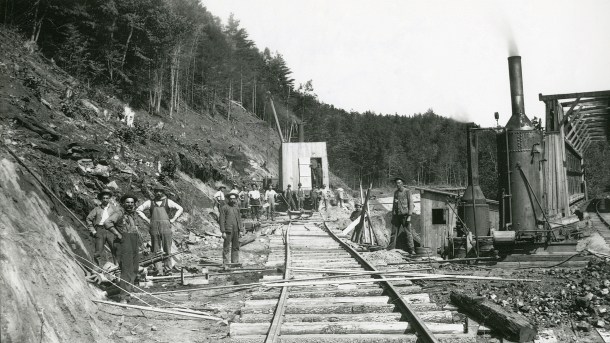
Vermont had never seen anything like it. More than 200 workers simply downed tools and walked off the job one day in 1846. The men weren’t striking over low pay, but rather over no pay at all since they started working more than two months earlier.
Working conditions might have been an issue, too. Men sometimes died doing this dangerous work.
Vermont’s first strike started on July 3, 1846, and involved laborers building a railroad trestle and laying track through the town of Bolton on the way to Burlington.
The men were recent arrivals from Ireland. They had stepped off boats in Canada and been quickly recruited by railroad representatives. The Irishmen, some accompanied by their families, had fled their homeland in the midst of the Potato Famine, a massive crop failure that would ultimately claim more than 1 million lives.
The emigrants must have been grateful to find work in Vermont, but when the promised pay didn’t materialize, they surely feared that their families were still in danger.
Given their plight, their response is perhaps understandable. The men launched what was soon dubbed the Bolton War. That’s a bit hyperbolic. What came next would more accurately be called a riot or a protest, depending on your perspective.
The Irishmen and some of their wives and children lived in a pair of temporary settlements north of the Winooski River in Bolton. The settlements, nicknamed Cork and Dublin, were home to about 300 people. You can see the rough location of the shantytowns if you drive through Bolton on Interstate 89 or Route 2.
The towns were apparently built in the flats and crept slightly up the hillsides in the general area of what has recently been a golf driving range. The land is privately owned and hasn’t been studied by archaeologists.
On or about July 1, 1846, the work camps emptied as about 200 laborers, perhaps joined by their wives and children, marched to the hotel in the nearby Jonesville section of Richmond. That’s where a railroad manager was staying. The men had earlier confronted a low-level contractor named H.S. Barnum to complain about their missing wages. Barnum had said he didn’t have the money, so they should talk with a Mr. Barker, who was a higher-level contractor. Fearing for his life, Barnum had then fled to Burlington.
Thus it was Barker who faced the angry throng of workers, who swore they would hold him prisoner until they were paid.
The situation might not have been Barker’s fault. Railroad ventures in those days were notoriously corrupt. The principal contractor would subcontract work to others. Those subcontractors would in turn subcontract out their work. The process would repeat and create more layers of subcontractors, each of which would skim a bit of the construction money before passing it down.
Barker said he didn’t have the money to pay the workers, because he had never been paid by the main contractor, a Mr. Belknap. Belknap, in turn, claimed the Vermont Central Railroad, the corporation organizing the track construction, owed him $200,000. Barker promised he could straighten things out if the strikers permitted him to travel to Montpelier.
Figuring that Barker was their bargaining chip, the workers refused. Barker sent an associate, Stephen Haight, instead.
While awaiting Haight’s return, the workers did what they could to get attention for their cause. They encamped around the hotel and made speeches about the injustices they had suffered.
“Give us our pay and we will disburse — this is all we ask, and this we will have,” they told the local sheriff when he arrived and tried to end the impasse. Strikers created obstacles in the road that ran between Burlington and Montpelier and threatened anyone who tried to pass.
Local resident Edward Jones wrote to his son, Jebez, who was in New York state, about the disturbances the workers were causing. “Recently the R.R. Chaps have had a break up in some way or for some Cause they did not pay their workmen and the Pats [Irishmen] waged a small Mexican war [the Mexican-American War had just started]. Shut up one of the directors, stopped Teams on the Road, forbid them to pass, dug ditches across the Road and stopped the stage two hours before they could pass. Their employers ought to have paid them but this state of things Could not be Endured.”
Haight apparently didn’t return as promised, and the blockade continued. The sheriff arrested several strike leaders, but the men were soon rescued by force. The sheriff called for backup, which in those days meant the militia. The Burlington Light Infantry, along with a company of Burlington firefighters armed with muskets by the sheriff, 75 to 80 men in all, arrived on the evening of July 3.
If the laborers needed more convincing to leave the scene, a Roman Catholic priest arrived and persuaded the men to give up. Jones, in his letter to his son, wrote, “The militia were Called out and when the Pats (Irishmen) saw them Coming, they fled to the mountains in Bolton.” A handful of the strikers, estimates vary from nine to about 12, were caught and briefly jailed in Burlington. The strikers were never paid.
In reporting the incident, DeWitt Clinton Clarke, editor of the Burlington Free Press, criticized the “outrage” caused by the laborers but was sympathetic to their plight: “Now these were poor men, earning their daily bread by the sweat of their faces, and they ought to have been promptly paid.”
Despite the strikers’ illegal actions, he wrote, “we yet unhesitatingly affirm that these laborers, indefensible as their conduct became, were not the first wrongdoers. That sin must lie at the doors of those who, knowing their necessities, continued to receive the benefit of their unrewarded labor.”
Breaking the strike did little to benefit the railroad, however. “The R.R. to me seems to be Rather an uphill business,” Edward Jones wrote in his letter to his son. “Years must pass away before it is Completed.” Indeed, work on the tracks halted for almost three years. Construction began again in March 1849, and the line was completed by November. The work remained hazardous. Seventeen men lost their lives running track through Bolton. But at least now they and others who took the risks were paid.

