


Editor’s note: This is the fourth story in an invitational series exploring the complex, varied experiences surrounding the BLM flag in Vermont’s school communities. The first installment in the series offered a snapshot of the debate this year, and the H.92 flag bill; the second profiled Noel Riby-Williams, who led the effort to raise the BLM flag at Montpelier High School; the third explored the breakdown of civil discourse in the Mill River school community. The Underground Workshop is an open platform for student journalism from across Vermont. For more information please contact Ben Heintz, the workshop’s editor, at ben@vtdigger.org.

by Josie Gawrys, Castleton University
In the summer of 2020, Castleton University senior Raynolds Awusi was invited by his mentor, Raphael Okutoro, to participate in a study about racial discrimination on campus.
He volunteered, wanting to share his story. As his fellow students spoke, he realized they shared the same experiences he faced.
Two students told stories of incidents at parties. Both were bumped into, and then called the N-word by white students. Awusi described one time, during a soccer game, when a white student called him “F–king n—–r.”
“This is just, what, five or six people in a room?” Awusi said. “So what does the rest of Castleton have to say?”
Following the death of George Floyd, Awusi felt a call to action. He joined Castleton’s Student Government Association, and proposed raising a Black Lives Matter flag. Both Interim President Jonathan Spiro and the student government approved.
Castleton’s student newspaper, the Spartan, picked up the story. The semester had already been challenging for the newspaper, following a stabbing at the beginning of the fall. The events Awusi set in motion would create a difficult decision for the Spartan’s editors, and for Awusi himself.
In October 2020, Awusi organized a ceremony for the Black Lives Matter flag raising. He said that he planned the event almost entirely on his own, with the approval of administration but without its help.
“I felt isolated,” Awusi said. “I felt I had to go through this whole thing by myself.”
It seemed to Awusi as if the school didn’t want the faculty involved. He said one faculty member told him personally that the flag would be “too controversial.”
But he stuck to it, and the ceremony plans were finalized for Oct. 11, 2020. He sent out an email inviting the student body and faculty to attend. In October, when only around 300 students were living on-campus, 50 attended, both from campus and the community.

When Awusi sent an email to the student body about raising the flag, he received just one reply, containing hateful speech.
“I just wanted to let you know that it’s disgusting that you would raise a Black Lives Matter flag. You realize Black Lives Matter killed a cop. And destroyed this country. You’re a delusional f—-ng idiot,” the student wrote.
“This is a university built on the backs of men and women who fought for this country and Black Lives Matter is destroying it. Maybe it would’ve been better if we picked her own cotton [sic]. Then we wouldn’t have stupid f—s like you.”
When Awusi read this, he wasn’t surprised. In fact, he was expecting it.
“I didn’t think it was much of a big deal,” said Awusi, “because that’s something that just happens all the time here.”
Awusi replied to the email, and after a second exchange, the other student ended with, “Oh what no reply to that??? That’s right p—sy.” Awusi decided to stop responding.
Awusi said many people at Castleton don’t realize things like this happen, as there isn’t usually a paper trail. He saw the email as an opportunity to show the community that racism exists at Castleton.
“Maybe this one time, people will actually wake up and be like, ‘Yeah, we do have a problem here, and we should probably try to fix it,’” he said.
Awusi shared a screenshot of the email to his Instagram story. Other students started sharing the screenshot to their stories. One student who saw the screenshot online was Aris Sherwood, an editor for the school’s student-run newspaper, the Castleton Spartan. She informed members of the editing team about the incident, and they quickly began planning for an article.
In the following days, they worked to put out a story on the incident. The editors decided it was important that the student who sent the email to Awusi get a chance to comment. They were unsure whether the student would respond, but thought that it “can’t hurt to try.”
This reporter sent an email to the student, and quickly received a response.
“I have a few things to say about that,” he wrote. “I was out of line in the first email. Yes black lives matter. I support a flag that says it. But I do not support the organization destroying the streets of Portland.”
“That was the meaning of my original email,” he wrote. “Not to come across as a racist which the email was spoken about as.”
There were rumors — and photo confirmation — that the student’s dorm door had a boot on the doorknob, meaning he had been locked out by the school. The Spartan reached out to Castleton’s administration for comment, but received none.
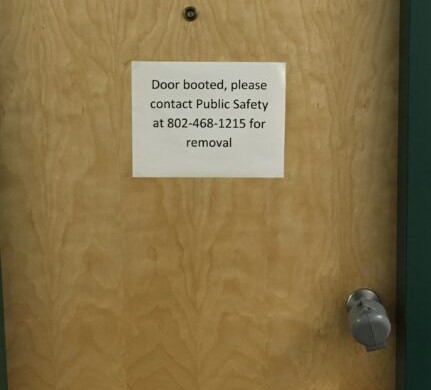
The Spartan reached back out to the student again. The student declined to answer any further questions, but sent one final email: “My second statement is the liquor did it.”
As the story was wrapping up, the student editors began a conversation on whether to include the name of the student in their story.
After a debate over text, journalism professor and adviser Dave Blow suggested holding a Zoom meeting for the editors to discuss the story.
This led to several meetings over the course of a few days. In each Zoom meeting, they were going over edits, working toward a decision, and aiming for a final draft. With an incident like this, the editors were under pressure to make the correct choice.
Student editors Brendan Crowley and Aris Sherwood disagreed initially about naming the student. Blow mostly stayed out of the discussion and encouraged the students to decide.
“I automatically was like, ‘No, I don’t think that’s a good idea,’” said Sherwood, “But Brendan and Dave were like, as journalists and from a journalistic perspective, that would be a good idea to do, because it’s interesting.”
As managing editor, Crowley had the final say, but wanted the editors to come to an agreement together.
“When something like this comes out, especially on the spot, we’ve got to make sure that we’re covering it right, to make sure that we’re not doing anything against the ethics,” he said.
He emphasized in the meetings that because the student had replied to the email, they had permission to run his name in the paper. Ethically it is allowed, he said, and Blow agreed.
Crowley reminded the team that people want details when they read a news story: They don’t want to feel as if there’s any information left out.
But Sherwood noted that most people reading the story would already have known through word of mouth, and if they really wanted to know, they could find out elsewhere. She argued that putting the name in the paper could cause the situation to escalate.
In the final Zoom meeting, student editors met once again to go over the final draft of the article and to make a final decision on the name. Sherwood said she “felt in her gut” that naming the student was wrong. Crowley insisted that because the student had agreed to an interview, that included consent to name him. If there was backlash, the editors could handle it.
But Sherwood wasn’t worried about the editors — she was worried about Awusi.
“I cared way more about the safety of Ray, and any other Black student on campus, than I did about being a good journalist,” Sherwood said.
Eventually, the reporter suggested that they ask Awusi whether he wanted the student named. The editors agreed on this, and asked Awusi for his thoughts.
“I didn’t want his name released because I know he was clearly uneducated and needed help,” Awusi said, “Maybe I wasn’t the person to educate him, but he needed help, and not his name all over Vermont.”
Ultimately, it was Awusi’s choice to leave the student unnamed in the story.
This February, to celebrate Black History Month and to bring discussions about race to the forefront at Castleton, the previous president of the Rutland NAACP chapter, Tabitha Moore, visited Castleton for a virtual talk.
Dean of Students Dennis Proulx spoke about those working toward change at Castleton. Moore and Awusi were both noted.
“What they’re trying to help us with will contribute to that continued evolution, but boy, do we have challenges,” Proulx said.
After the flag was raised, two faculty members reached out to Awusi about starting a student-run chapter of the NAACP at Castleton. Now he is president and a founding member.
Awusi believes the school is starting the necessary steps to improve. He works closely with Public Safety, the school’s administration, and with the Diversity, Equity and Inclusion Committee to work toward a better campus.
“I definitely have a positive outlook on the future,” Awusi said, “and I feel like there’s a lot of great people in school who want to do the right thing.”
But six months after the flag was raised, Awusi said the school’s climate still needs improvement.
“I don’t really think there’s been significant change, I haven’t heard of this change,” he said. “I think it’s still a work in progress. There are things going on today that we would have thought would have been resolved or corrected by now.”

