

This commentary is by Megan Gordon, restoration and ecological management fellow for The Nature Conservancy in Vermont.
We all know that water is essential to all life on earth, but can you identify whether waterways are healthy or not? What we consider “healthy” rivers are just aesthetically pristine. Bubbling streams cascading over rock steps with an unobscured view for hundreds of feet up a straight pathway catch our eye and make us raise our cameras.
Don’t get me wrong; even I stop in awe at this sight,but there is a deeper story here.
The more we learn about the history of North America, the more we understand that our presence has dramatically, and literally, shifted the course of our rivers. Our earliest accounts of the land were by explorers like Lewis and Clark, who documented the country from a canoe. Their findings? Miles and miles of “impenetrable swamp” created by the backup of logs and beaver dams.
This is far from our current state, a landscape altered by a long history of manipulating our waterways to accommodate human uses. Rivers most likely spanned entire valleys in Vermont, now confined by highways, homes and other infrastructure. Seventy-five percent of Vermont’s rivers have been straightened, dammed, and severed from their floodplains — resulting in rivers that move faster, carry more runoff, and flood more frequently.
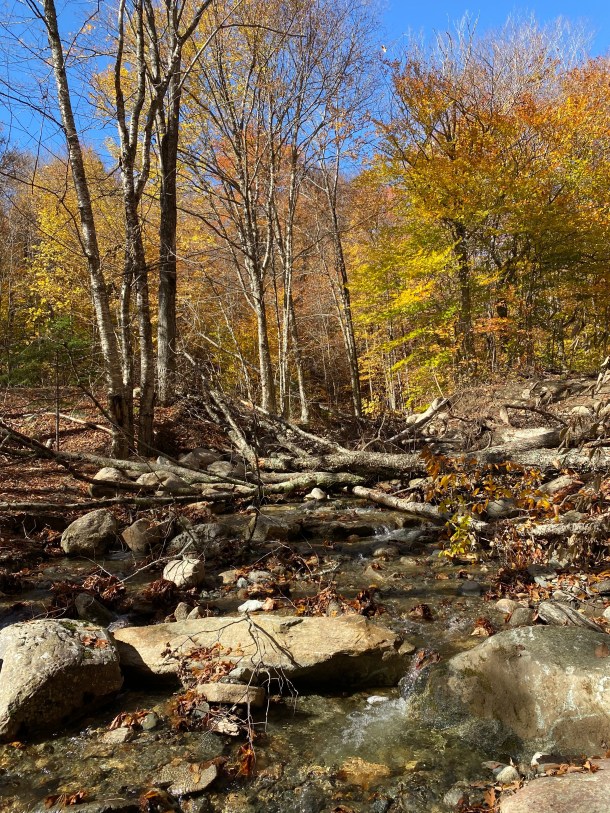
Environmentalists are beginning to understand that rivers should not be pristine — they should be impenetrable and sinuous. Wood zigzagging a stream creates habitat for fish, traps debris and sediment, and slows the flow of water to protect downstream from floods. Beaver dams create necessary habitat and healthy floodplains that retain water and nutrients that otherwise would have been washed downstream.
This is all to say that, when we give nature an inch, it returns a mile in benefits.
The Nature Conservancy in Vermont has conserved waterways by protecting the land around it for years but is now taking a more active restoration role as we work to mitigate the impacts of flooding and droughts in an ever-changing climate. By protecting the stream corridors, the land around the rivers, it creates the space for rivers to move from side to side and reconnect with their floodplains, as they once were able to do, resulting in slower-moving rivers and less damage downstream.
But we can’t protect land alone. Restoration actions that mimic natural processes, like adding wood to streams or allowing beavers to alter flow, help rivers return to a functional state that yields positive impacts for fish, birds and water quality.
So, what can you do? As you paddle Vermont’s rivers, hike along a brook, or fish in a stream, take notice of the areas that have the most life. You’ll find the fish where the river is messy and not necessarily beautiful. You’ll find birds in the brush and willows that overhang the stream. You’ll find moose in the open beaver meadows and vast floodplains. These are the places that we should be called pristine.
Our current ideal river is based on outdated views of water as a resource for us, and not as the life force that drives every ecosystem. We owe it to Vermont’s natural communities to embrace nature-based solutions to our water issues. By embracing this approach, we can benefit both our natural and human communities.
By accelerating conservation and restoration efforts, I hope to one day find an impenetrable swamp; then I will know what a truly healthy and pristine waterway looks like.

