

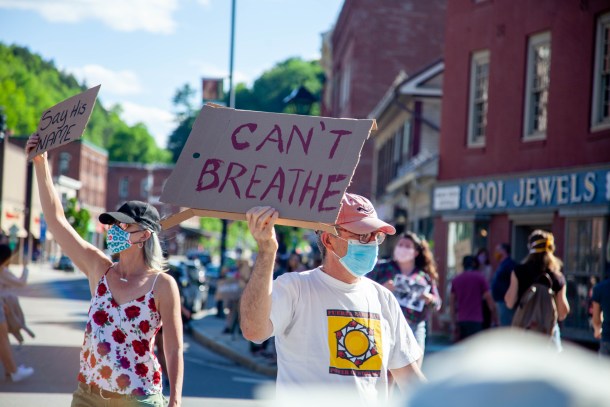
The state Senate backed legislation Thursday that alters a use of force law banning police choke holds.
The new measure, H.145, would allow police to use a choke hold as a means of defense when confronted with life-and-death situations.
Legislators passed a law last year, S.119, that made it a crime for police to use certain restraint methods, including choke holds, that can result in injury or death. The measure was part of a package of law enforcement reforms that was enacted after police killed George Floyd in Minneapolis.
This legislative session, police groups asked lawmakers to soften the choke hold ban.
The Senate provision would allow an officer to use a choke hold to “defend against an imminent threat of death or serious bodily injury to the officer or to another person.” Under the measure, a law enforcement officer must stop the choke hold as soon as the individual no longer poses an imminent threat of death or serious bodily injury.
The Senate passed the measure by a voice vote with little debate. The legislation is up Friday for a third and final reading.
The provision includes proposed changes already passed the House. Representatives will have one more opportunity to consider amendments made by the Senate, including a change in the effective date from Sept. 1 to Oct. 1, 2021.
Many of the questions on the Senate floor Thursday centered around when an officer was permitted to use force. The legislation says an “objectively reasonable law enforcement officer” can use force based on the “totality of the circumstances.”
“I would like to think that reasonable as used here would mean that there are identifiable defensible reasons other than how the police officer felt,” Sen. Dick McCormack, D-Windsor, said. “Must there be objectively arguable reasons, is that what we mean by reasonable?”
Sen. Joe Benning, R-Caledonia, who presented the bill on the Senate floor, replied that the intent is to move in that direction.
“Our hope here,” Benning said, “is that these standards are setting guidelines that will make sense and clarify that the officer really does have to have some reasons that are acceptable when using deadly force, especially, and literally any use of force.”
“What I’m hearing said is that ‘I was afraid he was going to kill me so I shot him’ is not an adequate explanation,” McCormack said.
“I would argue that under the statute as it is now being changed, that would be correct,” Benning replied.
Sen. Mark MacDonald, D-Orange, asked Benning if any high-profile police-use-of-force cases or fatal police shootings in Vermont in recent years in which officers were not charged would have been resolved differently if this legislation had been in place.
Benning said he did not know the specific “fact pattern” of each of the individual cases and so he couldn’t say.
“We are trying desperately to understand the world around us and to put in a different culture, if you will, how law enforcement uses force, especially when it comes to deadly force,” Benning said. “I will confess, it’s still a work in progress.”
