

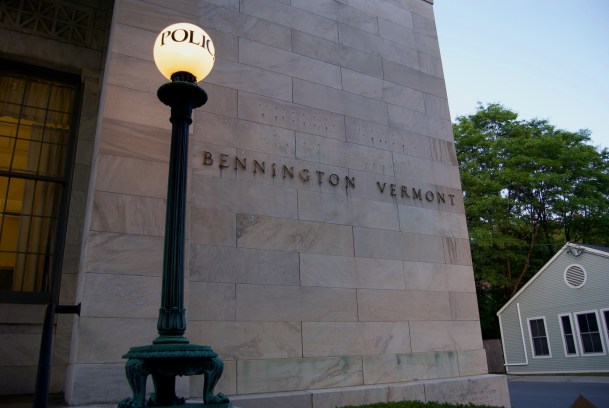
New and clearer guidelines have been issued for the conduct of Bennington police officers, and town officials now want to know what residents think of the new rules.
The guidelines are based on seven new policies that the Selectboard approved last fall.
Selectboard member Bruce Lee-Clark was on the committees that devised the new policies, but he said the actual procedures are “where the rubber meets the road.”
“When you’re getting to procedures, what you’re getting to is the technical, nitty-gritty — how do you put the policy that was put into place into practice?” Lee-Clark said.
For example, the department’s use of force policy states that “all responses to resistance must be objectively reasonable” and that “the BPD and all officers recognize that the sanctity of human life serves as the guiding principle in use of force decisions.”
The procedure that accompanies that policy, now on the table for debate, outlines the methods police officers must use to ensure that their use of force remains within those guidelines.
The procedure for the use-of-force policy addresses officers’ use of firearms, chokeholds and chemical spray, and outlines the situations where those methods would, and would not, be appropriate. It also says other officers have a duty to intervene if they see an officer using excessive force.
A formal public comment period begins Monday, April 19, and ends Wednesday, April 28.
“What I’m hoping everybody will look for is: Do the procedures that have been outlined, do they put the policy that the board has already passed and that citizens have helped draft — are they putting that policy into practice? And are there places where that needs to be improved?” Lee-Clark said.
As of Monday morning, all seven policies and their accompanying procedures were posted on the town’s website. Comments can be submitted online or sent to Selectboard members.
“Following the public comment period, the BPD will review and incorporate comments, as
appropriate,” a release from the town said. “Once the review of comments is complete, the final policies and procedures will be posted on the BPD website.”
Some procedures, like one that accompanies a policy about fair and impartial policing, address ongoing issues with the department.
“As required by law, all enforcement actions by law enforcement officers, such as investigations, detentions, traffic stops, arrests, searches and seizures, etc., must be based on reasonable suspicion, probable cause or other or relevant exigent circumstances, supported by articulable facts, circumstances and conclusions that support the given action,” the procedure states.
The Vermont Supreme Court unanimously overturned the conviction of Shamel Alexander, a Black man, finding that a Bennington police officer searched him without reasonable suspicion. Traffic stop data shows that Black and Hispanic people are consistently overstopped in Bennington.
The seven policies that now regulate police conduct in Bennington include use of force, domestic violence investigations, fair and impartial policing, investigating and reporting of hate crimes, responding to those experiencing a mental health crisis, duty to intervene when another officer is engaged in harmful conduct and use of electrical weapons.
More policies that relate to social media conduct, special events, body cameras and more are currently being formed.
The updated policies are part of ongoing reform of the Bennington Police Department, which began after police were criticized for not properly handling harassment of former state Rep. Kiah Morris. The town hired the International Association of Chiefs of Police to perform a comprehensive review of the department’s policies and its relationship with the community.
A 55-page report released in April 2020 recommended that the department “adopt the practice of procedural justice by creating policy, training to the newly developed policy, and executing the policy in everyday interactions.”
Last fall, six police advisory committees — which included Lee-Clark, Assistant Town Manager Dan Monks, Bennington police Cpl. Dan Ferrara and four community residents — created the seven policies, which the Selectboard has already approved. A total of 23 community members helped create the policies, which also passed through a two-week public comment period.
New policies were adapted from existing “general orders” from within the department, along with model policies from the Vermont League of Cities and Towns and the International Association of Chiefs of Police.
While the policies were drafted by boards that include civilians, the procedures were created by members of the police department in a process that Lee-Clark said is fairly typical.
“This comment period will be how there’ll be citizen involvement,” he said.
Critics of the reform effort often say that new policies will not go far enough as long as they’re implemented by the same leaders of the town and the police department.
“Policy reform will not work without police department reform,” said Mia Schultz, president of the Rutland Area NAACP, which also serves Bennington. “It also won’t work because there has been no acknowledgement that there has been harm that has been done in the past, and currently, especially to communities of color.
“When you have the same people making decisions on policy, you have the same results. In my opinion the process has always been performative. The goal has never been for transformation. It has been to give the appearance of it.”
This latest step in the town’s police reform comes less than a week after the ACLU filed a formal complaint against the Selectboard, alleging it unlawfully released identifying information about an interracial couple who submitted a formal complaint about suspected racial profiling by the Bennington Police Department.
Critics of the town’s process have made repeated calls for permanent civilian oversight of police. Lee-Clark said it won’t be long before the Selectboard takes another step forward to create such a board.
“I think it’s critical that we involve the public in finding out about, what are the options for civilian oversight of the police department?” Lee-Clark said. “What are the range of options? And so that will be coming, I think, sooner than later.”
