

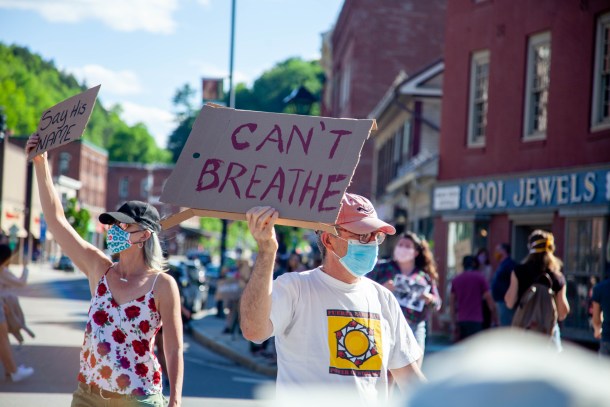
The Vermont House voted Wednesday to clarify a ban on police chokeholds and make it easier to prosecute hate crimes.
In enacting 2020 policing reforms after police killed George Floyd in Minneapolis, Vermont made it a crime for police to use certain restraint techniques, such as chokeholds, that can cause injury or death. The Vermont Department of Public Safety was assigned to put together a training policy for the new use-of-force restrictions, and report back.
In working on the policy, law enforcement officials decided to ask legislators to clarify the chokehold ban. The new legislation, H.145, would explicitly allow police to use chokeholds to defend themselves in life-and-death situations.
Rep. Martin LaLonde, D-South Burlington, said last year’s law had a similar intent, but the new bill “is more direct, clear and transparent in reaching this conclusion.” LaLonde said the proposed changes “do not ease the restrictions that we put in place on the use of chokeholds.”
If police use a chokehold to defend against “an imminent threat of death or serious bodily injury,” they must stop as soon as the threat eases.
“There are situations where the use of a chokehold may be the best, or only, option that a law enforcement officer may use in a life-or-death situation,” LaLonde said on the virtual House floor on Wednesday. “If an officer’s only option is use of a firearm, that could result in more fatalities than if the officer could use a chokehold in such a situation.”
The bill passed with little discussion. The voice vote appeared to be unanimous; no legislators could be heard voting against the legislation.
Hate crimes
The House also approved a measure that prosecutors say would make it easier to prosecute hate crimes.
Now, for a person to face hate crime penalties, prosecutors have to prove a crime was “maliciously motivated” by a victim’s race, color, religion, national origin, sex, ancestry, age, or service in the U.S. Armed Forces.
The bill, H.428, would jettison the requirement to prove “malicious” motivation.

“This change removes an element that the prosecution would need to prove to establish a conviction under the statute,” said Rep. Kevin “Coach” Christie, D-Hartford.
The Vermont Attorney General’s Office told legislators that hate crime laws in other states, including New York and Massachusetts, establish penalties for hate crimes without requiring proof of a “malicious” level of motivation.
The legislation would also require the Department of State’s Attorneys and Sheriffs and the Vermont Attorney General’s Office to produce an annual report on bias incidents within the state and its court system.
The United States has had an increase in hate crimes in recent years. During the Covid-19 pandemic, Asian Americans have faced a sharp increase in racist hate incidents.
The hate crime legislation was approved without debate on a unanimous voice vote Wednesday afternoon. Both H.428 and H.145 are expected to pass the House and move to the Senate after receiving second votes on Thursday.

