

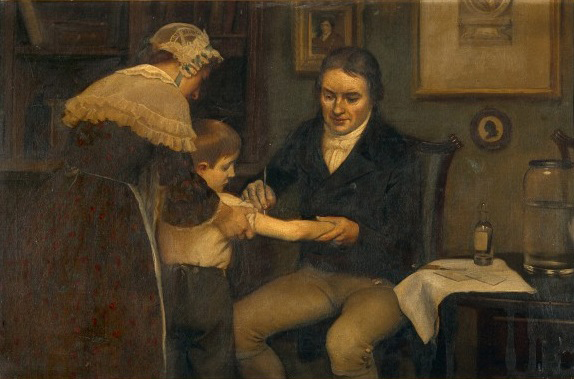
Ethan Allen wasn’t hiding anything. One Sunday morning, he stood before the meetinghouse in his hometown and had his friend, the doctor Thomas Young, perform a medical procedure on him.
It was a simple process: Young made a scratch on Allen’s arm and ran a tiny piece of thread soaked in pus onto the wound and then bandaged him up. Allen had just been inoculated against smallpox. The procedure was quick, almost painless — and illegal.
This event occurred in 1764 in Salisbury, Connecticut. It would be several years before Allen began speculating in land to the east of Lake Champlain, and more than a decade before he would become the “Hero of Ticonderoga” and help found Vermont. At the time of the incident, he was just Ethan Allen, a Connecticut resident with a particular knack for running into trouble.
To understand the subsequent uproar over Allen’s smallpox inoculation, it’s important to know something about the region’s experience with the disease. Smallpox was a scourge in New England in the 1700s. Residents could reasonably assume that they would contract the disease or have friends or family members who did.
Smallpox spread through contact with bodily fluids or contaminated objects. The disease killed roughly 30 percent of the people who contracted it. Among Native Americans, who had no natural immunity, the death toll was far higher. The disease caused fever, fatigue, and a crusty rash that left survivors permanently scarred.
Some smallpox scars were psychological and on a community level. The people of Salisbury in 1764 were deeply fearful of smallpox because of what had happened in Boston in 1721. In April of that year, a British ship docked in Boston. A sailor on board was exhibiting symptoms of smallpox. The man was quickly quarantined, but it was too late. Other crew members came down with the disease and spread it to the local population.
As the sparks of disease blazed into a full bore epidemic, Puritan minister Cotton Mather sought a way to protect people from this plague. He looked to popularize a technique he had learned several years earlier from Onesimus, a West African man he enslaved. Mather had asked the man if he’d ever had smallpox. “(H)e answered, both yes and no,” Mather wrote in his journal, “and then told me that he had undergone an operation, which had given him something of the smallpox and would forever preserve him from it.”
The operation Onesimus described was essentially the one Ethan Allen would undergo decades later, in which a person was intentionally infected with pus from a smallpox sufferer. The treatment usually triggered only a moderate case of smallpox. The process is formally known as variolation, after the variola virus that causes smallpox.
During their illness, the inoculated had to quarantine or risk spreading the disease. The great majority survived, emerging from quarantine perhaps with some scarring, but still very much alive. And immune to future infection.
The Boston public was intensely suspicious when Mather shared what he had learned. Part of the negative response was racist: Some white colonists didn’t trust a remedy that had come from Africa and claimed there must be something satanic about it. Others argued that epidemics were divine retribution for sinfulness, and that no one should try to thwart God’s will.
Furthermore, they said, there was no biblical basis to support the treatment. As the Rev. John Williams wrote, “There is no Rule in the Word of God to found inoculation upon. Therefore, inoculation cannot be according to the Will of God, nor according to Knowledge.”
Doctors had other worries. They feared that the treatment was untested and might only spread the disease to the general public. As a result, Mather couldn’t find anyone to perform the operation, until he asked Dr. Zabdiel Boylston. Boylston agreed to test the treatment, operating on two slaves, and on his own son. The experiment proved successful and Boylston began treating more people.

When word of Boylston’s actions circulated, he was summoned before a gathering of Boston’s selectmen and justices of the peace, as well as some of his fellow physicians. The doctors present issued a statement that Boylston’s behavior was dangerous and would probably result in a “most dangerous Consequence.” Boston authorities ordered him to stop.
But Boylston continued inoculating patients, even after receiving death threats. Mather was also attacked for promoting the practice. In November 1721, someone threw a bomb through Mather’s window. The bomb bore a note, “I’ll inoculate you with this; with a Pox to you.” The bomb failed to explode. Perhaps it wasn’t intended to — who attaches a note to a functioning bomb?
The smallpox epidemic killed 844 Bostonians, or 7.6 percent of the population. Boylston managed to inoculate 287 people, of whom only six died, a death rate of 2.1 percent. So even though getting inoculated with the live virus could kill you, it was still nearly four times safer than taking your chances as a member of the general public.
Nevertheless, inoculations remained controversial and most people opted against them. Many adults decided against inoculating themselves or their children, finding it hard to justify the risk when they might never become infected.
That’s why Benjamin Franklin chose not to inoculate his son Francis. “In 1736,” he later wrote, “I lost one of my sons, a fine boy of 4 years old, by the smallpox taken in the common way. I long regretted bitterly and still regret that I had not given it to him by inoculation. This I mention for the sake of the parents who omit that operation, on the supposition that they should never forgive themselves if a child died under it; my example showing that the regret may be the same either way, and that, therefore, the safer should be chosen.”
In 1764, the year Ethan Allen made his choice, New England was facing another wave of smallpox. The disease had landed in Boston the previous December, probably aboard a ship from Newfoundland that carried an infected sailor.
This time, Boston residents wanted to take action. They voted to allow inoculations and even to cover the cost of treatment for people who couldn’t afford it. Doctors inoculated nearly 5,000 people in the Boston area, including future president John Adams, and presumably helped blunt the impact of the epidemic.
Connecticut took a different approach. The colony didn’t organize mass inoculations. Instead, residents could legally get inoculated only if their local selectmen granted permission. When Salisbury’s selectmen rejected Ethan Allen’s request, he decided to get inoculated publicly in an act of civil disobedience.
Afterward, town leaders confronted Allen and he responded with the sort of stream-of-consciousness outburst for which he would later become known. Selectmen were so outraged by his language that they hauled him into court on a charge of blasphemy, and didn’t bother charging him over the inoculation.
After his quarantine period ended, Allen was in court facing a charge that he had told the selectmen: “By Jesus Christ, I wish I may be Bound Down in Hell with old Belzabub a Thousand years in the Lowest Pitt in Hell and that Every Little Insippid Devil should come along by and ask the Reason of Allen’s lying there, [if ] it should be said [that] he made a promise . . . that he would have satisfaction of (selectmen) Lee and Stoddard and Did Not fulfill it.”
Allen is said to have been acquitted because he persuaded the court his oath wasn’t blasphemous since he had been speaking hypothetically. Perhaps he was actually acquitted because the court found it as difficult as contemporary readers do to decipher what Allen had even said to the selectmen. Despite the acquittal, Connecticut authorities were probably relieved when this troublemaker decided to move north.
Smallpox remained a terrifying threat during the Revolutionary era. The failed American attack on Quebec in 1775 brought more than a military defeat; it also brought smallpox back to the Champlain Valley as American forces retreated to Fort Ticonderoga.
Faced with a smallpox epidemic in July 1776, Abigail Adams traveled with her four children from their home in Braintree to Boston so they could all be inoculated. She couldn’t discuss the matter with her husband, John, who was in Philadelphia, serving in the Second Continental Congress. The week before, he’d helped the Congress adopt the Declaration of Independence. She also had no peer-reviewed studies to tell her whether this was a good idea. She had to go with her gut.
She was hardly alone in her decision. “Such a spirit of inoculation never before took place, the Town and every House in it, are as full as they can hold,” she wrote John the next day. “I had many disagreeable Sensations at the Thoughts of coming myself, but to see my children through it I thought my duty, and all those feelings vanished as soon as I was inoculated, and I trust a kind providence will carry me safely through.” They all survived the treatment.
In 1796, English doctor Edward Jenner devised a safer treatment than inoculating patients with smallpox. He noticed that dairymaids often contracted cowpox, which is related to smallpox, except much milder. Sufferers develop sores, but the disease is potentially lethal only for immunocompromised people.
Jenner experimented with inoculating people using cowpox and discovered that they became immune to smallpox. Jenner called the process “vaccination,” deriving the word from the Latin adjective “vaccinus,” meaning “of or from the cow.”
In 1980, the World Health Organization declared that smallpox was the first disease ever globally eradicated by vaccination. Success was attained through an international effort. It helped that getting inoculated was no longer an act of civil disobedience.
