


Since the Covid-19 pandemic reached Vermont last March, Rep. Alyssa Black, D-Essex, has spent a lot of time at her dining room table.
She hasn’t eaten at the table in months. The room has been outfitted it as a workspace for her two jobs: legislator and health care administrator. On one side is a desktop computer and landline phone for her work at Evergreen Family Health, a family medicine clinic in Williston.
On the other side she keeps a laptop and iPad for tuning into virtual legislative meetings.
Black, who was elected to her first term in the Vermont House last November, says that remote legislating has been “bittersweet.” On the one hand, she doesn’t have to commute to Montpelier, which frees up her schedule.
“It affords me a little bit more time to fill in hours of my day job,” Black said. “I literally move from one side of my dining room table over to the other side of my dining room table.”
But the downside is building relationships with her colleagues in the Vermont House is “just not possible” given the remote nature of the legislative session, she says. Instead of convening in cramped committee rooms and socializing in the Statehouse cafeteria, legislators now meet via the teleconferencing app Zoom; their work is streamed on YouTube.
“You just see them on a grid,” Black said. “Maybe you can have a two-minute conversation with someone before you go on YouTube about some banal topic like what kind of tea are you drinking today — that sort of thing. But you can’t actually get to know anyone in depth.”

Black is one of more than 30 legislators first elected to the Legislature during the pandemic who haven’t had a chance to work out of the Statehouse. That’s made learning the ropes of the legislative process particularly difficult.
Sen. Josh Terenzini, R-Rutland, said he believes that being a freshman legislator this year puts him at “severe disadvantage” because it’s been much harder to get to know his colleagues and push for his legislative priorities.
“I think a lot of my aspirations and goals are deeply muted right now because of the fact that I don’t know what I don’t know. I think relationships are formed in the hallways and the cafeterias. I think side conversations can occur in person, and they don’t via Zoom,” Terenzini said.
“In many ways I feel like I’m a sort of a lame-duck freshman senator because I’m just not in the room. And I think you have to be in the room to make a positive and effective change,” he said.
Black said she’s concerned that some legislation may not advance this year because of the challenges posed by remote work. On a morning in late January, she noted that about 10 legislators had emailed her that day, asking her to co-sponsor bills.
“There’s not that member coming up to me in the cafeteria and explaining the history behind something, or why they feel it’s important that I should sign on to it,” Black said. “So I’m reluctant to sign on to anything, really.”
‘Incredibly frustrating’ communication
Rep. Anne Donahue, R-Northfield, has found remote legislating “incredibly frustrating” because it’s impossible to have the informal but “essential” communication with colleagues that typically takes place in the halls of the Statehouse.
It’s even tougher for first-time legislators.
“I mean, anyone who’s coming in for the first time doesn’t know what it’s usually like and so they’re learning that whole system,” Donahue said. “Now we’ve got new people who are learning a new system, who don’t have a basis to compare, who only have the fact that it’s this really cumbersome, difficult to communicate, difficult to share your ideas, very stilted process.”
According to Donahue, newly elected legislators play an important role. They bring fresh energy and ideas that make longtime lawmakers “rethink” how they look at policy issues. But this year, in the remote work environment, she suspects that new members may not feel comfortable enough to speak out.
“We are going to lose out, I think, on the mix that the new voices bring because it is going to be more difficult for them to feel secure in sharing their opinions,” she said.
Donahue, a member of the House Rules Committee, said it’s not clear whether the Legislature will return to normal by January 2022, the start of the second year of the biennium.
The Statehouse’s cramped committee rooms have always been “germ breeding grounds” and she speculates that lawmakers may decide to spread committees throughout other buildings in the future, she said.
Rep. Alice Emmons, D-Springfield, the longest-serving member of the House, said that in addition to struggling to build relationships, new legislators are missing out on learning about the history, decorum and process that comes with conducting business in-person.
“I feel really bad that the new members are not experiencing that,” Emmons said.
“They’re not advocates for their own agenda. They’re in the Legislature, and they need to govern. It’s governing and it’s being a statesman,” she added. “And that’s hard to feel when you’re sitting at home.”
A ‘benefit for working Vermonters?’
There is an upside to remote legislating, according to several lawmakers who have to balance Statehouse obligations with full-time jobs.
Rep. Taylor Small, P/D Winooski, a newly elected legislator, said the virtual work environment is a “benefit for working Vermonters” serving in the Legislature.
But Small, who works as director of the health and wellness program at the Pride Center of Vermont, said that although working from home can make it easy for legislators to toggle between jobs and legislative business, it doesn’t mean the load is lighter.
“It feels like, since there is no travel time, per se, that our days are just filled up even longer with meetings because there is relatively little to no excuse for not being present, because we are at our computers already,” Small said. “The expectation is that you can just log in and should be there.”
To help bridge the digital divide, lawmakers are setting up smaller meetings on Zoom or on the phone to get to know each other and discuss policy.
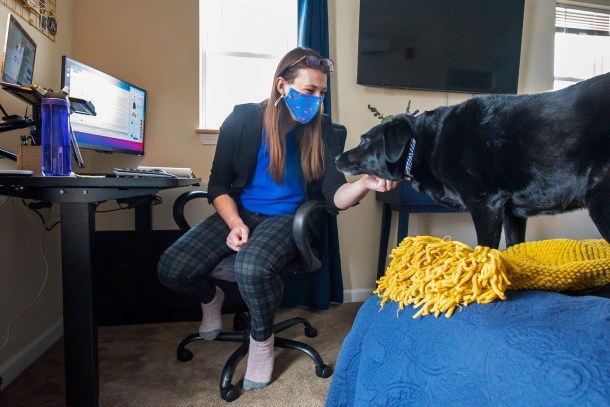
Small said she and others are working long hours to fit in these smaller discussions. “It means that legislators are typically going from 7 to 8 a.m. until 9 o’clock in the evening, sometimes even later, trying to have these conversations, because our days are so packed in with meetings,” Small said.
Rep. Erin Brady, D-Williston, has been part of a group of about a dozen new legislators, including Small, that has stayed in touch since the beginning of the session via email and text.
The group, which includes legislators across different legislative committees, pools resources and information. They bond during occasional “weekend retreats” on Zoom.
“I would say that network has been a lifeline,” Brady said.
The group is made up entirely of women and many members have younger children whose school schedules are somewhat unpredictable due to the pandemic, she said, and childcare is an added challenge for those lawmakers.
Brady is a social studies teacher at Colchester High School, though she has taken a leave of absence to serve in the Statehouse. She has been sharing parenting duties during the day with her spouse, who is also working from home.
“If it were just me it would be incredibly challenging,” Brady said. “ I really feel for people — for kids who are not in school at all, for kids who are juggling it, single parents. There’s just so many challenges out there.”
Sen. Kesha Ram, D-Chittenden, isn’t new to the Statehouse — she previously served three terms in the House — but this is her first term in the Senate.
Ram said while legislators face frustrations with remote work, they need to focus on those feeling the most strain during the pandemic: people who are working in frontline jobs or facing a “precarious living situation.”
“We all have to be focused on them and not lose sight of the impact that this pandemic is having on them while we sort of deal with what feel like pretty gourmet problems at the end of the day,” she said.
