


The Deeper Dig is a biweekly podcast from the VTDigger newsroom, hosted and produced by Sam Gale Rosen. Listen below, and subscribe on Apple Podcasts, Google Play, Spotify or anywhere you listen to podcasts.
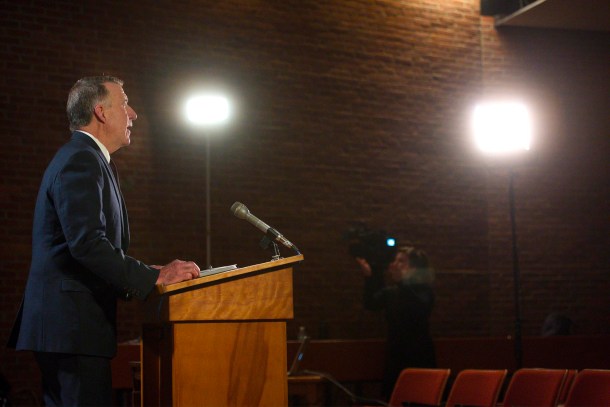
Gov. Phil Scott pitched a $6.83 billion budget this week, leveraging an infusion of federal dollars to fund $210 million in one-time investments. The windfall is providing the state a “rare opportunity,” Scott said, to accelerate Covid recovery and invest in long-term needs such as broadband and child care.
“This isn’t ongoing revenue, meaning it won’t be here next year, so we need to be smart about how it’s spent,” Scott said.
Democratic leaders in the House and Senate said they’re glad to hear the governor highlight some of the Legislature’s longstanding priorities. But another round of federal relief funding could further shift the landscape midway through the budgeting process.
“This budget proposal is a point in time,” said Becca Balint, the Senate president pro tem. “It’s a snapshot, and we’re going to know a whole lot more over the next few weeks and months about what kind of additional funding is coming from the Biden administration.”
“I think it’s important that we remember that we have more federal stimulus money coming, and that we need to stay flexible,” said House Speaker Jill Krowinski.
Below is a partial transcript of this podcast as Mike Dougherty speaks with Xander Landen and Kit Norton, VTDigger’s primary reporters on the Legislature. Edited for length and clarity.
Xander, you and I talked last fall, toward the end of the Covid special budget session. And it sounded like at the time, the idea was that they were holding steady on the budget, but that the crunch was going to come this year. Now it’s seeming like that crunch just never came. What happened?
Xander Landen: It’s interesting, because even early this month, the Scott administration was thinking that to budget for next year, to make that budget whole, they would have to fill a $75 million gap from lost tax revenue as a result of the pandemic. The thinking has been, and continues to be, to some extent, that the pandemic and the economic downturn is going to lead to a lot less tax revenue coming in to states all over the U.S.
But what state economists said recently is that the federal money that’s come to the state since last March to help aid Vermont’s response to Covid — money that has expanded unemployment benefits, money that has gone directly to consumers in their bank accounts as stimulus payments, money that has been funneled through the state to support businesses that are ailing — all that money, which amounts to about $5 billion worth of spending from the feds, has helped fill the coffers in a way that economists weren’t thinking it would.
Tom Kavet: As recently as this summer, in the first six months of this fiscal year, we have seen a steady progression of above target performance in a number of key and very large tax sources.
Xander Landen: Tom Kavet, who’s the Legislature’s economist, broke this down to the governor and legislators at the Emergency Board meeting, which is the meeting where state officials set the state’s revenue forecasts.
Tom Kavet: What we’re seeing is the impact of a phenomenal amount of federal deficit spending to offset the pandemic — levels of spending that have never, in the history of this nation, been put into effect.
Xander Landen: He highlighted that this is an unprecedented amount of federal aid that has been showered upon the state.
Tom Kavet: Just to put it in a frame of reference, the state has received in 2020 about 20% of its entire gross domestic product in federal stimulus payments. That’s just a staggering impact. There are some regional models, when we tried to play this out, where it blows up the model because it never anticipates something like that happening.
Xander Landen: And we’re actually projected to end the year next year with more money in the state’s bank account, so to speak, than economists have thought we would before the pandemic even started.
Wow. What does the administration plan to do with all that money?
Kit Norton: So the Scott administration, before the governor gave his speech, was all about how this $210 million was the crux of the budget, and that the way it was going to work was that they could use this one-time money to go into programs which they think are worth shoring up here.
Suzanne Young: The governor is focused on making strategic investments into people into our localities into our economy, into our recreation systems, into broadband and into government modernization with that one time, extra money that we find ourselves with this year,
Kit Norton: Suzanne Young, one of the top members of the Scott cabinet, explained how really, this budget sets up the state very well for delays or if no federal money comes at all. Even though it’s likely that will happen, she said that this budget sets up the state on very good footing to go forward.
Suzanne Young: If those stimulus dollars disappear — the fear is we’re not going to be in the same place as we were without those. So our goal is to keep that momentum going with these key investments with one-time money.
Kit Norton: Adam Greshin, who’s really the top money man for the governor, the way he explained it was a bit, he said, “bipolar” in terms of how this budget works, in terms of using state funds, but also with a bit of an eye to the federal side.
Adam Greshin: This budget is bipolar. On the one hand, we have the rocket fuel from the federal government that we’ve poured into the new initiatives you’ll hear about today. And on the other hand, we have the 87 octane that we put in our base to keep us on the road. We’re always mindful of the funding streams that we have, the longevity of those funding streams. And as the secretary said earlier, we have really benefited enormously from federal support. And that has provided us the ability to invest in many new initiatives that we hope will stand us in good stead over the long term and save us operating expense and also provide better services.
Kit Norton: So what we see here is Greshin really also giving full credit to that federal stimulus that came in last spring, and how that was able to propel the state forward and really set it up in a very, very good way in terms of state funds moving into fiscal year 2022.
Xander, what details did we learn when the governor actually stepped up and presented this approach to the public?
Xander Landen: The governor made it clear that this was an opportunity to make big investments in the state — investments that will help address immediate and long-term issues that the state is facing.
Gov. Phil Scott: This pandemic has tested all of us. It’s created new, immediate challenges that we never thought we face. It’s exposed and deepened all the problems we’ve grappled with for decades. And it’s presented us with a rare opportunity, giving us more of the resources we need to make meaningful progress on both.
Xander Landen: It’s interesting, a lot of the stuff that’s in the budget — broadband expansion, affordable housing, child care, a bunch of these other issues — these are issues that have always been discussed. They’re not new. But there’s been a lot of talk about how all these problems the state faces — poor internet access, poor access to child care — had been worsened during the pandemic. And so there’s there’s an immediate need to address them. And both the governor and Democrats have been saying that during the pandemic.
Gov. Phil Scott: While our fiscal picture looks better than expected, we must recognize it’s mostly due to billions of dollars of one-time federal stimulus money. Remember, this isn’t ongoing revenue, meaning it won’t be here next year. So we need to be smart about how it’s spent. That’s why we must invest in areas that grow our economy, or lower costs for the future. Let’s not fall into the trap of using it to create new programs we can’t afford after the federal money is gone.
Obviously the pandemic has changed so much about this session. But one of the other key things that’s different here is that there’s new leadership in both the House and the Senate. In the House, we’ve got Speaker Jill Krowinski, and in the Senate, we’ve got the new President Pro Tem Becca Balint. How have they responded to the approach that the governor put forth here?
Xander Landen: I think that in general, they’re happy to hear that the governor is talking about things that they are interested in working on as well.
Jill Krowinski: As you know, I strongly believe that we have to work together with the administration to create a recovery plan that leaves no Vermonter behind. And that includes improving access to broadband, child care and affordable housing. I was happy to hear the governor highlight some of those initiatives and others that help people in all zip codes — funding for affordable housing, some money for broadband, and for weatherization…
Xander Landen: There’s definitely a lot of bipartisan messaging here from both of the leaders, saying, we’re glad to hear the governor talking about these things.
Jill Krowinski: I think it’s important, though, that we remember that we have more federal stimulus money coming, and that we need to stay flexible. That is another piece in this whole equation here.
Xander Landen: I think that both Democratic leaders are making very clear that the state budget that Gov. Scott proposed is going to change dramatically in the coming months, once we have a better idea about the stimulus money that the federal government is almost certainly going to send states in another round of Covid aid. President Biden and the Democratically controlled Senate have made clear they want to send more money to states to help them with the pandemic response.
Becca Balint: We’re going to know a whole lot more over the next few weeks and months about what kind of additional funding is coming from the Biden administration and from this new Congress.
Xander Landen: Becca Balint told me the other day that she sees this budget as a point in time, and basically as a document, a budget, that’s going to be changing — and that the Democrats are going to have to change once we have a better idea about the money coming from the feds.
Becca Balint: I want to make sure that there’s an understanding in Vermont that these are choices that he’s making, his proposal, based on what we know right now. But if we get additional investments or additional streams of funds, we may, as a Legislature, make different decisions about where money should be spent, based on the new federal funding landscape.
Xander Landen: That would totally change the landscape if we suddenly got another $2 billion or $1.25 billion to play with.
When you say change, you mean we potentially have a lot more money coming to the state — and they want to start kind of planning for that now.
Xander Landen: Yeah. They said that they wish that they had heard that from the governor — him making clear that we’re likely going to have to rethink a lot. It’s definitely not a bad problem — we’re likely going to have more money to use. But the governor didn’t really talk about that at all in his speech.
Right. He pitched these as major investments. And what you’re saying is that the Democratic leaders here are saying, we could think even bigger. We could have even more major investments on the way. Kit, what do you think?
Kit Norton: What we have here is this is the main contrast in point of view between the administration and the Democratic leadership in the Legislature. On one hand, we have the Scott administration saying that they’ve decided to budget without federal funding, because in months previously, they’re having to wait and see: Oh, is federal money coming? Is it not? So they’ve decided to go ahead and make a state budget that does not look at or rely upon federal spending.
And this is why again, they’re pushing for the use of this $210 million in one-time funding. And then you have on the other side, you have Democratic leadership, who really in their comments kind of signaled: Yeah, this is fine when talking about the budget, but it doesn’t really matter, because we are expecting a large flow of federal money coming in, which we will then use.
This, then, in the eyes of Democratic leadership, opens up other ways to spend this $210 million in state funding — which has a lot more flexibility attached to it than federal funding, which might have stricter parameters around how this money can be used in relation to Covid-19. So you have these two separate ideas about how to look at the budget and how to look at Covid relief.
Do we have an idea yet of how they might plan to use that money differently from what the governor has laid out here?
Kit Norton: At this point, that’s one of the things that will come to light as the budget discussion gets underway in the Statehouse. It’s very possible that they look at the $200 million in state funding to look at shoring up the state employees union pension issue, which is an ongoing discussion right now. It might also be for more money into child care. There are things, and top priorities for Democrats, which they may look at using that for, or simply diversify what the governor they used it for, and change up little things here and there.
For instance, there’s already discussion about why there was money put all into weatherization and not into some electric vehicle programs as well. So there are different ways that some of the Democrats in both chambers are looking at how to spend that money differently than the governor. But this is one of the things which we’ll be keeping an eye on as the budget process gets underway.
It feels like there’s a disconnect when you’ve got all these conversations about windfalls and surpluses when, by certain economic indicators, the state is still having a really tough time. There’s still tens of thousands of Vermonters out of work. What is the immediate relief that your average Vermonter is going to see coming out of these conversations?
Kit Norton: I think it’s important to realize that this budget is not a Covid relief package. And we shouldn’t think about the two as the same. For instance, the House Appropriations chair, Mary Hooper, just on Thursday said how it’s time to start working on that type of package. That would be part of the discussion around the budget, where federal money will be going and what programs to shore up. However, that’s more of a discussion around how the administration and the Legislature are going to work in terms of deciding which relief programs they’re going to get going and to fund. For instance, the Legislature has already been working on unemployment issues, in terms of making sure that that fund is still relatively healthy. There are discussions about more business grants, etc.
I think generally, the budget proposal performed by the governor should not be misconstrued as a full-on Covid-19 relief package, because that’s not what that’s not what it does. There are portions of it which will help Vermonters. However, to think about it in that way can get some people into trouble.
Xander Landen: I think you’re right, Mike — you said earlier that there’s kind of a disconnect here between the talk about a lot of money in the state’s coffers, but at the same time you have 25,000 or so Vermonters who are out of work still. You have businesses that have gone under or are operating on a lifeline. There is this weird dichotomy.
But I think the economists are saying that it’s because of this artificial boost that we’ve gotten from the federal government — if we didn’t have that assistance, we would be looking at budget cuts, we’d be looking at potentially the rolling back of government services, benefits, who knows. There would have been a lot of really tough decisions that the governor would have had to come out with that would have been very unpopular. But luckily for state officials, they got this sort of unexpected windfall. And I think the hope is that, by the time we have to propose a budget next year, or the year after that, the economy will have righted itself, the pandemic will hopefully be over, and we’ll be on the path of normalcy.


