

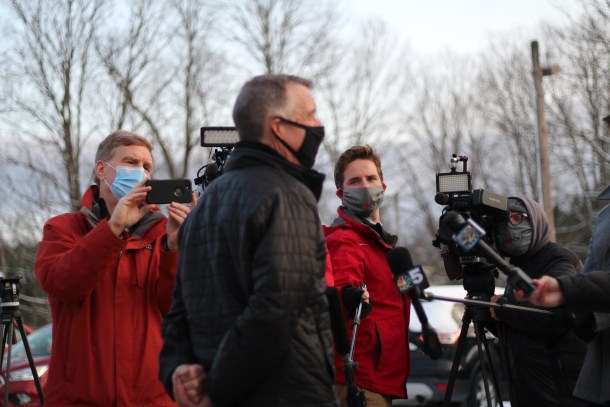
Leaders from Vermont’s political, business and nonprofit sectors are calling on members of the state’s press corps to reflect on the way they cover women in politics — and to address gender bias in their journalism.
In a letter sent Monday to newsrooms across the state, the group argues that sexism in the media has contributed to Vermont’s poor track record of electing women to the state’s highest offices. The letter asks news organizations to enter into a dialogue about their coverage and hiring decisions.
“We hope you will engage in internal conversations within your organizations about the issues of sexism, gender bias and racism in reporting, and commit to the challenging work of reckoning with the unconscious biases that affect our public narratives every day,” the letter reads.
More than 50 Vermonters signed the letter, including three former governors — Peter Shumlin, Howard Dean and Madeleine Kunin, the only woman to have held the state’s top office. Other signatories include Mari McClure and Mary Powell, the current and former CEOs of Green Mountain Power; Seventh Generation CEO Joey Bergstein; Vermont Human Rights Commission executive director Bor Yang; and former state representative Kiah Morris.
The initiative was led by Natalie Silver, a Burlington law school student who has worked for Attorney General T.J. Donovan, Shumlin and the Vermont Democratic Party. For the first time in a decade, she said, she found herself last year on the sidelines of the electoral process — learning about candidates not from her work but from the press.
“And I didn’t always like the stuff I saw, because I felt like there was a difference in how we talked about some of the women running,” she said.
Silver said she was inspired to take action after a group of national political operatives sent news organizations a letter last summer on the eve of then-Democratic presidential nominee Joe Biden’s expected selection of a female running mate. The initiative, known as “We Have Her Back,” urged journalists to avoid using gendered stereotypes and tropes when covering the vice presidential candidate.
“They were naming things that were essentially whispered,” Silver said. “I thought, ‘Why can’t we do this here?’” (The Vermont group has borrowed language from the national effort, employing the slogan and URL, “Vermont Has Her Back.”)
The resulting letter notes that the vast majority of Vermont’s political reporters and columnists are white men. “A more diverse press corps leads to more inclusive reporting,” it reads.
The letter cites a 2020 study by the University of Vermont’s Center for Research on Vermont that found that, over a three-year period, VTDigger and Seven Days quoted men more frequently than women in legislative coverage.
It also lists specific examples of sexism in Vermont news stories and political columns, several of which were published by VTDigger. A November 2016 column referred to a female gubernatorial candidate as “too aggressive” and asked whether voters may have found her “too shrill for their taste.” A May 2019 column posited that the Speaker of the House supported a paid family leave bill because she was “entirely female.”
The letter also contrasted the way VTDigger described the physical appearances of politicians last summer in a series of candidate profiles. One described a female candidate as “youthful and petite” with “bulbous cheek bones and almost shockingly flawless skin.” Another described her male opponent as having “the physical appearance of a classic northern New England politician.”
According to Dennise Casey, a public affairs and business strategist who signed the letter, such descriptions are unnecessary and often harmful.
“What we wear, what color we wear, how we wear our hair, our stature, our weight are all weighed against us before we open our mouths,” she said. “I have not observed that our male colleagues are held to that same standard.”
Casey, who previously worked for former governor Jim Douglas and the Republican Governors Association, added, “I don’t see why there’s this draw to describe women physically. In so many parts of society, that’s done to tear people down. It just doesn’t have a place in public policy.”
VTDigger editor in chief Anne Galloway said she understands the criticism and agrees with it.
“I am frankly embarrassed that our organization has been part of the problem,” she said. “On my watch, we have published misogynistic characterizations and sexist depictions of female candidates and government officials.”
Galloway said that VTDigger has engaged in robust internal discussions about the stories and columns in question. She said the news organization is committed to diversifying its editorial staff, seeking more representative sources and rethinking the way it portrays female politicians. (Two of those who signed the letter — Vermont Gas Systems CEO Neale Lunderville and attorney Jake Perkinson — serve on the board of the Vermont Journalism Trust, the nonprofit that operates VTDigger.)
“As the female founder of a news organization, I am no stranger to the kind of misogyny and sexism outlined in the letter. I have faced similar prejudice in my own industry,” Galloway said. “Unfortunately, the media is steeped in stereotypes, implicit biases and gendered expectations of women that continue to impede progress not only for half of the population, but for the whole of the human race. Going forward we will take action at VTDigger to prevent this kind of bias from pervading our work.”
The letter notes that women have made gains in Vermont politics in recent months and now control the top three leadership posts in the Statehouse. Last November, Molly Gray became the fourth woman elected lieutenant governor in state history; in January, Sen. Becca Balint, D-Windham, became the first woman to serve as president pro tempore of the Senate.
But the letter also points out that Vermont is the only state in the country to have never elected a woman to Congress.
According to Alex MacLean, a partner with Leonine Public Affairs who signed the letter, the press isn’t solely responsible for the dearth of women serving in the state’s highest offices. “Vermonters’ tendency to favor incumbents does play a role in this,” she said, referring to the fact that there has not been a vacancy in the state’s three-member congressional delegation since 2006. “But the press plays a unique role in democracy and elections,” she added.
Several of those who signed the letter said they did not believe that sexism was any more rampant in Vermont journalism than it is elsewhere.
“Generally, I think the Vermont press corps does a great job,” said Vermont Commission on Women executive director Cary Brown. “This isn’t meant to be a condemnation or a really broad-based criticism.”
But, she added, the Vermont news media could still benefit from “a heightened awareness” of gender bias in its work.
“We like to think of ourselves as being really different, but when it comes to bias we’re often very similar to everywhere else,” Brown said.
