


Vermont’s business grants program is getting a lot of attention at the moment from local officials and policymakers. And that has turned a spotlight toward the state auditor, a longtime foe of business incentive grants.
State Auditor Doug Hoffer has issued three similar unofficial reports on the Vermont Employment Growth Incentive, or VEGI, in the last year alone.
Now, a former lawmaker in Londonderry, Oliver Olsen, is carrying out his own audit of the auditor’s work — including Hoffer’s handling of confidential data associated with a VEGI report.
A report from Olsen that Hoffer isn’t following the standards he sets for other state agencies has prompted the Vermont Economic Progress Council, or VEPC — which operates VEGI — to hold a special meeting Friday to discuss Olsen’s charges.
Meanwhile, two lawmakers have introduced a bill calling for more transparency in the business grants program, which paid out $27 million in incentives through VEGI authorizations between 2007 and 2018. Businesses must meet job creation goals before receiving payments.
Sen. Randy Brock, R-Franklin, says he, too, plans to introduce his own VEGI transparency bill this year. The program reports it has incentivized a billion dollars in capital investments, $437 million in payroll, and 7,000 jobs at Vermont companies in that period.
Hoffer’s also weathering a volley of criticism for taking up the matter of VEGI when he’s well known as a critic of such programs.
“This is definitely a significant area of interest for the auditor, but there are much bigger fish than VEGI and TIF,” said Rep. Charles Kimbell, D-Woodstock. TIF, or tax increment financing, is another popular economic development tool that’s a frequent Hoffer target.
“He seems to be very intently focused on these two programs not because of the risk involved but because of his disagreement with the policy,” Kimbell said.
Hoffer worked for years as a policy analyst before being elected auditor, “and that’s what a lot of this looks like,” said Brock, a former state auditor himself. “Policy analysts often write things from particular slants based on their outlook, and that to me is not what an auditor should be doing.”
Hoffer’s job
Hoffer is an elected official whose job is to run the office that analyzes whether government programs and operations are working the way they should.
The state auditor’s office produces both official performance audits and then non-audit investigative reports. In 2020, the latter included three reports on VEGI and other work. Hoffer also released an extensive report in 2018 on state incentive programs.

Hoffer did concede, in a Dec. 31 email to his critic Olsen, that he did not follow the procedures of his own office in making a request to the Agency of Commerce and Community Development in gathering information for one of his reports. But he also pushed back against Olsen’s close scrutiny.
“Your supposed concern for the quality controls applicable to investigative reports from my office is curious at best,” he emailed Olsen on Dec. 28.
“Interestingly, you have said nothing about the substance of the two reports at issue, which involve the questionable authorization of millions in taxpayer dollars,” Hoffer said in the email.
“… Your attempt to play the ‘bias’ card is misguided. My antipathy to the VEGI program is not specific to that one program. I am biased against all state programs that I find are ineffective and waste taxpayer funds.”
New scrutiny of Hoffer’s methods
Olsen, who served two separate stints in the Vermont House as an independent, said he decided to start focusing on Hoffer after a story about Hoffer’s August non-audit report on health care expenditures got his attention.
“I started looking around at different reports and really looked at his standards manual and started comparing it and noticed that there were a lot of deficiencies,” Olsen said.
Olsen said he’s found several instances where Hoffer isn’t holding his own office to the standards he demands in other state agencies. And he says Hoffer misrepresented the nature of his research last year in order to obtain confidential data from the Agency of Commerce and Community Development.
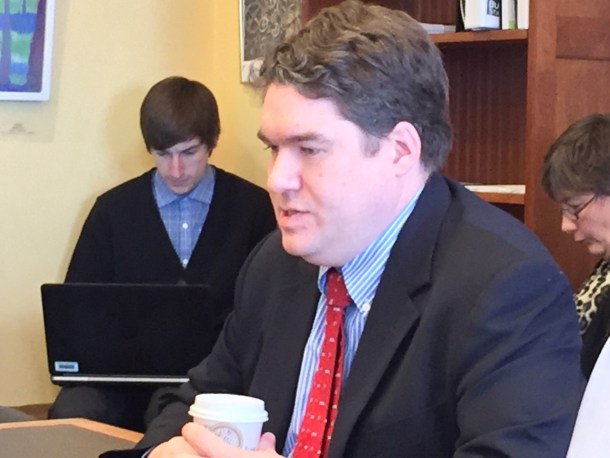
Olsen, a researcher himself who works as a software consultant, wrote to Sen. Becca Balint, D-Windham and now Senate president pro tem, and to Rep. Jill Krowinski, D-Burlington and now speaker of the House, in late December to say he was reviewing some of Hoffer’s recent work out of personal interest.
“My review, which is not yet complete, has identified a number of problems with the auditor’s work that I hope to bring to the Legislature’s attention in the new biennium,” Olsen said. Neither Balint nor Krowinski replied to an emailed request for comment.
Widespread but unpopular
For a program that pays out $2.5 million to $3 million in incentives each year, VEGI is a small target for scrutiny in a state with an annual budget of $6 billion. The attention reflects a widespread distaste for state and federal programs that funnel cash to private companies as an incentive to move in, stay, or grow. U.S. Sen. Bernie Sanders, I-Vt., has been calling this type of grant program “corporate welfare” for several decades.
VEGI provides incentives to encourage businesses to grow beyond where they would have naturally or organically. The incentives are earned and installments paid when performance requirements are met and maintained. A list of recipients over the years includes hundreds of Vermont companies, including GW Plastics, Caledonia Spirits, DealerPolicy and Seventh Generation.
Hoffer frequently focuses on the “but for” proof when assessing the value of incentive programs — the proof that, but for the program, the growth or development wouldn’t have happened.
He’s also written that it’s impossible to measure the efficacy of incentives programs. “Ultimately, companies don’t expand because of incentives,” he said in a March 2019 column. “They expand when the demand for their products or services exceeds their capacity.”
Economists, scholars and economic development officials around the world have published papers saying economic incentives like VEGI and TIF don’t work. Some say they hurt other businesses.
But they also have many supporters who say the programs are one of just a few tools available to economic development officials in states like Vermont. Kimbell and Brock both agree with Hoffer that VEGI needs to be watched closely, and that more transparency is needed. But Brock said the “but for” provision is an impossible standard to meet.

“When you continue to harp on what basically is a philosophical belief … the ‘but for’ is something that can’t be audited quantitatively,” said Brock, whose district includes a TIF project that has come under blistering criticism from the auditor’s office. “It doesn’t mean it’s evil, it doesn’t mean it’s bad. Everything in government can’t be audited quantitatively.”
While VEGI represents a tiny share of the state’s budget, “when we’re using state funds, it’s important we have all the information we need to make decisions about that,” said Rep. Emilie Kornheiser, D-Brattleboro. Kornheiser said she is sponsoring new legislation that seeks to make more of the grant program’s information public. “We need to focus on accountability across the board, but we have to start somewhere.”
Kornheiser cited the criticism of VEGI-type programs in other states and other countries. “This type of incentivizing represents an older model of economic development,” she said.
Longtime foe of business incentives
It’s clear to most longtime political observers that Hoffer, who was elected auditor in 2012, is opposed to VEPC’s work.
“I don’t think it’s any secret the state auditor has real misgivings about any kind of tax incentive program,” said Kimbell, who is the House representative to VEPC’s board. “He’s been very clear about that.”
But Kimbell said it’s not clear Hoffer’s personal feelings have affected the way he carries out his work.
Olsen communicated with the auditor last year about several of the office’s recent non-audit reports, including a 2019 report on clean water efforts in Lake Champlain and a September non-audit report on VEGI.
Olsen also did a detailed investigation of his own to see how well the auditor’s office is conforming to the standards it sets out for other state agencies.
It’s not doing well, said Olsen, who said the auditor’s website contains outdated information and lacks transparency about single-source contracts, among other things.
“He failed on every score,” Olsen said.
Olsen said on Dec. 31 that he thinks Hoffer is using the unofficial “non-audit” reports he creates through his office to further his advocacy work.

Hoffer is authorized to receive confidential information from the Agency of Commerce and Community Development for his performance audits. That agency houses VEPC, which operates the VEGI program.
But he recently requested and received information that he was not authorized to receive for a non-audit report. Hoffer misrepresented the nature of his work in that case, Olsen said.
In that information was private payroll data, capital investment projections, financial statements and business plans, and employee names, with Social Security numbers and hourly wage rates, said Joan Goldstein, the state’s economic development commissioner.
The auditor is authorized to receive that information only when conducting an audit, not when conducting a less formal non-audit report, according to the office’s own standards manual, Olsen said.
Kimbell said that while he, like Hoffer, has concerns about VEGI, he doesn’t think VEPC has made any errors in administering the program.
As for Hoffer, on Jan. 5 he said Olsen is attacking the auditor’s office because of a report Hoffer did that included information about independent schools. “He is well known for his longstanding and ardent advocacy for private schools and, apparently, doesn’t much care for those who engage on the issues,” Hoffer said.
