

Editor’s note: Mark Bushnell is a Vermont journalist and historian. He is the author of “Hidden History of Vermont” and “It Happened in Vermont.”
If you were cataloging the events that brought modern life to Vermont, you could assemble a lengthy list. Taking the long view, you would surely include the arrival of Europeans in the 17th century, with its cataclysmic impact on native populations, and the founding of the state in the late 18th century.
You would probably include events from the middle of last century, when the national interstate highway system allowed drivers quicker routes into, out of, and across the state. You presumably would also highlight the recent radical changes wrought by the internet, which connected the state, virtually, with the rest of the world.
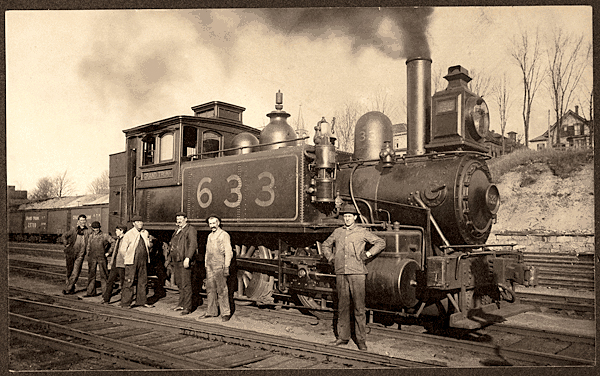
However you wrote the list, you should probably leave room for the arrival of the railroads. They changed the pace of life unlike anything before them by providing unheard of speed over land. Trains initially averaged about 15-20 miles per hour. Though horses could run faster, trains could travel for hours on end and pull massive loads. To a world used to moving no swifter and farther than a horse could travel, this was a revolution.
In 1843, the state Legislature drafted the rough map of where the railroads would travel. That year, the General Assembly granted charters authorizing the construction of four train lines — one running from Burlington to Rutland and then across the Connecticut River at some to-be-determined location in southeastern Vermont; one cutting across the center of the state and connecting the Connecticut with Lake Champlain; one traveling north along the Connecticut River Valley and into Canada; and one covering from Brattleboro to Fitchburg, Massachusetts, 50 miles northwest of Boston.
Sketching the rail lines was easy. They mostly ran through river valleys and therefore along old Native American trail networks. Actually constructing them, however, would be no easy task. Railroad companies faced geological, political, and financial obstacles that impeded construction for years.
In fact, when those first charters were issued, Vermont businessmen had already been maneuvering for their share of this lucrative industry for 13 years. In 1830, a group of leading businessmen had gathered at a Montpelier hotel to discuss how to bring trains to Vermont.
One of the main obstacles was money. Vermont just didn’t have enough potential customers to justify the substantial investment in laying tracks. Railroad executives needed to find ways to link their tracks with larger markets for the investment to make sense. So they eventually ended up fighting with each other over contracts to connect with lines serving cities including Boston, Portland and Montreal. They also had to look outside the state for investment, because Vermont didn’t have enough investors to cover all the costs of building a railroad.
The charters issued in 1843 gave the railroads flexibility in where they would lay their tracks. Charles Paine, president of the Vermont Central, bent the route of his railroad to his will, and to his enormous benefit. The Vermont Central was chartered to connect the Connecticut River and Lake Champlain. Instead of following a logical and shorter route that would have included Montpelier and Barre, Paine suggested the railroad take a longer route with slightly less elevation gain. Paine, who was endlessly self-serving as a railroad executive and later as governor, wanted to run the tracks through Northfield, where not coincidentally he owned property that would skyrocket in value.
Paine succeeded in his plan, and even had Northfield named as the company’s hub, leaving Barre and Montpelier to be served by a spur. Paine even had the corporation compensate him for the “hardship” of having the track cross his land.
Construction of the various rail lines created thousands of jobs, many of them held by recent immigrants from Ireland. The work was dangerous — fatal accidents were not uncommon — and the pay was meager. Workers sometimes earned less than four cents an hour. Still, railroads sometimes ran low on money and neglected to pay workers.

A group of laborers working on a stretch of Vermont Central line in Richmond, walked off the job on July 3, 1846, and started the state’s first strike. The 200 men had been working since April without pay. So they decided to take a contractor hostage and demand their wages. An infantry company from Burlington and a group of local firemen, who had been deputized and given firearms, confronted the strikers. A Catholic priest persuaded the laborers to release the contractor and end their walkout. A dozen of the strike leaders were briefly jailed, and many of the laborers were never paid.
The Rutland & Burlington Railroad completed the state’s first train line in late 1849. Company officials celebrated by sending a train south from Burlington and one north from the Connecticut River. At a ceremony in Mount Holly, men poured together salt water from Boston harbor and fresh water from Lake Champlain, symbolizing the connecting of the lake and the Atlantic. (Never mind that the line didn’t yet reach Boston.)
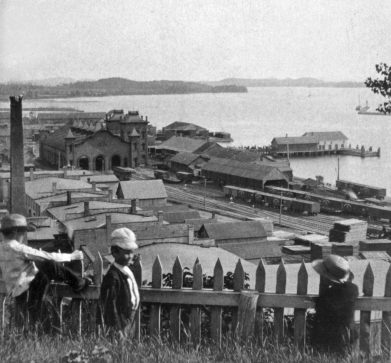
When trains ran through a community, a new center sometimes grew around the train station. The town of Brighton, for example, changed when the railroad arrived. Brighton is roughly the midpoint on a rail line connecting Portland and Montreal. The village of Island Pond, located just east of the old center of Brighton, grew beside the tracks. White River Junction also prospered as a rail hub. Its name refers to the fact that three rail lines cross in the village.
At least one Chittenden County village owes its name to railroads. Charles Paine’s Vermont Central, having bypassed Montpelier and Barre, also missed Burlington. Instead, it ran to a spot six miles east of Burlington, where it could connect with a line serving the lucrative Montreal market and another that linked with the Midwest by way of Rouses Point, New York. This key junction was at a place previously known as Hubbells Falls. People started calling it Painesville. Today we know it as Essex Junction.
The location proved to be a major nuisance for Burlington passengers and shippers, who had to rely on a spur to reach Burlington. But from Vermont Central executives’ perspective, it was worth it.
The arrangement dealt a heavy blow to Vermont Central’s chief rival, the Rutland & Burlington, which never managed to create its own direct rail connection north across the border. Instead, the railroad had to unload goods in Burlington and ship them across Lake Champlain, where they were reloaded onto trains and shipped to Canada. Hardly a competitive formula.
The hurly-burly world of railroad building led to numerous bankruptcies, takeovers, and mergers of convenience. As a result, if you try to follow the history of a given railroad, you will see that its name likely changed several times over the years.
By 1869, nine rail lines crossed the state, and railroads transformed Vermont’s economy. The state’s leading exports, whether raw materials like lumber, marble or granite, or finished goods like scales from St. Johnsbury and Rutland, organs from Brattleboro or woolens from Winooski, expanded with increased access to larger markets. The railroads also helped create the state’s tourism industry and their routes largely determined which communities thrived and which withered.
Not everyone was thrilled with the railroads, however. George Perkins Marsh, known today as a pioneering environmentalist, was the state’s first railroad commissioner. He was alarmed by the railroad’s impact on the landscape. Forests were leveled to make way for train lines and provide wood to power the locomotives. That deforestation often devastated fish habitat. Railroads also rerouted rivers and streams, which sometimes still experience severe flooding as they try to return to their natural courses.
Marsh also criticized the railroad industry’s corrupting influence on politics. Across the country, he said, the industry was so wealthy it could essentially buy the legislation it wanted from state governments. But due to its small size, Marsh said, Vermont mostly avoided “the enormous moral, political, and financial evils to which the almost universal corruption of great private corporations has elsewhere given birth.”
