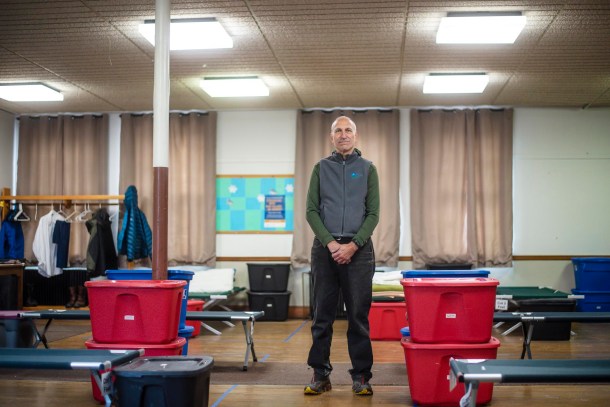

Emily knows she’s one of the lucky ones. She became homeless over a year ago before the coronavirus hit, and she had been moved from motel to motel under the state’s temporary housing voucher system.
After a year of instability, she now has her own apartment. Emily secured a Section 8 housing voucher and moved into a property overseen by the Champlain Housing Trust in November. Still, it had taken months for her to find a more permanent place to live.
It’s common knowledge at the South Burlington Holiday Inn, Emily says, where she lived for the summer, that Section 8 vouchers are now in good supply, due to CARES Act money and other programs that are stabilizing housing for people experiencing homelessness at a time when isolation is critical to containing the pandemic.
Long-term affordable housing is much harder to come by.
“I was issued a voucher, but it’s already pretty well known there are a number of people with vouchers that can’t find apartments,” she said. (Emily’s last name is being withheld because she’s a victim of domestic violence, which led to her housing issues.)
Emily’s experience is one piece of a complex puzzle that the state is trying to solve as it prepares homeless shelters, motels and residents for the winter, even as Covid-19 cases peak nationwide.
When the state shut down group shelters during Covid 19, the system was expanded to provide individual temporary housing for 2,000 Vermonters.
Some shelter providers say the money they’ve received from Vermont’s $1.25 billion federal stimulus package has kept them afloat and enabled them to make adjustments during a time when they’ve never seen more demand for services. Others have expressed concern about the lack of systemic testing and contact tracing among homeless populations.
And then there is the inevitable to contend with: Once a vaccine is widely available, the pandemic subsides and funding for the expanded motel voucher program stops, where will those 2,000 Vermonters go when housing is already so scarce?
Voucher funding secured through the winter
It was only a month ago that shelter providers worried that the expanded motel voucher would disappear on Dec. 31. That’s when the federal stimulus money, which was largely being used to prop up the program, expires. The state must use the $1.25 billion in CARES Act monies by that date.
Sarah Phillips, director of the Office of Economic Opportunity, says that’s no longer the case.
The program will continue for the foreseeable future, she said, as long as the state can keep the costly motel voucher program afloat through the Federal Emergency Management Agency.
“So long as there is a pandemic at play and we have a need for non-congregate housing, we will continue to pursue that approach,” Phillips said.
Vermont is eligible for FEMA funding as long as the pandemic emergency order is in place.
From March through October, the state spent $21 million on the expanded motel voucher program. Phillips said 75% of that is expected to be reimbursed by FEMA, while the rest will be covered by the coronavirus federal aid. Based on the average motel rate and average number of clients served, the nightly motel bill is about $153,000, she said.
The number of people served by motels is rising. Now, 2,018 people in about 1,700 households are housed in motels. In May, there were about 1,500 households in motels. That number waned in the summer but is now growing again.
Phillips, who has led the state’s Covid-19 homelessness response team, said program leaders are starting to think about what a wind-down of the motel program would look like in the spring or summer if the vaccine is widely available and the pandemic subsides.
“We absolutely do not want to create some sort of humanitarian crisis by really quickly shutting off the motel voucher program and pushing hundreds of households out onto the street,” Phillips said.
The state has prepared for this transition by organizing hundreds of housing vouchers and working with housing providers to rehab housing and shelters, she said. That way more beds can become available outside of the motels so people like Emily aren’t stuck waiting for a home with a voucher in hand.

The Vermont Housing and Conservation Board has bought up motels and an apartment building with the Covid-19 stimulus money and has helped coordinate, along with other housing groups, the rehabilitation of apartment buildings with landlords.
The rehabilitation program is expected to bring 216 units online by the end of December when the deadline for the stimulus money expires, said Josh Hanford, commissioner of the Department of Housing and Community Development. The units are required to give preference to people who are currently homeless, Hanford said, to help lessen the burden placed on motels.
“It’s not going to solve the problem by itself,” Hanford said. “But it’s a big part of moving people into more stable housing.”
Shelter providers prepare for the winter months
When the Covid-19 pandemic hit in March, winter weather was subsiding as spring and summer approached. This made it easier for homeless warming shelters to shut down and send clients to motels.
As shelters head into a full Covid-19 winter, they’ve had the summer and fall to prepare with the help of CARES Act funding, which has allowed them to renovate spaces, hire more staff or buy up new properties.
Burlington’s ANEW Place shut down its warming shelter last March because social distancing was impossible. The nonprofit recently secured a deal to buy the Champlain Inn, which ANEW Place Executive Director Kevin Pounds says can house up to 50 people at full capacity. Burlington now has 564 motel rooms occupied under the voucher system.
“There’s going to be some people who ultimately have to exit the motels,” Pounds said, “and opening this helps us pick up the slack.”
However, Burlington may have more resources available than other parts of the state. Patrick Shattuck, director of Rural Edge, an affordable housing provider in the Northeast Kingdom, says its warming shelter had to shut down in March and no substitute has been found.
“We don’t really have an emergency homeless shelter for the folks that are single individuals,” Shattuck said.
In prior years, several groups had run a 12-bed overnight shelter in St. Johnsbury. But Covid-19 restrictions have made it impossible to operate, Shattuck said, “because it truly was a congregate setting.”
Shattuck said his organization will open up 40 apartment units, funded through CARES Act money, for people to transition into before the year’s end.
“We will make a significant dent in the issue, but there are still gaps,” he said.
Rick DeAngelis, director of Barre shelter Good Samaritan Haven, is concerned about the rising risks of the virus as cases have peaked heading into the winter. An employee recently tested positive, forcing many others to quarantine and leaving the shelter short-staffed as residents were tested in the nearby Barre Auditorium.
The shelter was originally a single-family home that was converted to fit 30 residents. Even now when it hosts only 15 due to Covid capacity rules, he said, “it still feels overcrowded to me.”
“We haven’t had any shelter guests be symptomatic — fingers crossed it remains that way,” he said.