

Many experts see skiing as a safe, socially distanced option for getting out of the house this year — but Covid-19 is still expected to have a major effect on winter sports areas. What can skiers expect at the slopes? How are resorts ensuring the safety of their guests? And how will state regulations affect skiers and operators?
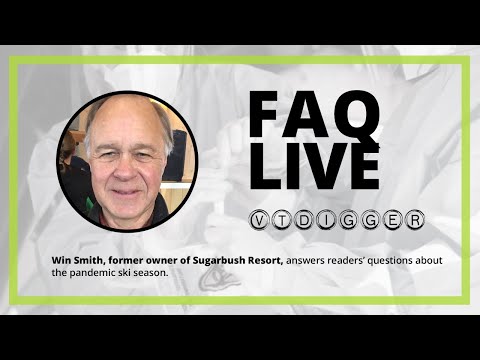
Win Smith, former owner of Sugarbush Resort, joined VTDigger on Wednesday to answer reader questions about the ski season. Below is a partial transcript, condensed for length and clarity.
Anne Galloway: I wonder if you could give us an overview of what the season could look like.
Everybody knows this is going to be a different season, and we just have to understand that and be ready for it. The words that I think everybody should think about and remember are, plan — it’s going to be important to plan ahead. We can’t be as spontaneous, as flexible as we’ve been in the past.
Patience is another word that I think is really important. Lift lines are likely to be longer because there’s going to be social distancing. It’s not going to be easy to access lodges. There’s not going to be an immediate “run to the bathroom,” there’s going to be restrictions and limitations on how many people can come into the lodge at one time. So we’re all going to have to have patience, which isn’t necessarily natural, especially on a powder day.
I think also, we’re going to have to be flexible. Things are going to change. The state regulations change frequently, and we’re going to have to adapt and be flexible with those.
Then the other thing is understanding. It’s really difficult to plan in the ski business right now. I was in it for 20 years. I’m glad I’m retired, because it’s tough. And I know what my colleagues are going through — not only at Sugarbush but in every ski area that I’m familiar with — they’ve been working for months to prepare. They’re working hard, and a lot of what they’re going to have to do they don’t necessarily like, they’re not going to really enjoy doing it, but they’re going to have to do it.
What’s going to be restricted is the indoor activities. So the ski rental, the tuning, the dining activities, the retail activities, those are all going to have limitations. What every ski area I have listened to has been telling customers is, this year you have to think of your car as the base lodge. Most people are not going to have lodges open for changing, for storage. So it’s going to be required to really boot up in your car and come ready to get right on the lift.
Most of the ski areas that I know of are actually trying to do more outdoor dining, they’re bringing in food trucks, they’re putting in different outdoor pickup opportunities. There’s going to be more fire pits, heaters being installed on buildings, so that you can still be around and more comfortable without having to go inside as one naturally does.
Obviously there’s a lot of questioning about: what are the state guidelines? And every ski area that I know really has to have their guests attest — and that is really sign a waiver — attest that you have read the state guidelines, you’re familiar with the current guidelines, and you are following them. The ski areas themselves can’t be the enforcement agent. It’s really going to be put on the shoulders of the guests that they have read and they are following the guidelines. But before a pass is activated, one will have to sign and attest. Before one buys a ticket, one has to attest. So that is really going to be some of the check and balance on it.
Is it perfect? No, it’s not. But that’s really what we are faced with as a ski industry, and that’s how it will be operating for the season.
Anonymous reader: I’m calling to inquire about home owners from across the border who typically come to Vermont ski areas for the season. How do those restrictions the governor has currently put in place affect those who own a home and regularly ski in the state?
This is one of the challenges and one of the real concerns. Obviously, you can’t prevent somebody from coming to their own home. But currently, if you’re coming from out of state, you have to quarantine for 14 days, or quarantine for seven days and take a test.
Quarantine, as I understand, can also be done in your home. If you’re in Connecticut and you really have quarantined according to the guidelines, my understanding is that you are able to drive to Vermont and you don’t have to then quarantine again. I’d really refer everybody to the state guidelines.
Brian, Wilmington: I’m calling with a question about what could be done to make the resort experience even safer this season, by further reducing capacity or reducing lift lines. The other part of this as well is safety on the hill. Because anyone who’s going to a hospital right now for an injury shouldn’t be there. We need that capacity for other use.
I believe all resorts are really trying to limit capacity in some way. Every resort is doing this a little bit differently, so you have to really look specifically to see how they’re doing it. The way Killington is currently looking at limiting capacity on the hill is by requiring parking reservations. There’s no fee for the parking, but in order to get in you have to have a parking reservation. Stowe and the other Vail resorts are actually requiring a reservation for your pass if you’re a passholder, and there’s limited ticketing done in advance. Sugarbush, which is part of the Altera family, is not requiring anybody to make a reservation if they’re a passholder, or to have parking reservations. They are limiting the capacity by really restricting the number of day tickets sold. This year, for example, you cannot walk up to the window and buy a ticket. You have to buy in advance and there is limited supply based per day. Purchase it online, and it will be activated and you can go directly to the lift.
The lodging is following the state guidelines. I’ll give you an example because I’m familiar with Sugarbush. Our cafeteria, which typically can seat 400, close to 500 people on a busy weekend — one half of that has been carved out for reserved seated dining. The limit is 75 people. All the tables are spaced more than six feet apart. It requires online reservations, online ordering. Going to rent equipment, you have to do that online. It’s delivered quickly, and some of it even out of doors. There are no group lessons. And right now the governor has actually restricted to households what can actually be done as a group setting.
Each area is really looking at the limitations, how to control capacity. At lift lines, you’re likely to see ghost lanes, in-between lanes. So it’s really spreading people out dramatically. If you have a high speed quad, it’s going to be limited to two people, instead of four people, unless people are from the same household and agree to ride together. If somebody gets in line and they want to go solo, at Sugarbush that’s going to be permitted. That’s going to be a safer environment.
Injuries on the hill, that’s another good question. If you get injured and you get taken to a hospital, it could take away, obviously, from caring for other people. So I think it is especially important this year to focus on safety. Ski in control. Ski safely. Injuries are going to happen, unfortunately; that’s the nature of the business. But I think we all can be even more careful than we normally are to make sure we don’t put a burden on our first responders.
Chuck, Wilmington: What does a ski resort do when the honor system fails? We know there are
out of state visitors coming and going with quarantine.
I think that’s probably one of the dilemmas that we’re going to be faced with. I don’t think ski areas can be, and know how to be, enforcers. I think if they are aware of something that is certainly very overt, disregarding the rules, I believe all of them have the power and will likely take action by revoking a ticket or revoking a pass. But you know, it’s really difficult to assume.
When I see somebody with Connecticut plates here in the [Mad River] Valley, I can’t assume that that person has not quarantined, or they haven’t been here for three months. Many people have. I can’t make that assumption. So that’s why the attestation is being put back on the shoulders of the individual. Hopefully people are going to act responsibly. And if they don’t, that puts the entire sport in jeopardy.
So I have to have faith that people are going to be responsible, that they are going to do the right thing. But if they don’t, and it’s obvious, I think resorts will take action.
Donald, Burlington: It seems it would be safe for two mask-wearing non-pod members to safely ride the side seats of the quads and stay safe in the breeze. Is that true?
I think most people believe that is true. I’m not going to be a doctrine of science. But again, the guidelines that we have received are, yes, that is permissible and deemed to be safe. And if you think about it, you know a fixed grip quad is going about 500 feet a minute, so there’s a breeze blowing. A high speed quad is going about 1000 feet a minute, so a breeze is blowing. So yes, I think the answer to your question is, people feel that that is a safe environment for two people on a quad, seated apart.
Colin, Burlington: How will ski resorts will enforce the mask policy?
I think what you’re going to see is that every ski area is going to ask everybody to wear a mask when they’re on premise, once they come into the resort environment. And I believe most people, if somebody comes in with a mask not on or mask not on properly, they’re going to be asked politely, “would you please wear a mask?” And if they say they refuse to wear a mask, I believe most areas will say they are not welcome to ski that day. And explain why — not just that it is for the protection of you, protection of everybody. It is something that is being required. And it jeopardizes everybody’s activity if somebody is not wearing a mask. So, please bear with it and wear a mask. And I’m sure most people will have masks available if somebody isn’t wearing one or didn’t bring one.
