


Burton’s plan to bring Higher Ground to the company’s Burlington campus has met with a number of challenges. The latest is “historical contamination” at the site on 152 Industrial Ave.
The Vermont Department of Environmental Conservation has expressed concerns about the facility, which was built in 1962. The building was previously used by General Dynamics Armaments Systems, a defense contractor that documented releases of contaminants on the property in past records that were shared with the state.
The use of the building is set to change from an industrial to a commercial site as a part of Higher Ground’s relocation.
Burton is adamant that there are no environmental issues at the site, but neighbors are skeptical and worry that construction could disrupt toxic waste and contaminate the well water that the Queen City Park neighborhood uses for drinking.
“The well is within striking distance of the facility which may need some environmental cleanup work done to protect the neighbors’ well,” said Laurie Smith, a resident of Queen City Park.
In 2019, Burton, the snowboard manufacturer, and the popular concert venue Higher Ground announced plans that the two businesses would work together on relocating Higher Ground, currently on Williston Road, to an expanded performing arts space on Burton’s Burlington campus. The relocation has been contentious, with neighbors hiring a lawyer to appeal permits for the project.
Burton says there are no environmental issues at the site. Now, the state has asked the company to work with an environmental consultant to update testing that was last conducted in 2005.
In an Oct. 23 letter to Burton from DEC, the agency sets a deadline of Nov. 20 for a site investigation work plan. It requires that Burton contract a “qualified environmental consultant” to put together the plan for investigating the site. Burton has an additional 90 days after results return from the lab to supply the information to the DEC.
“We have a number of concerns regarding potential historic contamination which was not investigated, as well as threats of releases from historic operations that may be present and causing impacts and exposures to human health and the environment,” wrote Lynda Provencher, a project manager for the Sites Management Section of the DEC in a letter to Justin Worthley, the senior vice president of global human resources of Burton.
“Review of the site file indicates that additional work is required to determine if contamination from historic releases or threatened releases is present,” Provencher writes to Worthley.
“Unfortunately, contamination can stick around for a very long time,” Provencher told VTDigger. But she said that more information was needed to make a determination about this case. “We just don’t really know if there’s any kind of issue at all. There’s suspected releases, potential releases here, but we’ll know a lot more after testing is done,” she said.
Worthley said that Burton has been working with “one of the state’s top environmental consultants to do an evaluation.”
“There are no environmental issues right now,” Worthley told VTDigger.
But some neighbors are skeptical. Laura Waters, a resident who has been an opponent of the development, said General Dynamics used an underground storage tank to store a solvent, which had leaked. When they dug it up, soil and groundwater contamination were found. After speaking to neighbors about the history of the property, Waters called the DEC to bring the issue to their attention.
Provencher told VTDigger that while this is “definitely not the usual path” for this type of assessment, “it does happen.” She said that properties that may have containment issues are typically assessed when a property transfer is happening or property owners are seeking refinancing.
“This is definitely one avenue if something comes to our attention from an old site then that maybe was previously held to different requirements then we have the ability to sort of reopen and relook at the site to see if it would still meet our standards,” explained Provencher.
When Provencher reviewed the property’s file, “some things just weren’t looked at back in the ’90s and earlier that we would look at today. That’s what mostly jumped out at me,” she said. “That wasn’t our practice in the ’90s to require that comprehensive review and it is today. It’s not that they didn’t meet our requirements,” Provencher added, “our requirements have increased.”
According to Provencher, because General Dynamics was manufacturing ammunition it is likely that many chemicals were used. Now, more information is needed about what is present at the site. “We’re not quite sure; they may not have had any affect on the environment but they may have so we need to go back and make sure there isn’t an active release,” said Provencher.
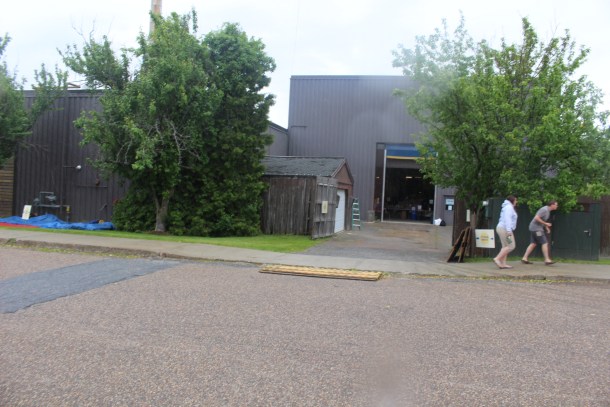
Waters has also reviewed the state’s files. “We do know for a fact that there had been a release of hazardous materials on the north side of the building,” said Waters.
“There’s no other information as far as how it was removed, if they took that tank out,” she said. “That could still be there for all we know.”
For Waters, the presence of both solvents and heavy metals were a concern, and she was pleased with the state’s requirement of additional testing.
“This project was approved by City Council and there is known contamination on the property,” said Waters. The responsibility is on the company she said “to know what they have on the property, what they need to do and how they need to proceed.”
“They all knew that this was General Dynamics. General Dynamics has had a history of soil and groundwater contamination. And nobody stepped back from this and said, ‘oh, let’s check off this box too’,” said Waters.
“They never did any assessment on the south side of the building to see if anything was moving south,” said Waters. The well that she and her neighbors use is located to the south of the buildings that Burton now owns.
Burton says the company is acting in accordance with state guidelines. Worthey said state standards have become more stringent over the years.
“We just follow the path that’s laid out by the ANR (Agency of Natural Resources) and those rules. Whatever is identified, we’re going to have to deal with it,” said Worthley. “Our hope is that there won’t be anything newly discovered.”
Provencher confirmed that Burton has contracted an environmental consultant who has requested an extension on the Nov. 20 deadline to submit a work plan. The DEC has granted its request, and said that it now expects to receive a work plan in early December.
Both Waters and Smith have opposed the Higher Ground program because of concerns about noise pollution, traffic, and disturbances to the neighborhood. They have both been involved with a group called Citizens for Responsible Zoning that neighbors call CRZ for short. The group has been fighting the project for 20 months now. They currently have two appeals out on separate permits for the project.
Waters and Smith say, the environmental contamination is a separate issue.
“When Laura discovered from the DEC that some of the contamination could easily get into the groundwater and impact our well it became a personal concern,” said Smith, another neighbor who has been involved with CRZ. Smith has been living in the neighborhood for 11 years “which makes us newcomers,” he said.
Burton bought the property in 2007.
“Now this has nothing to do with Higher Ground. It has to do with doing the right thing to protect the neighborhood on another level,” said Smith.
Waters and Smith are adamant that their environmental concerns are not motivated by their opposition to the Burton project. “We don’t want this tied to the concerns that the CRZ has around the Burton-Higher Ground plan,” said Waters.
But Worthley was skeptical. “I’m not sure that’s a genuine statement when we have, particularly, two members of the CRZ group who have been the most active and one of them called the state to make this open-ended inquiry, immediately after we received unanimous approval at the DRB. That seems a little coincidental to me,” he said.
Waters’ background is in environmental consulting. “Someone in our neighborhood started bringing up the fact that this building used to be General Dynamics,” said Waters. “Our well is less than a quarter of a mile away.”
“There are no wells,” said Worthley in response to neighbor’s concerns. “Everybody’s on municipal water and I mean, there is no contamination. There is no issue to talk about right now.”
Champlain Water District confirmed that the neighborhood does, in fact, get water from wells. The DEC is also aware of the well’s presence.
“I do know that there is a well pretty close by, but it’s a public drinking water well and they’re required to do routine sampling of the well,” said Provencher. “I don’t think they’ve had any contamination issues,” she added.
According to the city of South Burlington’s website, Queen City Park is served by Fire District #1: “SBFD #1 contains a deep rock well and an independent storage tank which supplies domestic water to the residents of Queen City Park.”
Drinking water wells are considered “a potentially impacted receptor,” said Provencher, and would be included in an investigation to determine if it is contaminated or could become contaminated in the future, due to construction or other changes at the property.
According to Worthley, the Higher Ground project is still in the planning, permitting and design phrase. Earlier in the fall, Burton received conditional use permit approval from the Burlington Review Board. After a lengthy hearing process, the board unanimously decided to approve the permit, allowing the project to move forward. According to Worthley, 18 conditions were added to the permit to address noise and traffic concerns raised by CRZ among other nearby neighborhoods.
“We’re cranking ahead, continuing to be excited about the future,” said Worthley. “We think this type of venue is going to be as important as ever coming out of the pandemic,” he added.
When it comes to future measures to ensure that the site is secure, more information is needed. “Nobody has made a determination that we even need to do more testing. We’ll do more testing if we find any sort of contamination that needs to be dealt with. We’ll deal with it,” said Worthley.
But according to Provencher, additional testing and taking samples from the property will be necessary to determine “where potential releases occurred.”
“We need to have more testing to make sure, to determine what’s there and what’s not there,” said Provencher. She added that “anything that is found can be remediated,” citing the brownfield program, where old industrial properties are cleaned up and redeveloped, into housing or a viable business property.
“If anything is here,” said Provencher, “it will be addressed.”
Worthley said that Burton is “a company of unyielding commitment around environmental responsibility,” and that the company will follow the process outlined by the state.
In a written statement, Worthely said that “Buton is fully cooperating with the State to investigate whether there is any historical contamination at the site that requires further action, and has retained VHB, one of the state’s most respected environmental consulting firms, to assist with this work. As a B-Corp, Burton takes these concerns very seriously, and will work to ensure that the health of our employees, tenants and the public are protected.”
Both Waters and Smith said they thought Burton should have been more proactive about getting the testing done. “Burton certainly knew that there was contamination,” said Waters, based on documentation it would have received when purchasing the property.
For their part, the neighbors said the proposed project has put them in a difficult position. “It is kind of painful to be in a position where we’re acting in opposition to two organizations that we believe in,” said Smith. “Our hope is that they end up and we all end up doing the right thing and finding something that is an ultimate benefit to all the parties.”
Worthley said communication had broken down with opponents. “CRZ won’t talk with us directly,” said Worthley
But for his part, Smith said that at least as an individual, “We’d be open to talks.”
“The last thing I would add is that I still hold the wish and the hope that Burton and Higher Ground, as community-minded organizations would really work to ensure that the community surrounding their venue doesn’t get disrupted by this project,” said Smith.
