

Three UVM Student Athletes Work Toward Racial Justice
by Madeleine Ahmadi

The Underground Workshop is VTDigger’s new platform for student journalism. This article was written by Madeleine Ahmadi, of Essex High School.
On Saturday, Sept. 12, the Student-Athletes of Color Affinity Group (SAOC) at the University of Vermont secretly gathered in front of the green and gold entrance to Patrick Gymnasium. They circled the flagpole that sits on the green.
“We ordered the Black Lives Matter flag online and on a Saturday evening we, as a student athlete of color group, decided to hang the flag outside of Patrick Gym,” said Carolyn Carerra, vice president of SAOC.
“We were all just like, yeah, let’s raise this thing ourselves.”
Without permission from UVM administration, they considered cutting the lock that held the rope in place. However, they discovered a different pole with a severed lock. With their own Black Lives Matter flag and clips, they raised the flag above the campus green.
At the University of Vermont, it’s against school policy to raise a flag that implies university sponsorship or endorsement without prior written authorization from the appropriate university official. Students on the Athletic Inclusive Excellence Committee were denied their request to raise Black Lives Matter banners inside the Patrick Gym lobby.
Carerra explained that when the president of SAOC, Skyler Nash, found out that their proposal to raise Black Lives Matter banners inside Patrick Gym was rejected, he messaged the SAOC group chat with an idea to raise the Black Lives Matter flag outside of Patrick Gymnasium.
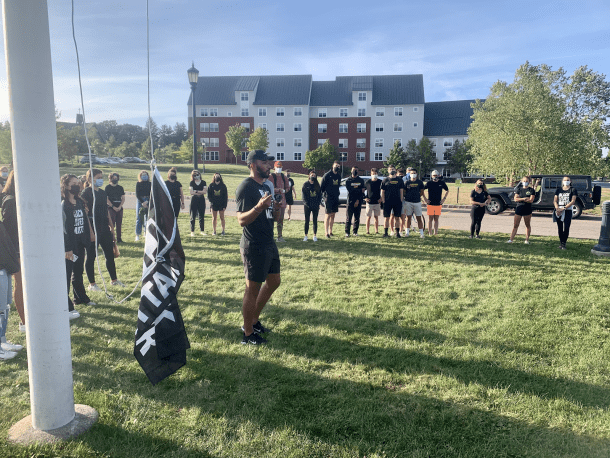
For 16 days, the Black Lives Matter flag flew in front of Patrick Gym. According to Nash, on Sunday, Sept. 28, the flag was taken down by school administration.
In spite of a wavering institutional stance, these UVM student athletes have decided to do whatever it takes to make racial justice a part of what it means to be a Catamount.
Carolyn Carerra:
Carolyn Carerra is the vice president of SAOC and a UVM women’s lacrosse player.
Before Covid-19 disrupted schedules, SAOC met monthly to plan projects. It facilitates difficult conversations about its members’ experiences as student athletes of color. SAOC has continued to be active throughout the pandemic by adapting its meeting and event procedures.
While UVM administration’s official position is in favor of racial justice, some student athletes feel that there is a disconnect about what is important.
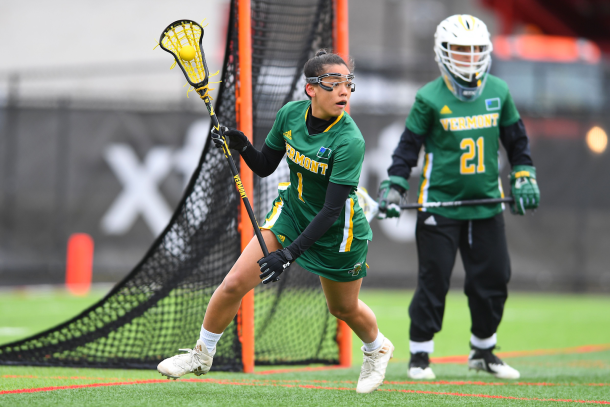
Carerra called out administrators by name when discussing her frustrations. She explained that “the biggest obstacle has been the process of talking to Suresh Garimella [UVM president] and Patty Prelock [provost].”
President Garimella shared this comment in response to Carerra’s claims:
“I commend our student athletes for their commitment to racial justice. It is very much in keeping with Our Common Ground values. Provost Prelock has met with the group on multiple occasions, and I also offered to meet with them.”
“Input from our students, faculty, staff and alumni is key to the actions we are taking to advance inclusive excellence. We are listening and we are implementing programs that will support ongoing positive change.”
In an article with The Vermont Cynic from Sept. 22, Prelock stated that “we have had a number of meaningful conversations around the racial challenges the world faces, and we remain committed to continue our conversation to achieve our shared goals.”
In spite of these statements of support, in mid-August, a Black Lives Matter flag was removed from the Davis Center flagpole by administration. It was relocated to the Mosaic Center for Students of Color to be permanently displayed.
“In a sense, we feel like we have to defend Black Lives Matter,” Carerra said. “They only wanted to fly the Black Lives Matter flag at the Mosaic Center for Students of Color.”
“We felt that the students of color don’t need to be reminded that Black Lives Matter.”
On Sept. 17, SAOC released a letter to the UVM administration with a list of demands: that implicit bias training be required for UVM students once per semester; that the UVM athletic department interview at least one person of color during the hiring process; that three members of SAOC be included in the interview process; and that control over the two Patrick Gymnasium flagpoles be transitioned from the university to the athletic department.
Carerra is hopeful that changes will be made. She is looking forward to working with the administration and believes “Black Lives Matter” is a phrase that represents the core values of the University of Vermont.
While she does feel frustration, Carerra also believes that UVM has moved in a positive direction since her first year. She believes that racial justice has become a fundamental aspect of campus culture and athletics.
Carerra, along with many other student athletes, hope that through their activism and voices, they can have their demands met.
Sarah Wells:
University of Vermont women’s basketball player Sarah Wells is a member of the Athletics Inclusive Excellence Committee. The committee is composed of administrators, coaches and student athletes working towards racial justice.
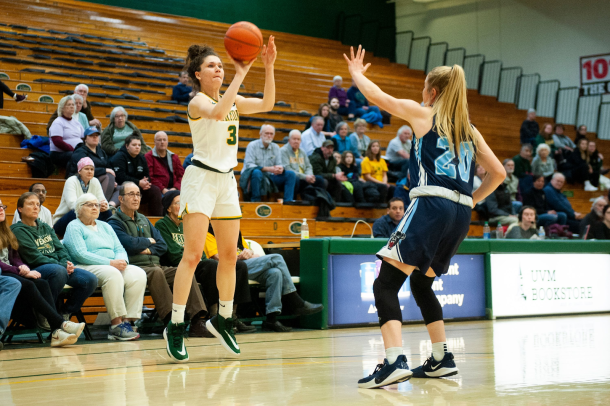
Photo Credit / UVM Athletics
Wells feels like she has a platform as a student athlete. “I think it’s really important for us to be hyper aware of how we compose ourselves,” Wells said.”I think we have a social responsibility to be very aware of our place in our community,”
Wells knew it was her time to step up and be a part of the change when she was asked to join the Athletic Inclusive Excellence Committee. “I’m part of some really interesting conversations,” she said, “and I have a new set of resources now that have enabled me to be more active and more educated.”
Each week, Wells’ coach, UVM women’s basketball head coach Alisa Kresge, creates themes for her players to discuss in circle conversations after practice.
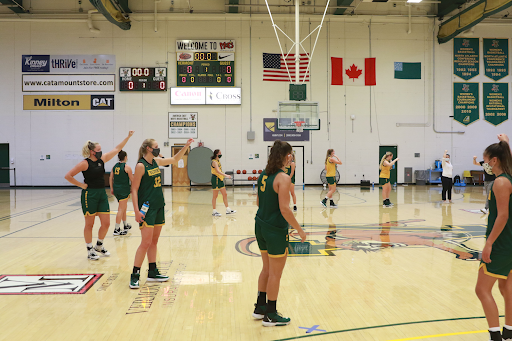
On Mondays, the team usually discusses something that has happened recently in the news. In the past few months, the conversations have centered on racial justice.
Head coach Alisa Kresge gives the student athletes homework assignments. Whether it’s watching a movie or reading an article, the UVM women’s basketball team works off the court to educate themselves on the issues that affect people of color.
“Over the years, I’ve fostered my voice and found a way to communicate with my teammates,” Wells said. “I lead not so much vocally but by example, whether that’s on or off the court.”
Ben Shungu:
Ben Shungu is a UVM men’s basketball player and the 2019- 20 America East Defensive Player of the Year. He’s also an active member of SAOC and a Vermonter who cares deeply about racial justice.
“You take on a leadership role, being a student athlete,” he said. “And like the rest of my teammates on the basketball team, we have to set an example within the community and towards our peers.”
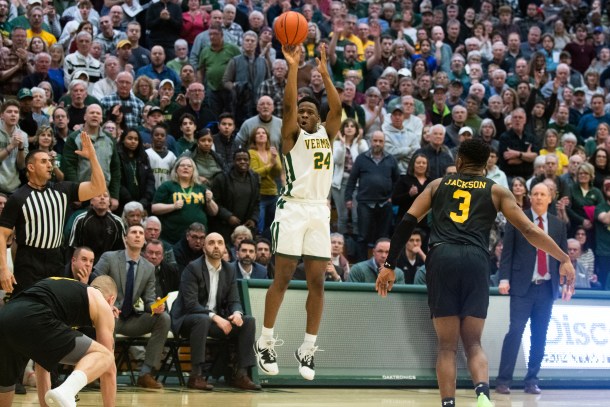
Photo Credit / UVM Athletics
Shungu said that in his view the university as a whole has failed for years to support them. “The reason why we raised the flag is because the university wouldn’t allow us to.”
Since student athletes have returned to the University of Vermont, SAOC has been committed to making change. Shungu explained that SAOC is in the process of creating a website with more information about the group’s specific goals.
Shungu felt the need to become active after witnessing the death of George Floyd and Breonna Taylor on the news.
He has a message for people who don’t believe racism is an issue in Vermont.
“I would say they’re part of the problem,” he said. “It’s as simple as that.”
