

The Deeper Dig is a biweekly podcast from the VTDigger newsroom, hosted and produced by Sam Gale Rosen. Listen below, and subscribe on Apple Podcasts, Google Play, Spotify or anywhere you listen to podcasts.
As the presidential race comes to a close, fears that a divided nation could see a rise in political violence remain high. Last week, a VTDigger special report revealed how a militia training site in West Pawlet is stoking that fear and intimidating its neighbors.
Men from Slate Ridge have harassed locals online and in person. They also appear to be stockpiling weapons and ammunition, and they’ve promoted symbols of far-right anti-government groups. But state authorities say that without evidence of criminal activity, there’s no way for them to intervene.
Joe Young, a professor at American University who studies political violence, said that while it can be difficult to tell when images and rhetoric will lead to violence, any threats on social media should be taken seriously.
“If people want to get together and shoot together as a recreational activity, that’s totally OK,” he said. “It crosses a line when you start preparing and training for some kind of a violent event that you’re going to undertake.”
Young said he’s seen signs that the aftermath of the presidential election could remain nonviolent. But long-term, militant anti-government groups are likely to remain a problem. “This is the kind of domestic threat that will be most prominent for us to deal with in the next 10 years or so,” he said. “I do think that this far-right terrorism is the place that we’re likely to see political violence.”
**Podcast transcript**
This week: A militia training site in West Pawlet is terrifying its neighbors. Men from the site have harassed locals online and in person. They also appear to be stockpiling weapons and ammunition, and they’ve promoted symbols of far-right anti-government groups at a time when tensions over political violence are high. But state authorities say that without evidence of criminal activity, there’s no way for them to intervene.
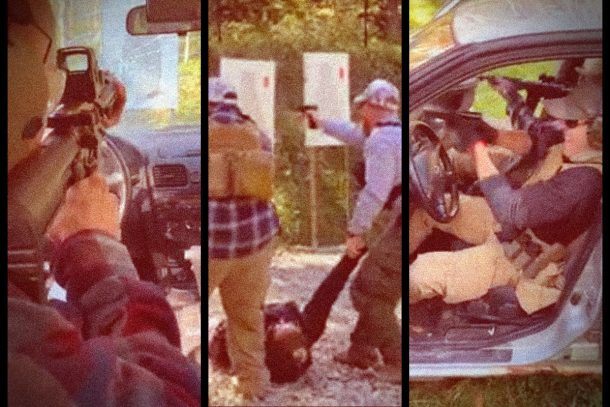
There’s a video on Facebook. It’s public; anyone can see it. At first you can just see a man sitting in the driver’s seat of a sedan. The door is open, and you see him from the left. He’s sitting perfectly still. Then after a few seconds, someone off camera shouts “stand by…up!” In a split second, the driver raises a gun and shoots it toward the front of the car, through the windshield. A second shooter in the passenger seat does the same — they’re perfectly in sync. Then they both slide out of the car. As he moves, the driver holsters the first gun and reveals a military-style rifle. The two men meet by the trunk and point their weapons forward, ready to shoot. And that’s it. The video ends.
There are dozens of these videos on the Facebook page for Slate Ridge, a gun range in West Pawlet. You see men practicing military formations, playing out scenarios with junk cars and makeshift partitions. The description on their page reads: “We provide solutions for a dynamic threat environment.” One video is titled: “These men are being built to end a problem.” What that threat or that problem is, is unclear.
For people who live near Slate Ridge, there’s one video that crossed a line. The narrator is looking at a specific bullet. He’s describing how it can shoot all the way through a car door, moving the camera around to show the damage. As he moves the camera toward the bullet hole, you see a name — Hulett Trucking — the name of one neighbor’s trucking company.
The owner of Slate Ridge, a man named Daniel Banyai, and a supporter named KC Cummings were angry that the Huletts had spread the word about Slate Ridge to a farm where Cummings was looking for work. Slate Ridge posted the names and addresses of the farm and members of the Hulett family, what’s known online as doxing. In that post, they wrote: “We must eradicate these people from allowing them to continue to cultural, ethical, and religiously cleanse an area they feel they own and control.”
Banyai and Cummings declined to speak with us. But what’s troubling neighbors, too, is what Slate Ridge puts out in the open: a stream of Facebook posts showing off machine guns and ammo, logos of anti-government extremist groups like the Three Percenters and the Oath Keepers, and talk about being “prepared” to face their “enemy.” Community members are wondering: what exactly is this heavily armed crew preparing for?
Joe Young: If people want to get together and shoot together as a recreational activity, that’s totally OK. It crosses a line when you start preparing and training for some kind of a violent event that you’re going to undertake.
This is Joe Young. Joe’s a professor at American University who studies political violence.
Joe Young: Where I think it’s really challenging or really complicated is — just like when I was a kid, and I liked to go in the woods and play war, I wasn’t actually going to make war. How do we know if these guys are just essentially doing that, going into the woods and playing, versus actually hatching plans, and having actionable items that they want to undertake?
Right — how do you start to parse out those calls?
Joe Young: Well, I think that’s the $64 million question. You know, there are several terrorism databases that are housed by the federal government, a no-fly list and all those sorts of things, and these databases, depending on which one we’re talking about, can have millions of names on them. Your name can be on there for good reasons; it can be on there for not such good reasons. But of those millions of people, that’s a bunch of noise that we’re getting, and there are a few of those people that are going to be violent. So how do we take that millions of people and then boil it down to the couple that will actually do it? To be 100% honest, we’re not good at that. And maybe because a lot of it is hard to predict.
This is why I study human beings: They’re the most fascinating, difficult things to understand and predict. You can say violent things and never actually do something violent. And on the flip side of that, you might not have zero social media presence; you may never threaten anybody and do something violent, right? So you can never be 100% certain. We can never have a 100% predictive model that’s going to say: These guys are gonna be violent, these guys aren’t. And the problem with that is, even, let’s say, if we’re 90% accurate, we’re going to have 10% mistakes. And those mistakes are real lives. Those mistakes are people dying.
It’s unclear what’s being done to address the concerns about Slate Ridge. Federal authorities appear to be involved: The FBI wouldn’t confirm or deny the existence of an investigation, but a leaked memo from the Bureau of Alcohol, Tobacco and Firearms from earlier this year refers to an ongoing investigation into Banyai.
Here in Vermont, authorities have said they’ve shared information with the feds. But they say they don’t have evidence that would allow them to take legal action. Here’s Governor Phil Scott.
Gov. Phil Scott: We’re very much aware of the situation. We’re monitoring the situation. But if it doesn’t rise to the level of criminal offense, what would you suppose we should do?
At a press conference on Oct. 30, our reporter Anne Wallace Allen asked the governor whether he would encourage prosecutors to use the state’s so-called “red flag” law to intervene. This is a relatively new law, passed in 2018, that would allow a judge to call for Daniel Banyai’s weapons to be confiscated.
Anne Wallace Allen: Do you think this is an appropriate occasion for prosecutors to file an extreme risk protection order, to remove firearms from the situation?
Gov. Phil Scott: I think it’s up to the prosecutors, and I’ll leave it to our commissioner to maybe answer that, but obviously, it’s up to — the role of the state’s attorney to determine that.
Anne brought up the case of Jack Sawyer, an 18-year-old from Fair Haven, who had allegedly been plotting to shoot up his high school. Scott pushed back on the comparison.
Anne Wallace Allen: …because you pushed for charges against Jack Sawyer, you can do that.
Gov. Phil Scott: There was an extensive plan in place to do harm to the school and the members of — students in the school. There wasn’t a question of if, it was a question of which day? And he had a hit list. I’m not sure — I guess, to compare the two, if that’s fair or accurate.

Apparently in response, a post went up hours later on the Slate Ridge Facebook page stating, “Thank you Governor Scott for standing up for Slate Ridge.” The governor’s office was forced to clarify that it does not support Slate Ridge.
I asked Joe about all this.
When you have these kind of signals that are out there, but nothing else — what is the role of governments in trying to deal with these potential issues?
Joe Young: Well, there’s not much local law enforcement can do except respond if something violent occurs. Expecting the local sheriff or local police department to do something is tough. They just don’t have the resources. But, this is the role for more federal law enforcement. And the FBI has infiltrated a lot of groups, both on the far right, the far left, as well as jihadi groups. And so, if I were a local police department, and I had some some basic intelligence that said things like this, I would be reaching out to the FBI for for help to infiltrate the group.
I don’t know if you’ve ever heard of the Earth Liberation Front, or the far-left groups right around 9/11. They were infiltrated by the FBI. There’s arguments about whether that was needed — but regardless of those arguments, it was highly successful. That happened in the Aryan Nations and the far right as well. The FBI can pull off those kinds of operations.
I guess what I’m getting at is, earlier you described how, parsing out these signals and figuring out which percentage of them would actually lead to a real threat, that we’re kind of bad at that. And I wonder, how do we get better at it?
Joe Young: It’s a great question. One of the things that I’ve argued that we need to do is, we need to have more information about these groups. One of the things that the federal government really tries to do to us researchers is not let us talk to terrorists, not let us go to prisons and talk to these folks. And you know, having more access and more information about what they want to do and their behaviors, that’s going to be super helpful in interdicting and stopping these kinds of plots.
Definitely, there are more people that are monitoring their public communication, and monitoring social media. There’s a professor at Elon University in North Carolina. She’s a computer scientist, and she collects a whole lot of big data on the far-right groups and does a lot of big data analyses on these things. I think those are profitable, but those aren’t going to be, like I said, 100% predictive. But I think if we had a lot more big data like that, if we had a lot more inside information about what these people want through informants and sources, plus having more academics talking to people like this — not just academics, but law enforcement — I think we’ll get a better picture of what’s happening. But I am also humble enough to know that, well, we’ll never get this 100% right, in the same way we’ve never gotten crime 100% right. And I actually maybe don’t even want us to be 100% right, because as you get more and more right, you probably ensnare people that are innocent.
Do guns play a role here?
Well, one way that relates to broader trends within American society is, gun ownership per capita is going down. Less and less people are owning guns. But there are more guns, right? So the people that own guns own a lot of guns. Speaking with, I have lots of rural family, they have tons and tons of guns. Part of what you’re describing for this group situation, that’s consistent with, I think, a lot of folks living in rural areas, which, again, is not uncommon. And there’s nothing wrong or illegal about doing that. As someone who’s a supporter of the Second Amendment, I don’t necessarily have a problem with that. It’s when you couple that with threats, that makes you a little more nervous.
But we’ve had guns and access to guns for a long period of time. So that’s not really changing. That’s not the variable that’s changing.
What is?
One thing we know about these groups — we’re talking about in the 1990s, we saw a big resurgence of events, around Ruby Ridge and Waco, and partially, what we know in the literature, is that far-right violence tends to spike when we have sort of more left-wing movements in the government. Also, during time periods of economic recession, we tend to see right-wing violence increase. We’re kind of seeing both of those things, so that makes sense that we might see groups like this develop now.
They had guns then, we have guns now. That piece of it, it’s not really different. And they have access to pretty much the same kinds of materials. But some of the factors that made far-right violence really prominent in the early ’90s seem to be coming to the fore right now as well.
This concern in West Pawlet comes at a time when tensions are high across the country. Anti-government groups have been on the rise for years, and many have called for action related to the current presidential election. To someone like Joe Young, this is all part of a major shift in who’s considered a threat in our country.
Joe Young: The U.S. traditionally, in modern times, has been the beacon of democracy in the world. And a lot of times there’s been almost something holy about our electoral process. In other places, it’s quite common to get spikes in violence around election time, and it’s not that unusual or that weird. But since for a pretty long time, we’ve had nonviolent political participation around elections, I think there’s a lot of concern — there was a lot of concern especially weeks ago — that this was going to be particularly unusual.
I think right now there’s more of an interest in it when we’re talking 2020 — the threat of jihadi terrorism or Islamic terrorism, or whatever you want to call it, has really waned, especially in the U.S. And so far-right violence is sort of the most pressing homeland security concern.
I’m talking to you on the third day of the aftermath of this very confusing and slowly-being-counted election, and I know some of these groups have signaled that there would be intimidation or violence related to the election. Do you have any predictions for what might happen over the next few weeks? What does this landscape look like in the immediate future?
Joe Young: First of all, I was grateful that there really was no violence around the election. I was just grateful to the American people that everybody voted, and we did it in a nonviolent way. There wasn’t intimidation, and every story that I read that suggested it was pretty non-credible. It’s hard to know what the correct information and what the right information is, but from everything I understand, it was quite peaceful, which I’m grateful for.
Now, moving forward, as things remain tense and contested and what have you, I still think we’re going to stick to this nonviolent pathway. Because even the Trump campaign has decided to take their grievances to the courts, which I don’t think they’re going to be very successful at. Which in the short term is good, because they’re using institutional channels.
When it’s all said and done, if in fact Trump loses, I think there may be some violence around the far right, that feel frustrated that their person was, in their mind, potentially robbed, or there was fraud of some kind. But I don’t think it’s broad-based. There have been plenty of signals from other mainstream political actors that: We’re going to respect election results, and we’re going to do this in an organized and nonviolent way. So I’m actually quite hopeful that over the next couple of weeks, however it all shakes out, that it will remain nonviolent.
If that is true in the short term, and I think everybody hopes that it is, what about more long term? I mean, where do you see, you know, these trends of these groups kind of going over the next few years?
Joe Young: I think this is the kind of domestic threat that will be most prominent for us to deal with in the next ten years or so. That would be my guess. Terrorism and political violence like this tends to go in waves. And we had, let’s call it, a jihadi wave from 2001 to about now. Prior to that, we had different kinds of terrorism in the 1960s, we had sort of Marxist waves of terrorism and nationalist waves of terrorism. I do think that this far-right terrorism is the place that we’re likely to see political violence.
But I don’t think we’re going to see events like we saw on 9/11. And I don’t think it’s going to be sustained or as horribly destructive. I think it’s a threat that our law enforcement should take seriously. And I think it should be a priority for our homeland security.
But I also would want to caution folks: One of the things that we tend to do as a country is, we get too excited about things instead of prioritizing threats and seeing them in context to each other. And we’ve got, I think, pretty big fish to fry right now, with a global pandemic, and race issues, and all sorts of other things. And I think this is an important issue, but it should be seen in context with these other sorts of massive issues we’re dealing with.
I really appreciate your expertise on this. Thanks for taking the time to chat.
Joe Young: Thank you.

