

NEK Community Broadband, the telecommunications district formed this year to improve internet access in the Northeast Kingdom, has hired a veteran of statewide infrastructure projects to lead its efforts.
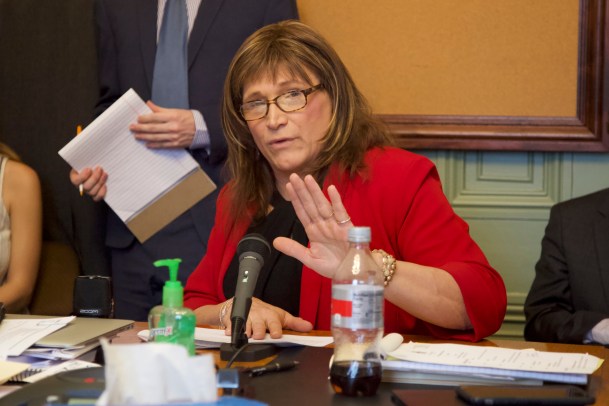
Former Vermont Electric Co-op CEO Christine Hallquist became the communications union district’s administrator in October. Her position is funded by a yearlong federal grant.
“I have complete faith that when you get a bunch of smart, passionate people together, you can pretty much do anything, and this board is a bunch of smart, passionate people,” Hallquist said Friday.
During her time at the electric utility, the co-op deployed and managed fiber lines.
The hiring of Hallquist — who was the Democratic nominee for governor in 2018, but lost to Republican Phil Scott — is one of the latest signs of the district’s progress since Town Meeting Day in March, when 27 towns in the Kingdom voted to join the regional body. The aim is to address the area’s lack of access to high-speed internet.
Communications union districts, enabled by a 2015 law, are a relatively new type of municipal entity in Vermont. Only two CUDs existed in the state before Town Meeting Day 2020, and only one of those districts, ECFiber in east-central Vermont, offers service right now.
The district in the Kingdom covers the three worst-served counties in the state; they make up three of the four Vermont counties with the highest percentage of addresses without broadband.
In the months since formation, several more towns have joined the CUD, including Brownington, Walden, Wolcott and Westfield.
District officials have decided to focus on building and owning the telecom infrastructure that local service providers will operate on, said Evan Carlson, chair of the CUD’s governing board.
“So the community has a say in how the network is run and who operates it,” Carlson said.
That differs from the approach by ECFiber, which runs the infrastructure and provides internet service.
Carlson and Hallquist said the Kingdom CUD has already collaborated with one service provider, Kingdom Fiber in Hardwick, and used CARES Act money to offer free fiber hookups to 500 addresses on the company’s fiber network.
“Which I think is a good example of how we want to work,” Hallquist said.
Clay Purvis, who leads the Department of Public Service telecommunications division, said similar models have had some success around the country. He cited Rockport, Maine, as an example, which in 2014 launched a municipal broadband network with a third-party service provider.
District leaders will hold a public hearing Nov. 12 on their proposed 2021 plan and budget, which will detail infrastructure plans for the near future. A feasibility study funded by a state grant is set to be finished Nov. 13 by Tilson, a technology infrastructure firm.
“Ultimately, next year, we’re forecasting about $4 million in investments in the capital construction of fiber,” Hallquist said, though the CUD doesn’t know yet where that infrastructure will be placed.
District officials are looking to secure that $4 million through the Vermont Economic Development Authority’s broadband expansion loan program. The program funds up to $4 million and requires a 10% match. Carlson said that with Act 137 — a Covid-19 relief bill with a focus on broadband — the CUD would have access to $400,00 for the funding match.
“That’s what we see as the most easy-to-access capital at this point,” he said.
The Kingdom CUD’s leaders are already eyeing some fiber line acquisitions that will help it get off the ground.
Carlson said the CUD recently took control of the board of Northern Enterprises, which runs North-Link, a fiber project in the region. Carlson said the CUD is in the process of taking control of the 55 miles of Northern Enterprises fiber that runs through the Kingdom.
The CUD has also asked the state Department of Public Service about taking control of about 85 miles of fiber in the Kingdom owned by the state, but talks have not progressed beyond that.
The two sets of fiber assets are “really key to being able to build out,” Carlson said.
Purvis confirmed that the CUD had requested an asset transfer, and “I think it’s a proposal that merits serious consideration.”
But because the fiber cables are state property, a transfer would likely be complicated, he said. Broadband providers, utilities and the state use the fiber now, he said, and any transfer would likely have to involve the Legislature.

