Ask Vermont voters what spurs them to the polls in a presidential election year and few will point to local, county or state politics.
Says one: “I think the national race is the most important in my lifetime.”
And a second: “The world sees the United States as this big, fat, dumb bully.”
And a third: “As a woman, I don’t agree with anything that most of the Republican men have been preaching.”
None are referring to the current candidacy of Donald Trump, however. Instead, the above responses are comments I reported in the past about GOP tickets headed by, from top to bottom, George W. Bush in 2004, John McCain in 2008 and Mitt Romney in 2012.
For two decades, I’ve barnstormed the state on Election Day, surveying 100 voters in seven major Vermont cities and towns — from Brattleboro to Burlington, Middlebury to Montpelier — on their most pressing concerns present and future. The coronavirus pandemic may have canceled this year’s plans, but a review of past interviews reveals what voters may continue to be thinking.
Vermont is known as the home of progressive icons Bernie Sanders and Ben & Jerry’s, yet from the founding of the Republican Party in 1854 through the 1988 election of George H.W. Bush, it supported a Democratic presidential contender only once, favoring Lyndon Johnson over Barry Goldwater in 1964.
Then came Bill Clinton’s victory in 1992. Ever since, locals have turned on their televisions the moment the polls close at 7 p.m. to see national newscasters project the state to be the first to cast its electoral votes for a Democrat. Stake out a ballot box and you’ll hear often-hyperbolic declarations why.
“I think if George Bush wins again, the republic is over,” Burlington writer Peter Kurth told me in 2004. “It’s a question of doom or not doom.”
“It feels like a once-in-a-lifetime vote,” Middlebury playwright Dana Yeaton said the day Barack Obama (and vice presidential candidate Joe Biden) won in 2008. “We get to elect a president who, with both the substance of the man and the symbol, says we’re a better people.”
“I’m very nervous,” Middlebury educator Kerry Burns-Collins said hours before Obama’s reelection in 2012. “I’ll have to move to New Zealand if Mitt Romney wins.”
Historically, most Vermonters aren’t anywhere near as passionate about the rest of the ticket.
“I couldn’t get too excited about the governor’s race,” Kurth said in 2004. “Neither candidate could do much damage.”
That year, Democrats tried to paint then-Gov. James Douglas as a Bush crony, only to find a fifth of voters who strongly disapproved of the president supported the top of the state’s GOP slate, according to an Associated Press exit poll.
“Vermont has a Republican administration I don’t feel as bad about,” one told me then.

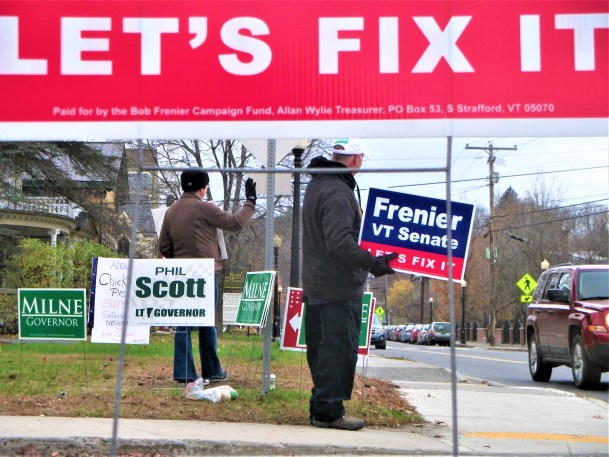
(Present-day GOP Gov. Phil Scott is expected to benefit from similar sentiments Tuesday.)
Concerns about ballot counting are just as consistent. Although Vermont doesn’t vote with punch-card machines like those that caused problems in the 2000 race between George W. Bush and popular-vote winner Al Gore, Green Mountain residents haven’t stopped worrying.
“I’m not trusting that democracy is working in its purest form because of who’s in charge nationally,” one said in 2004 while voting in person rather than absentee.
Others long have wanted out of the Electoral College.
“It seems Florida decides our fate,” one said the same year. “It should matter how even little Vermont votes.”
Ask people about problems and you’ll often hear individual idiosyncrasies, ranging from the mother who wants more services for her special needs son to the musician concerned about pig farmers’ use of “gestation crates” to confine pregnant sows.
“I’m sure it’s not an issue that’s rocking the state,” the latter conceded in 2014.
But many have agreed on a few themes. Take the plodding and polarizing political process.
“I wish the two sides could start communicating,” a Springfield carpenter said in 2010.
“We need a change in all of government,” a Randolph retiree added that year.
The cost of living is another constant complaint.
“We just can’t be a vacation state,” one voter said in 2004. “We have jobs, but they’re low-paying and people don’t have benefits.”
“We need to deal with the economy, jobs, health care,” another reiterated in 2008. “They all domino off each other.”
Although Vermonters have been vocal about who and what’s a problem, they’re less sure about specific solutions.
Said one in 2008: “They have to look at the budget — and get rid of everything that shouldn’t be there.”
Added a second in 2010: “I think taxes are out of control — but I don’t know any one thing they could cut back.”
And while voters often pin the blame on Washington, at least one, casting a ballot in 2012 in the state capital of Montpelier, concluded it’s not that simple.
“I’m annoyed with Congress and the way it has been behaving,” she said. “Then again, the co-op and city council are always at loggerheads. We need to listen to each other and look for common ground.”