

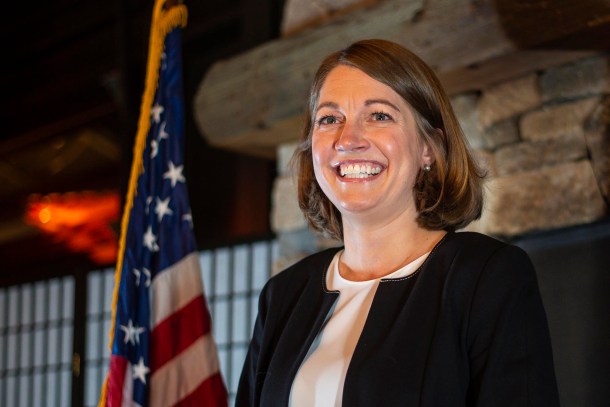
Democrat Molly Gray defeated Republican Scott Milne in the lieutenant governor’s race Tuesday, becoming the fourth woman in Vermont history to hold the second highest office in state government.
Gray, a 36-year-old who serves as an assistant attorney general, was successful in her first bid for elected office in defeating Milne, a successful businessman who found himself on the losing side of a statewide race for the third time in eight years.
Just before 11 p.m., Gray claimed victory although The Associated Press had not officially called the race. She had 52% of the vote to Milne’s 43% with 80% of precincts reporting results.
“Tonight we made history,” Gray said Tuesday night at the Great Northern restaurant in Burlington.
“For the fourth time in Vermont’s history we’re sending a woman to the lieutenant governor’s office,” she told supporters. “I’m humbled and honored to stand before you this evening.”
Previous female lieutenant governors include Consuelo Bailey, former Gov. Madeleine Kunin and Barbara Snelling.
Milne called Gray shortly after she announced she had won to concede the race, according to the Gray campaign.
He congratulated Gray in a statement sent to media shortly after 11:30 p.m.
“I am honored by the tens of thousands of Vermonters who supported my candidacy,” said Milne in the statement. “I send my sincere congratulations to Molly Gray on her victory this evening. I wish her success moving forward.”
Earlier in the day, Gray had made stops in Chittenden County before making her way through Central Vermont with stops in Montpelier and Barre.
Gray arrived in the capital during a snow flurry and with four members of her campaign team stood outside City Hall waving signs along with Washington County Democrats.
Later in the afternoon, Gray stopped outside the Barre Auditorium to thank people for voting.
After stops in Chittenden County Tuesday morning, including Williston, Milne visited Barre before heading down Interstate 89 to Randolph and then traveled west to Rutland.
“It’ll be interesting to see who gets more votes, David or Trump,” Milne said, referring to Lt. Gov. David Zuckerman and his challenge to Gov. Phil Scott.
One Montpelier voter, former Vermont Arts Council director Alex Aldrich, said he didn’t vote a straight Democratic ticket.
Aldrich decided to come in-person to vote out of an “overwhelming desire to put this country back where it belongs.”
“That of course means getting rid of our current president,” he explained.
In the lieutenant governor’s race, Aldrich said Milne had a stronger social media presence and simply based on that, the Republican candidate should “kick Molly Gray’s butt.” But Aldrich said Gray’s ground game had been far more impressive than Milne’s, and he expected Gray to win what he thought would be a close race.
“I think she is going to take it, but not by much,” he said. “All four for governor and lieutenant governor are fantastic candidates and that’s a good problem to have.”
“I wouldn’t vote for someone just because they are female,” said Kristin Allosso, a 50-year-old psychotherapist, at the Burlington Electric Department, a polling location in Burlington’s South End. “I was excited to have her as a candidate.”
Ten months ago, Gray entered the race for lieutenant governor as an unknown. But she quickly built up a strong fundraising apparatus — bringing in $427,000 throughout the election cycle — and a campaign ground game across the state, buoyed by support from a number of high-profile Vermont Democrats.
Gray faced tough competition in the Democratic primary, squaring off against Senate President Pro Tem Tim Ashe, former gubernatorial candidate and activist Brenda Siegel and Sen. Debbie Ingram, D-Chittenden.

Gray received early endorsements from Kunin and former Gov. Peter Shumlin, former Lt. Gov. Doug Racine, and Matt Dunne who ran for governor in 2016 — and many others.
With that impressive backing and her experience as an assistant attorney general and in Congress as an aide for Rep. Peter Welch, D-Vt., she made a pitch to Vermonters that she was qualified to hold statewide office.
After winning the Democratic nomination, Gray received the formal support of Sen. Patrick Leahy, D-Vt., and Welch.
Sen. Bernie Sanders, I-Vt., issued no endorsement for Gray, while announcing his support for other Democratic statewide candidates and Lt. Gov. David Zuckerman in his bid to unseat Gov. Phil Scott. In addition, Sanders endorsed four state Senate and 27 House candidates.
Ahead of Tuesday’s election, Milne said Gray’s Democratic Party affiliations as well as early endorsements from members of Vermont’s Democratic establishment gave her a strong advantage in the race.
“St. Patrick and the pairs of Peters and Queen Madeleine and everybody else came out and anointed her over everybody else in the party in the spring,” Milne recently told VTDigger, referring to Leahy, Shumlin, Welch and Kunin.
Milne, for his part, received endorsements from several Democrats, including Ingram, who ran against Gray in the August primary.

Throughout 2020, Gray has been dogged by reports that she failed to vote in four election cycles between 2008 and 2018, which drew criticism from Vermonters across the political spectrum, as well as questions about her residency status during the last four years.
During the primary and again in the general election campaigns, Gray was forced to respond to inquiries about where she had recently lived and the constitutional requirement that candidates for governor and lieutenant governor “reside” in Vermont for four years before holding the office.
Gray’s eligibility came into question after reporting by VTDigger that for 15 months between 2017 and early 2018, she had lived in Switzerland while working for a human rights nonprofit.
Gray has maintained she legally retained Vermont residency and that she would not be running for lieutenant governor if she were not eligible to do so.
The Milne camp repeatedly criticized Gray for not voting consistently in elections, including the 2016 general election, and attempted to characterize her as dishonest. The Republican pointed to an inaccurate claim Gray made during a VTDigger debate in which she said she had voted for Hillary Clinton in 2016.

Earlier this month, Milne’s campaign also challenged Gray to prove she had filed taxes in Vermont between 2016 and 2019, part of a broader line of attack questioning Gray’s residency in Vermont during the 15 months she spent living in Switzerland.
Gray provided documents to VTDigger last month showing that she filed taxes on time during those four years — including 2017. However, while Gray filed in 2017, she did not pay Vermont taxes that year.
“In 2017, Molly filed Vermont income tax returns, but did not owe Vermont taxes,” Gray’s campaign manager, Samantha Sheehan, wrote in an email to VTDigger. “As stated repeatedly, Molly returned home permanently to Vermont in 2011 and filed Vermont income taxes every year since.”
Peter Teachout, a constitutional law professor at the Vermont Law School, is among a half dozen prominent attorneys who have said Gray is eligible, and would prevail in court if challenged.
In the runup to Tuesday’s election, Milne hadn’t said whether he would contest Gray’s eligibility.
In 2014, Milne came within 2,434 votes of unseating two-term incumbent Democratic Gov. Peter Shumlin, who stepped down two years later. Because neither candidate received more than 50% of the vote, the election went to the Vermont Legislature, which awarded the win to Shumlin.
On WDEV last week, Milne was asked if he would concede if it was clear he was behind in votes. The Republican said a challenge to the election result was not something he and his team were contemplating.

