

Editor’s note: Mark Bushnell is a Vermont journalist and historian. He is the author of “Hidden History of Vermont” and “It Happened in Vermont.”
As a Vermonter, it’s easy to feel a bit neglected when you hear political commentators talking endlessly about how important some other states are in a presidential election. Vermont never enters the discussion.
The state gets ignored because of a couple of numbers — three and 100. The first is the number of electoral votes, out of a nationwide total of 538, that Vermont gets to cast, and the second is the percent chance that we already know which party’s candidate will win those votes.
Being sidelined isn’t a new phenomenon. Vermont has seldom been at center stage during the 57 presidential elections since it attained statehood. Sure, you could point to the two Vermont-born presidents as examples of the state’s importance. But both men left the state at a young age and rose in politics elsewhere. It’s also worth noting that the more recent of the two men left the White House nearly a century ago.
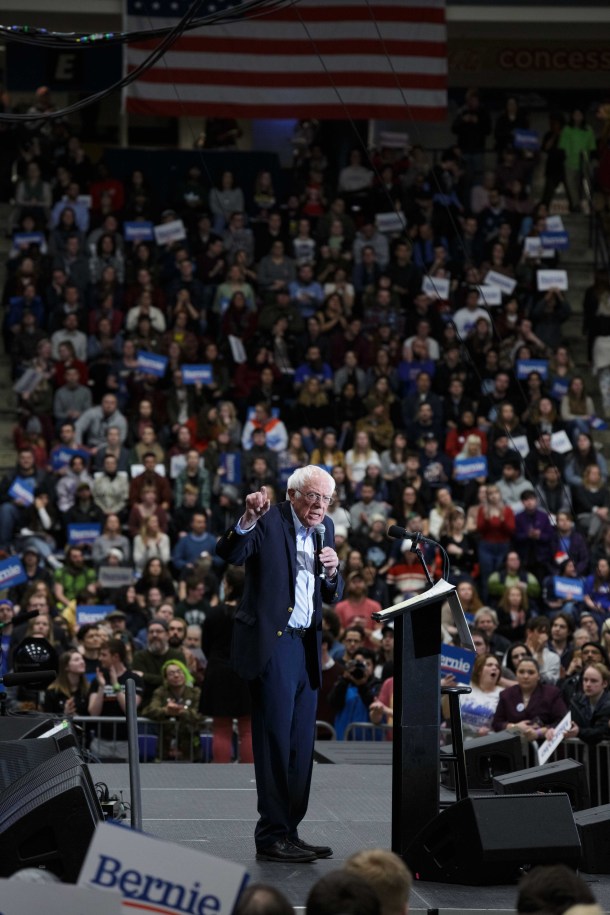
Where Vermont has played a more important role is during presidential primaries, especially recently. No matter your political leanings, you have to admit that the runs by Bernie Sanders and Howard Dean were at least interesting. Suddenly Vermont was getting the kind of attention that our neighbor New Hampshire basks in every four years. New Hampshire only has four electoral votes, but it gets talked about because its primary is the first in the nation and it doesn’t consistently cast its electoral votes for the same party.
No Vermont politician has come closer to being nominated by a major party than Sanders, who twice came in second as the Democratic nominee. But others have tried.

Vermont Gov. George Aiken made noises about challenging Franklin Roosevelt in 1940, before eventually thinking better of taking on the powerful president, who won reelection handily. Aiken’s instincts were probably right. Aiken certainly would have won Vermont, but what other states? Winning Vermont doesn’t get a candidate very far. Republican presidential nominee Alf Landon of Kansas proved that in 1936. He won Vermont, and Maine, and that’s it. He took only 1.5% of the electoral votes — the worst showing ever for a major party candidate. But he did spawn the saying, “As goes Maine, so goes Vermont!”
Another famous Vermonter named George explored a run in 1900. Unlike Aiken, this would-be presidential nominee didn’t exit the national stage with his good name intact. Admiral George Dewey became a national hero by winning the Pacific theater of the Spanish-American War in a single morning’s work when his squadron shattered the Spanish fleet at the Battle of Manila Bay. People in both major parties looked at this newly minted hero and saw a winner. It wasn’t clear which party Dewey favored, however, since he admitted he had never bothered to vote in a presidential election.
The more Dewey discussed running for president, the more he made it clear that he was ill-suited for the job. Dewey might have been among the last to realize it. He declared: “Since studying this subject, I am convinced that the office of the president is not such a very difficult one to fill.” Serving as president would be simple, he said, since his job would be merely to “execute the laws of Congress as faithfully as I have always executed the orders of my superiors.” Dewey apparently missed the part in civics class about Congress and the executive being coequal branches of government.
If those comments weren’t enough to disqualify him, Dewey blundered again. In the midst of the campaign to nominate him, he remarried and gave his new wife the house that he’d just been given by admirers. Dewey’s candidacy was made all the more challenging by the anti-Catholic bigotry rampant at the time, because his new wife was Catholic. The admiral eventually decided to remove his name from consideration.
Brandon-born Stephen Douglas made it a lot closer to the White House than Dewey. In 1860, Douglas ran for office in an era of deeply divided politics. Douglas represented the northern wing of the Democratic Party, while John Breckinridge represented the southern wing. Between them, the men won nearly 48% of the popular vote, and a candidate from the Constitutional Union party, John Bell, took another 12%. Splitting the vote, they allowed the candidate of the upstart Republican Party, a guy named Abraham Lincoln, to win election. Despite a decent showing, Douglas failed to win his native state. He campaigned here, but made the mistake of saying that Vermont was a great place for an ambitious person to be from, provided one moved away. That was the end of Douglas’ presidential ambitions; he died the next year.

Vermont of course boasts two native-born presidents — Chester Arthur and Calvin Coolidge. But between them, they served less than three full terms in office and won only one presidential election. Both men had the foresight to follow Douglas’ advice and leave Vermont to pursue their political careers. And both also happened to serve as vice presidents under presidents who proved quite mortal.
Arthur was born in Fairfield — or just over the border in Canada, if you believe his political detractors, who said this disqualified him from serving as president. He rose through the ranks of the Republican Party machine in New York, eventually rising to the lucrative position of customs collector for the port of New York, and chairman of the state Republican Party. Arthur was eventually elected vice president under James Garfield, and became president when Garfield was assassinated in 1881.
Many Americans were shocked to find that someone who had so recently been a political functionary had suddenly become president. “Chet Arthur, President of the United States! Good God!” cringed one, and he was a fellow Republican. Writer Mark Twain offered his tepid support: “I am but one of 55 million; still, in the opinion of this 1/55 millionth of the country’s population, it would be hard to better President Arthur’s administration. But don’t decide till you hear from the rest.” Arthur served only one term. In ill health when his term expired, he died likewise only months later.
Vermont’s other president, Calvin Coolidge, maintained lifelong ties to the state, particularly his hometown of Plymouth, despite moving to Massachusetts, where he finished his education and climbed that state’s political ladder.
Coolidge became president in 1923 when Warren Harding died, apparently of a stroke. After serving out Harding’s term, Coolidge did something no other Vermonter has done — he won a presidential election. He did so handily, winning 54% of the popular vote against a pair of candidates who split most of the remaining votes.
It would be tempting to call that election night in 1924 the peak of Vermont’s political power, but, really, Coolidge had moved away as a teenager, so he owed his success more to his decades in Massachusetts.

Actually, the peak of Vermont’s influence in presidential elections comes every four years. That’s because of a quirk in the U.S. Constitution that gives Vermont voters an advantage: Our votes have nearly three times the weight of the average American.
Thanks to the much-maligned Electoral College system, Vermont gets more than its fair share of the all-American electoral pie. Look at the math: 328 million Americans share the 538 total electoral votes. So every electoral vote represents, on average, about 609,000 Americans.
This is where being small plays in Vermont’s favor. The roughly 624,000 people who live in Vermont share those three electoral votes. That works out to one electoral vote for every 208,000 Vermonters. That’s 2.928 times the weight of the average vote in America, but who’s counting? Only Wyomingites have more political influence on the Electoral College.
We may not be a swing state, with presidential campaigns blanketing the airwaves, pleading and pandering for every last vote; we might only wield the power of three electoral votes, but we each have a disproportionate say in how those votes are cast. Seems we got the better end of that deal.
