

This article by Nora Doyle-Burr was first published Oct. 28 in the Valley News.
THETFORD — Two Upper Valley lawmakers have asked state officials in charge of creating Vermont’s Covid-19 travel map to “cut us some slack please” to ease quarantine requirements now in place for nonessential travel between the Green Mountain State and any county in New Hampshire.
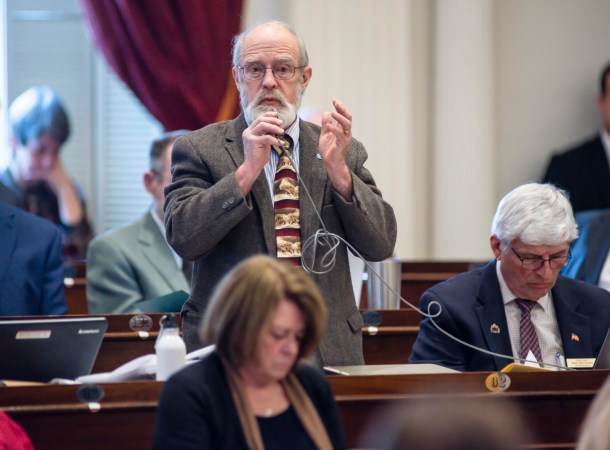
State Rep. Jim Masland, D-Thetford, made his plea Tuesday in an email to Michael Pieciak, commissioner of the Vermont Department of Financial Regulation, noting the interrelated nature of the Dresden School District, the bistate district including Hanover, New Hampshire, and Norwich, Vermont, that was founded in the 1960s.
People are allowed to make essential cross-border trips for classes and work, but they are not allowed to make the trip for leisure such as recreational activities, according to Vermont’s current travel guidelines aimed at limiting the spread of Covid-19.
Masland said Wednesday in phone interview that both he and fellow state Rep. Tim Briglin, D-Thetford, have heard from constituents concerned about their children’s ability to participate in the Ford Sayre ski program at Dartmouth Skiway in Lyme this winter. Others have expressed concerns about Lightning Soccer, which also involves young people from both states, Masland said.
“When it comes to outdoor sports (not hockey or basketball), it makes no sense that the Ford Sayre ski program based in Hanover and also soccer is off-limits to Norwich kids — even though they would be skiing with the same kids with whom they may well have been in class with during the day,” wrote Masland, a 1966 graduate of Hanover High School whose district also includes Norwich, Strafford and Sharon. “Ford Sayre should be open to kids from both states.”
The goal of the restrictions is to mitigate risk, Pieciak said in his response to Masland’s email, which was shared with the Valley News. To strike a balance between risks and benefits, the state has restricted dining and socializing with friends in higher-risk areas, but it allows people to continue to work and go grocery shopping.
But Pieciak acknowledged that “the policy can clearly result in some unintended consequences and circumstances where the risk is not necessarily elevated (i.e. outdoor recreation). This is particularly true for integrated communities like the Upper Valley.”
State officials are “working on some relief in this regard,” Pieciak said.
He did not pin down a timeline for that relief, however, due to the recent increase in cases in Vermont and the region, which he said “has caused everyone to put the brakes on policy changes for a moment. We hope this can be addressed soon.”
Grafton County, where Lyme and Hanover sit, first turned yellow on Vermont’s travel map on Oct. 13, indicating a moderately high case count.
N.H. state epidemiologist disagrees
At the time, some in the Upper Valley’s hospitality industry expressed concerns about losing customers from the neighboring state. And Dr. Benjamin Chan, New Hampshire’s state epidemiologist, who lives in Lebanon, said at a Lebanon School Board meeting that New Hampshire officials are “not advocating” and “not promoting” the Vermont travel map.
On a New Hampshire map showing levels of transmission around the state, Grafton and Sullivan counties both appear green, indicating there is minimal community transmission.
As of this week, all of New Hampshire is either red or yellow on the Vermont map, indicating that a quarantine is required for nonessential travel between Vermont and any part of New Hampshire. Sullivan County — which until this week had remained green, meaning no quarantine was required for nonessential travel — is now yellow.
[Related: 15 counties downgraded on Vermont Covid-19 travel map]
The Vermont Department of Financial Regulation creates the map and identifies counties outside of Vermont with fewer than 400 cases per million as green.
The department calculates this number using a weighted average and a multiplier rather than a raw number of cases in order to account for undetected ones. In an earlier email, Pieciak said Vermont, in creating the travel map, applies a 2.4 multiplier to help “account for both detected and undetected cases, as both can transmit the virus.”
As a result, among New Hampshire counties, Grafton County now appears on the Vermont map to have 500 cases per million; Sullivan County has 458 per million. In Vermont, Windsor County has 440 per million; Orange County has 322 per million. There are no travel restrictions between counties in Vermont.
In raw numbers, Grafton County had 30 active cases as of Tuesday; Sullivan County had 10. Windsor County has had 14 new cases in the past two weeks; Orange County has had six. New Hampshire has had a total of 10,530 cases since the pandemic began. Vermont has had a total of 2,120.
As legislators, Masland and Briglin don’t have the ability to grant the exceptions that the parents have requested. Instead, Masland said they are “basically pleading the case” with the state officials in charge of creating the travel map.
Masland said he hoped Vermont could allow outdoor recreation between the states, while encouraging “sensible restrictions” such as not gathering in the ski lodge to eat after practice, separating skiers on ski lifts and arranging for socially distanced transportation.
For his part, Briglin said in an email that he is focused on keeping Vermonters safe and reducing the spread of the coronavirus.
“Concerns that have been brought to my attention locally are that current state policy will direct local skiers to head to Killington or Burke or Craftsbury instead of staying local to ski at the Skiway or Oak Hill,” he wrote. “It would seem people would be safer staying local.”
