


Since March, the 970 students at Burlington High School have had only one day of in-person education: Their first day, in September, before the discovery of airborne PCBs — carcinogenic chemicals — shuttered the building for the fall.
Sara Farnsworth’s son, a freshman at BHS, was “super excited” on that first day. Now, facing indefinite remote learning, “he is struggling,” his mother said, and as a single parent of two, working outside of the home has become impossible. The district promises a return to in-person learning by the spring, but Farnsworth is worried. “We’re just losing time,” Farnsworth said. “I think that even waiting until January [to return] is too long.”
Farnsworth is part of a group of parents pushing for the reopening of Burlington High School, despite elevated levels of PCBs found throughout the building. The “Open BHS” coalition, according to its website, has 131 members “and counting.” At school board meetings, some Open BHS parents have claimed that the levels of PCBs recorded at the high school are safe for students and staff, blaming the Vermont Department of Health for holding the school to “stringent” health standards.
PCBs, used commonly in building materials before the EPA banned them in 1979, were found in the air of nearly every room sampled at the high school in September.
Some in the coalition say they believe the risks of staying home outweigh the health risks posed by the PCBs. “We need to weigh all the different risks to people’s health,” said Caroline Beer, one of the core members of Open BHS. “We have been watching our children slip into increasing depression and increasing anxiety.”
And the risks of PCBs, in Open BHS’s view, are small. “The main buildings at BHS we think are safe,” Beer said. “We think they’re safe right now.” The group’s website claims that there is “no material danger” in the buildings, according to “science.”
Scientists disagree.
VTDigger interviewed three leading experts on PCBs in schools, and provided them with the results of PCB testing done at BHS, including consultants’ reports that VTDigger obtained last month via a public records request.
All said that the PCBs discovered throughout the campus had reached levels of serious concern.
“It’s certainly not safe to go into the school,” said David Carpenter, the director of the Institute for Health and the Environment at the University at Albany-SUNY, whose research focuses on PCBs. “I applaud the Vermont Department of Health for taking a stand on this.”
“To me, those are high numbers,” said Keri Hornbuckle, a professor of environmental engineering at the University of Iowa, who has studied PCB contamination for more than two decades.
Hornbuckle said the PCBs throughout the high school — not just the technical center, which had the highest level of contamination, but in the other five buildings as well — had reached levels even higher than those she had measured in homes beside a PCB waste site in Massachusetts.
“It’s like those kids are living next to a PCB superfund site and breathing that air every day they’re in school,” she said.
Robert Herrick, an environmental scientist and retired professor of public health at Harvard, who has researched PCBs in schools extensively, also agreed. The PCB levels across campus were “clearly elevated,” he said, and particularly, the levels discovered in the soil were “really disturbing, and hard to explain.”

More difficult, Hornbuckle said, is determining just how dangerous those levels are. Conducting definitive, long-term studies on the impact of airborne PCBs on people is complicated, particularly in schools, so much of our knowledge of the precise health risks they pose comes from studies on animals.
Regulators have little to go off of, Hornbuckle explained, when crafting limits on PCB levels. “Nobody knows what level is protective of children,” she said. “The EPA values — they’re just guessing. And your state toxicologist is just guessing, also.”
One thing is clear, though: PCBs are cancer-causing, and they can also inflict neurological and developmental damage, particularly in children. “There is a tremendous amount of data showing that PCBs are very hazardous to children,” Hornbuckle said.
The research, Herrick said, “really suggests that exposure to PCBs should be as low as possible.”
That’s not just a concern for Burlington. PCBs are common in buildings constructed between 1950 and 1980, and are especially prevalent in schools.
Yet PCB testing is not required federally, or in the state of Vermont. The Department of Health has conducted just one survey of PCBs in Vermont’s old school buildings, in 2014, which tested only four schools. Though PCBs could be polluting the air of schools across the state, regulators usually get involved only when schools do testing by their own volition, as in Burlington’s case.
That frustrates Burlington parents. “On the one hand, it’s so dangerous in Burlington High School that kids can’t have an education, but on the other hand, we’re not going to test any other school in the entire state,” Beer said, calling that position “untenable.”
The EPA and Department of Health standards around PCBs have been a focal point for Burlington parents pushing back against the district. The “Open BHS” argument concentrates on the discrepancy between the Vermont state screening level for PCBs — 15 nanograms per cubic meter — and the EPA’s, which, for young high-schoolers, is 500.
While PCB levels in the school’s technical center reached concentrations as high as 6,300 (a level that is “criminal,” Carpenter said) the other five wings of the high school had levels that ranged from 1.1 to 300, which fall under the EPA screening level for teenagers and adults. Open BHS claims the state has “pressured” the district to close, based on its far lower screening levels.
The EPA screening level assumes, though, that the soil contamination at the school is “the same as in average homes or other buildings without elevated PCBs.” At BHS, elevated PCB levels in the soil were discovered throughout the property.
According to Sarah Vose, a toxicologist with the Vermont Department of Health, these screening levels are not meant to be hard lines. They are rather a “first pass,” she said, and noted that in other cases, the Department of Health has not recommended schools be closed even when there were some PCB levels discovered above the 15 standard. “Burlington is different,” she said.
“These [screening levels] are never meant to be bright lines between safe and unsafe conditions,” Herrick said. “Interpreting them that way is really a risky practice.” Hornbuckle said that she found Vermont’s standard to be “reasonable for identifying you have a source [of PCBs] inside that school.”
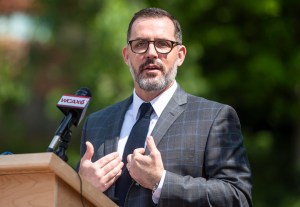
Carpenter took a harder line against the EPA, calling its recommendations “totally inadequate.” Rooms throughout the school, he said, were “not safe for anybody to be in,” including many of those with levels beneath the 500 guideline.
Tom Flanagan, Burlington school district superintendent, told VTDigger that, in any event, both the EPA and the Vermont Department of Health recommended the school be closed. “They both told us we should not return to the building without further testing,” he said. Had the EPA not been supportive of the closure, he said, the decision may have been different.
(EPA regulators that worked with the high school on the closure did not respond to multiple requests for comment.)
Weighing the costs
Hornbuckle was sympathetic to parents who wish to send their children back to BHS regardless. “It’s really difficult for people to say whether the harm of not sending the children back to school is greater than the harm of the exposure,” she said. “But [the contamination] does need to be fixed.”
Parents say that the harm has been great. Two BHS parents told VTDigger that they were considering pulling their children out of school as a result of remote learning. Others described mental health issues that have arisen from months of isolation.
“There are so many parents and so many students who are struggling,” said Caroline Crawford, a mother of a BHS senior and supporter of Open BHS. “And we are headed into some cold, dark months.”
As winter approaches, bringing shorter days and limiting outdoor activities, parents worry for their students. “Kids have really suffered in terms of their mental health,” Beer said.
Academics, too, are a concern. Farnsworth says their son struggles to focus in online classes; his academic record has suffered as a result. Mary Riley, the parent of a junior at BHS, says her son, initially thrilled for a return to school, has lost motivation.
“Things are going downhill,” she said. “Online learning is not working for my son. It did not work in the spring. And it’s still not working.”
At a school board meeting on Tuesday, more than a dozen parents called in to air similar concerns. The majority, as well as some Burlington school board members, agreed with Open BHS’s stance: The high school should open its doors.
But BHS teachers and staff feel differently.
“Going back in those buildings does not have my support,” said Dwight Brown, a tech specialist at BHS and the chair of AFSCME Local 1343, which represents many of the school’s staff.
“It’s dangerous in that building,” Brown said. “I understand that parents don’t think [remote learning] is best for their students, and I agree with that. It’s not best for anyone. But it’s dangerous for the staff.”
The other union that represents BHS staff, Burlington Educators’ Association, is also opposed to a return to the buildings, both Brown and Flanagan said, though the union did not return VTDigger’s request for comment.
Brown said teachers and staff are still reckoning with the discovery of PCBs, and the consequences it might have for their health. For decades, teachers and staff at BHS have raised concerns about the condition of the building. Brown described the discovery of PCBs as the culmination of this.
“The years of negligence have just caught up with us in that building,” he said. “And that’s unfortunate.”

Facing pressure from all sides, the Burlington School District is looking toward next steps.
On Tuesday, superintendent Flanagan presented three options to the school board, moving forward. The first option is a return to the building, before PCB remediation is complete.
The other two pathways involve finding an alternative space for BHS, which Flanagan says is already underway. The district is considering several temporary locations for the high school, and is in advanced talks with the owners of at least one building that could house all 970 students.
If BHS does find a new home, it would remain there for two to three years, according to Flanagan’s roadmap, while the district decides how to proceed with its renovation project — essentially deciding between renovating the current building, or building a new one entirely.
The concerns of parents, Flanagan said, are “really weighing on me.”
It’s an “impetus,” he said, “to move as quickly as we can to get back to in-person in whatever way we can.”
But Flanagan said he won’t consider a return to the high school without the state’s stamp of approval. A return to BHS now, he said, would take “a better understanding of the levels, and a recommendation from the EPA and the Vermont Department of Health that they think it’s safe to return.”
That prospect seems distant. In a letter sent to BHS families on Tuesday, Vermont Health Commissioner Mark Levine and Vose were adamant about the dangers of PCBs, and their standards for evaluating them. “Vermont protects the most vulnerable and those most exposed,” they wrote.
Still, the state says it will review additional PCB testing this fall, and reconsider its initial recommendation. “We recognize the importance of students being back in a classroom,” the letter says, “and are committed to prioritizing the review of additional air sampling data.”
That testing begins next week, Flanagan said, and results are expected in mid-November. The Department of Health has warned, though, that the PCB levels could come back higher in the colder months, as a result of reduced ventilation, a concern that the experts VTDigger consulted agree with. If they do, the district will be shut out of the high school until PCB remediation is complete.
For Hornbuckle, Burlington’s handling of the PCBs could set precedent. When PCBs have been found in other parts of the country, schools have handled the discovery in a multitude of ways — from demolishing the building, to keeping it open against the wishes of parents and staff.
“This is a very common and increasingly recognized problem,” she said. “And schools across the country will be looking at Burlington to see how they manage it.”
