


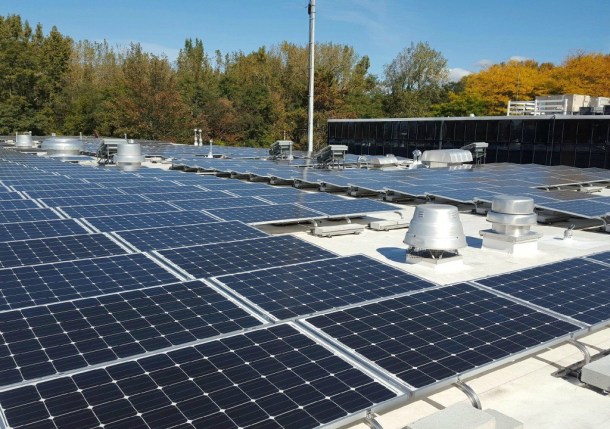
BURLINGTON — Burlington is considering a policy that would set an ambitious energy requirement for new buildings in the city: Either go all-electric, or pay a hefty carbon price.
If the ordinance goes through, it would make Burlington among the first cold-climate cities in the country to enact such strong incentives for its future buildings to disconnect from fossil fuels, moving the city closer to its ambitious goal of becoming carbon-neutral by 2030.
Burlington Electric, the city’s electric utility, presented the policy proposal to the City Council on Oct. 5, and it’s now being reviewed by the city attorney.
“We are in a position to be a leader on this,” Darren Springer, general manager of Burlington Electric, told VTDigger. In the absence of strong state policy on green buildings, he said, the proposal is “another opportunity for Burlington to show the way forward.”
In 2014, Burlington became the first city in the country to run its electric grid off all renewables. But the Queen City still produces plenty of greenhouse gases: Most buildings have heating and cooling systems that use fossil fuels, and most cars on the streets are not electric.
Last September, Mayor Miro Weinberger announced a road map to “net zero energy” for the city by 2030 — which would limit, and eventually eliminate, fossil fuel use in buildings and transportation. To do that, Weinberger said at the time, Burlington would have to “completely restructure” its energy use.
In 2019, 95% of the heat in Burlington buildings came from natural gas, according to the city’s report: “The building sector dominates Burlington’s energy consumption with 74 percent of total use. This energy is mostly used for heating buildings; 95 percent of heating is supplied by natural gas.” This likely will prove a “formidable challenge,” the report continues, as natural gas is cheaper than petroleum.
The other 26% of the city’s energy goes towards vehicles, and is “almost exclusively petroleum,” according to the report.
Making heating and cooling systems green, the road map says, is crucial; if all the city’s buildings went electric by 2030, that change alone would move the city 60% of the way toward its net-zero goals.

This new ordinance is a step toward that. In May, a resolution brought by Councilors Jack Hanson, Brian Pine and Jane Stromberg directed the city to create a policy on building electrification, recommending a ban on fossil fuel use for future developments.
The proposal that Burlington Electric brought to the table last week is not quite an outright ban. Rather, all new developments would have to be built “electric-ready” — pre-wired for all-electric energy sourcing, even if they are still using fossil fuels.
And if a building developer does choose to use fossil fuels, a fee would be imposed: $100 per ton of carbon emitted over 10 years. For a typical hotel, the city estimates, that would be a fine of about $200,000; for an office space, $20,000.
The proposed policy would have no impact on Burlington’s existing buildings.
Hanson expects the council to consider the ordinance in the next few months, once the city ordinance committee has ironed out the details.
Hanson said he thinks the policy is “really strong” — but he still supports the more aggressive ban on fossil fuel use in new developments that he and other councilors initially pushed for.
“I just think it’s a bad investment, at this point, in 2020, to make long-term investments in fossil fuel infrastructure,” he said. “It doesn’t make sense.”
Among the first in the nation
Even these more lenient rules, though, would still put Burlington at the “leading edge” of this kind of climate policy, said Jenna Tatum, director of the Building Electrification Initiative, a group that is working with Burlington and nine other cities nationally on all-electric buildings.
In July 2019, Berkeley, California, became the first city in the country to ban natural gas use in new buildings. Now, more than a dozen cities in the region have bans or looser restrictions such as the one Burlington is considering.

The milder weather in California puts these cities at an advantage; Burlington’s harsh winters require more muscular heating technology. But the Vermont climate also makes the potential benefits of electric heating and cooling “outsized,” Tatum said, because fossil fuel systems use up more energy.
The climate challenges were one reason the city steered away from a total ban on fossil fuels. “We didn’t want to put ourselves in a position where we wanted to propose something, but the tech wasn’t there yet in every scenario,” Springer said.
In Vermont, Tatum said, there might be “one or two” days a year that would stretch the capacity of electric heating systems. But really, she said, “the technology is there. And it’s only going to get better.
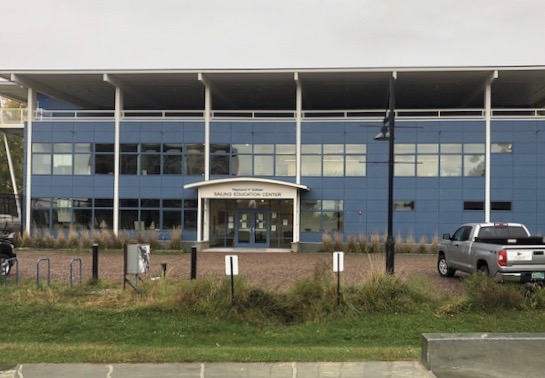
At the Lake Champlain Community Sailing Center on Burlington’s waterfront, sunlight streams into executive director Owen Milne’s office. The building’s main windows are south-facing, Milne told VTDigger — so during the winter, the sun can help heat up the facility.
The Sailing Center’s building, constructed in 2017, is fully electric. A solar array on the roof generates more energy than the building uses in a year. Electric heat pumps warm the facility through the winters. The windows are triple-pane glass, keeping it well-insulated.
The Sailing Center is proof that all-electric buildings, the keystone of the city’s net-zero plans, are already on their way to Burlington. Yet obstacles remain.
“Looking back on it,” Milne said, “a facility of this type and this size would be probably 25 to 30 percent less expensive on the upfront cost,” if it used fossil fuels instead of all-electric infrastructure.
The Sailing Center, backed by generous, sustainably-minded donors, was able to make the investment. But in the absence of philanthropy, many building developers can’t — or don’t want to.
Rental or multi-family units make up about two-thirds of housing in Burlington, which is a challenge for building electrification, the city’s net-zero roadmap notes. Landlords and commercial property owners tend to be more unwilling to switch over from fossil fuels, because tenants are often the ones who pay the energy bills, and thus reap the savings.
That’s one reason that building electrification, like other climate policy, can be distributed inequitably, leaving low-income communities and communities of color to face heightened health and financial impacts of continued fossil fuel use.
Power grid not sufficient
Burlington’s new policy would apply to all new building developments. But that’s “just one small piece of the puzzle,” Hanson said. To get to net-zero, the city will have to move its existing buildings off fossil fuels.
That will be a major challenge. Already, Burlington Electric offers substantial incentives for homeowners to invest in heat pumps, an electric replacement for gas furnaces and other fossil fuel-based heating. The mayor’s green stimulus package, in April, expanded the city’s weatherization programs for low-income housing.

But incentives alone, Hanson said, would not ensure that every building in the city left fossil fuels behind. “I think we need to get more aggressive,” he said — to use both incentives and requirements for electrification.
And even if Burlington did manage to convert its buildings, it would have to power them all.
“One of the unique challenges that I think Burlington will face is building enough infrastructure to support electrification,” said Paul Hines, a professor of electrical engineering at the University of Vermont whose work focuses on transitions to clean energy systems.
Right now, Hines explained, Burlington’s all-renewable electric grid could not yet support a wholly electric city. And building out the grid “is not going to be trivial,” he said.
Some solutions might include “smart” technologies, which can help make the distribution of the electric load more efficient, by tailoring the amount of electricity each building receives. The city’s net-zero roadmap recommended further upgrades to Burlington Electric’s distribution system.
Still, it’s a problem for the future, Hines said. “I don’t expect this particular initiative is going to cause immediate constraints,” he said, referring to the latest electric building ordinance.
For now, he said, “it’s an excellent step in the right direction.”
