

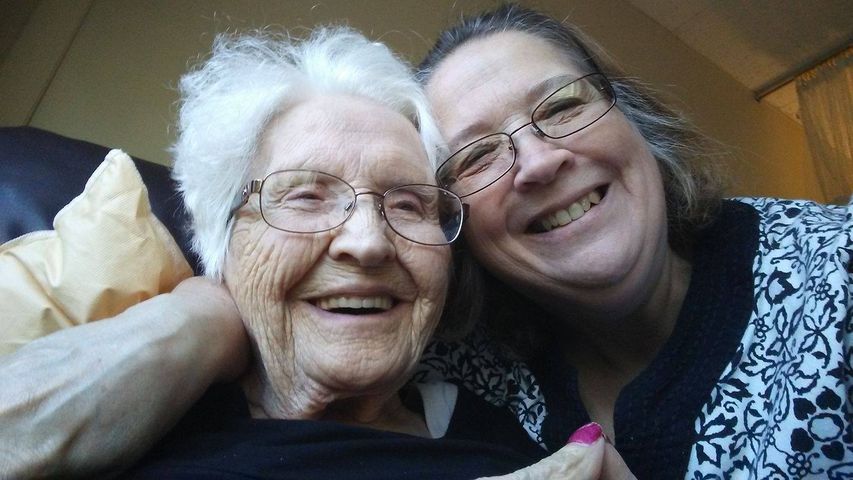
Rebecca Whittemore-Arsenault hasn’t shared space with her mother for nearly seven months.
Geraldine Whittemore lives at the Mountain View Center, a long-term-care facility in Rutland. She has Alzheimer’s disease, and for the past seven years she’s relied on her daughter to help her stay sharp.
During visits, Rebecca would change out the photos in her mother’s room and decorate for holidays. When Geraldine’s cataracts got worse, Rebecca bought her a larger TV and made sure the staff kept it tuned to her favorite game shows. Rebecca would help her mother to bed and hold her as she fell asleep.
“Before the virus hit, I was spending all the time I could with her,” Rebecca said.
That changed in early March, when Mountain View, like every nursing home in the state, closed to visitors. The months since have been an emotional roller coaster, Rebecca said.
Just before Father’s Day, state officials announced that some outdoor visitation at nursing homes would be allowed. Residents and visitors would have to remain 6 feet apart and wear masks.
According to Rebecca, those visits didn’t work for Geraldine. The facility kept a Plexiglass barrier in place, and her mother’s vision and hearing loss made conversation while social distancing impossible: “I would have to be screaming at her in order for her to hear me.”
Window visits were heart-wrenching, she said, because her mother didn’t fully understand the circumstances. “She’ll motion her hands, you know: ‘Come inside. I want you to come inside.’ And I will explain to her about the virus and everything. … I say, ‘We have to follow rules.’”
By August, the restrictions had worn on Rebecca. She wrote to the governor’s office and to her state representative to ask for help. But nothing changed.
“My mother is 96 years old. And I don’t know if we have another seven or eight months or even a year to wait until I can go in and hold her again,” Rebecca said.
One day last month, Mountain View sent a letter to family members, stating that, as of Oct. 1, some indoor visits, using masks and a partition, would be allowed. “We were both ecstatic,” Rebecca said. “It was a glimmer of hope.”
Just hours later, the facility called with bad news: Two staff members there had tested positive for Covid-19. Later, a patient in Geraldine’s ward also tested positive. Visits were off the table.
Rebecca remains frustrated. “I appreciate the precautions that the nursing homes are taking,” she said. “But somewhere in their policies or in their guidelines, they’ve got to take into effect that these are elderly people we’re talking about that need their families. And their families need them.”
‘They’re like prisoners with no visitation rights’
Officials have signaled that, as winter approaches, state guidelines will be changing to allow for indoor visitation. Reopening guidelines issued in September by the federal Centers for Medicare & Medicaid Services (CMS) recommend that visits can occur, with certain precautions, in areas where Covid-19 prevalence is low.
The state is now revising recommendations for nursing homes, to put “guardrails” on the CMS policies, said Monica Hutt, commissioner of the Vermont Department of Disabilities, Aging and Independent Living.
“Vermont is trying to really weigh the risks and the benefits of this,” Hutt said, “recognizing that there’s a benefit to more visitation, but also that it will increase the risk for each facility and increase the risk for residents.”
Indoor visitation guidelines will still include masking and distancing requirements, Hutt said. The guidelines will be more or less restrictive, depending on the infection rate of the county where a facility is located — although all counties in Vermont currently fall under the 5% infection rate threshold recommended by CMS as the most permissive. The Vermont Department of Health will also consider requests for special accommodations from facilities with unique patient needs, but those consultations will be limited.
Hutt said nursing homes have done “extraordinary work” in the face of shifting guidance from both federal and state authorities, but the state is still working toward rules that center “the best plan of care for the resident.”
“I realize how incredibly frustrating this is,” she said.
Lori Mayer, a spokesperson for Genesis HealthCare, which operates Mountain View, said the facility is dealing with an “unprecedented situation” during the pandemic.
“We agree that visitation is important for each patient and resident’s overall well-being and have developed a plan to begin indoor visitation, according to the conditions inside the facility and the prevalence of COVID in the surrounding community,” Mayer said in an emailed statement. Outdoor visits will resume next week, she said, if the latest tests spurred by the recent positive cases come back negative.
“We understand that families are anxious to see their loved ones,” Mayer said, “but clearly we must follow state and federal guidelines and proceed in a way that is as safe as possible for patients, residents, staff and visitors.”
While the state’s guidelines carve out exceptions for patients in end-of-life care, most elderly residents with dementia remain subject to the standard restrictions. For family members of these patients, it remains unclear when they can once again be fully involved in their loved one’s care.
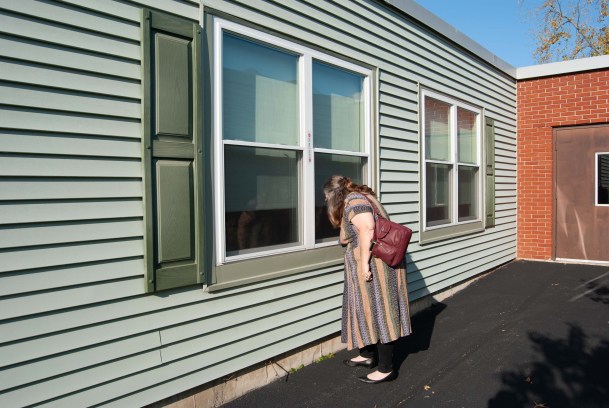
Rebecca Whittemore-Arsenault worries that, for those in her mother’s condition, irreparable damage has already been done. On top of her memory loss, Geraldine lives with depression, which Rebecca says typically worsens over the winter. When Rebecca calls now, her mother tells her, “I am so sick of looking at this room.”
“They’re like prisoners with no visitation rights,” Rebecca said. “I kind of think it’s mental abuse.”
Her best form of care, Rebecca said, is storytelling. When the two are together, they talk about Geraldine’s childhood. She grew up on a farm in Bridgewater and worked in department stores and factories around Rutland before becoming a nurses’ aide later in life.
Geraldine’s memories can be vivid, Rebecca said. “She remembers back in the old days better than she remembers three or four days ago.”
This type of social interaction can be key to caring for a patient with memory loss, said Lori McKenna, a social worker with the Memory Program at the University of Vermont Medical Center. “It helps the brain stay healthy.”
Geraldine loves fall foliage, and every year Rebecca would drive her to the Sherburne Riverside Cemetery to look at the leaves and visit the graves of Geraldine’s late husband and parents. That won’t happen this year.
Phone contact helps, Rebecca said, but the logistics can be difficult. Rebecca has to call the facility and find an aide who will bring a cordless phone into her mother’s room. Because the staff has largely turned over since she last visited, Rebecca no longer has a rapport with the people on the other end of the line. Even when she reaches someone who can help, she has to catch Geraldine at just the right time, when she’s not eating or resting.
Rebecca was the only family member who would visit Geraldine. Without that contact, she said, “I’m just worried that she’s going to get depressed and she’s going to give up.”
“One of the things that is very, very common with dementia is grief,” said Lori McKenna. “And I think that being separated from a loved one in a care facility has intensified grief and anxiety and depression.”
This affects both patients and their families, McKenna said. “Not being able to have face to face or physical contact, like hugging your loved one, I think has in many ways created some pretty excruciating sorrow.”
‘On limited time’
While relaxing visitation restrictions is a step towards normalcy, the long-term outlook is grim. “It’s hard to imagine removing the guardrails, recognizing how horrible it would be without them, until we feel like the virus isn’t an issue,” said Hutt, the commissioner of DAIL.
What that benchmark looks like is unclear. “I hate to hinge it on a vaccine or absolute elimination of the virus,” she said. “That seems like a long time into the future.”
At a press conference on Oct. 2, Vermont Health Commissioner Mark Levine said that antigen tests, which deliver faster results than the state’s preferred PCR tests, might be used in nursing homes more often. But those uses would be limited to identifying outbreaks or for screening staff and patients, he said, making them unlikely to affect the terms of a family member’s visitation.
Alice Harter, the state’s long term care ombudsman at Vermont Legal Aid, said flexibility has improved since the early days of the pandemic. But because individual facilities can opt for more restrictive policies than the state recommends, some families are still being left out.
“I still feel there’s a lot of room for facilities to be able to say, ‘No, you can’t do that,’” Harter said, “and I think there’s still more room for creativity in helping some of this to happen.”
Families of high-need patients across the system continue to face stress, said Lori McKenna. Covid-19 has curtailed respite services, like adult day cares and in-home medical services, leading to greater demand at clinics like hers. Plus, she said, this year’s pause on admitting new residents at many nursing homes has created a backlog of families seeking long-term residential care.
“Elders have really suffered through this pandemic,” McKenna said. On top of access to care being restricted, elderly people remain at the highest risk for infection. While the rest of the state reopens, she said, “I’m seeing a reluctance with many, many seniors to get out there because they are fearful of contracting this virus.”
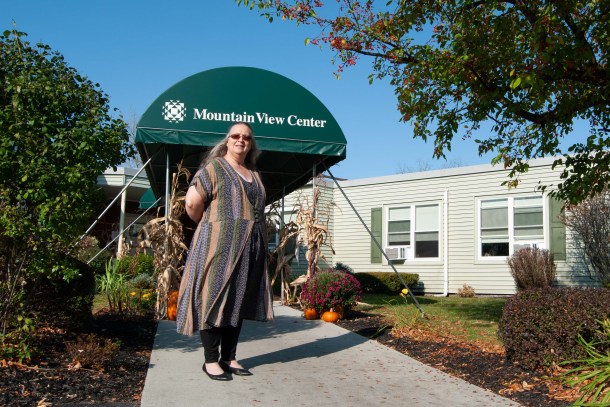
For Rebecca Whittemore-Arsenault, clarity can’t arrive soon enough. The recent cases inside Mountain View, and the subsequent lockdown, have shown her how quickly any steps toward reconnecting with her mother can be reversed.
“It took us seven months to get to phase four,” she said, referring to the facility’s rubric for relaxing restrictions. After the recent positive cases, “It’s, ‘all right, back to the beginning again.’”
She feels as if she’s out of options for getting her mother stable care. Rebecca’s own obligations and health issues prevent her from caring for her mother at home, and Geraldine’s dementia makes moving her inadvisable. (Rebecca said just moving her mother across the hall several years ago caused her to lash out.)
Rebecca has fantasized about forcing her way into Mountain View. “What would the facility do?” she wonders. “Would I get arrested? Would they file a no trespass charge against me?”
“It’s really physically draining because I think about my mom every day. And I want to be with her,” she said. “We’re on limited time here.”
For much of her mother’s 97th year, she said, “These months are gone.”

