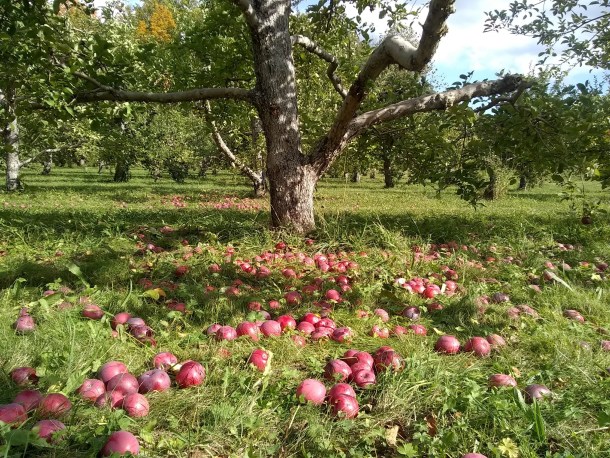

SHOREHAM — It was peak apple season, but on Tuesday, Champlain Orchards was eerily quiet. Long rows of apple trees sagged under the burden of their fruit.
Yellow caution tape hung across the driveway of the Shoreham orchard, draped over signs noting that the bakery and pick-your-own were closed. Passing cars slowed, tempted by the bounty. But only the orchard’s seasonal workers were on the farm to admire the view and the crops, as they stood in line waiting for Covid tests at the summit of a hill at nearby Douglas Orchards.
Last weekend, 27 workers at the Shoreham orchards tested positive for the coronavirus, leading to the biggest outbreak in Vermont since early June. Husband-wife owners Bill Suhr and Andrea Scott shuttered operations of the two orchards, and the Department of Health instituted a testing regimen.
“We’ve been here since March trying to avoid everything and here it comes knocking on the door,” said Utneil Hines, one of the workers.
Hines, who has worked at Champlain Orchards since March, had already tested negative on Saturday; he joined more than a dozen masked workers in a long, socially distanced line to wait for a second round.
The outbreak has served both as a cautionary tale of the economic impact of the virus, as well as a success story. So far only a group of workers who recently arrived from Jamaica and one other worker have tested positive.
“I don’t dare say anything because we’re going to get the tests back — but we’re hopeful it’s contained,” said Scott, orchard co-owner. “This also shows that quarantine works.”
Whether or not more test positive in the coming days will test that theory — and determine the future of apple picking season at Champlain Orchards.
Meanwhile, the workers are taking it as it comes.
“We have to depend on God,” said Noelle Hines, Utneil’s father. “He’s in the driver’s seat.”

‘They’re scared’
Who caught the virus first and where isn’t clear. Scott said she thought it was on Sept. 14, when 29 workers flew from Jamaica into John F. Kennedy International Airport in New York. They took a charter bus — “windows open, masks on,” Scott emphasized — to the Shoreham farm.
They were housed together on a farm for a 14-day quarantine, Scott said. They worked outside during that time, but didn’t associate with other workers, as permitted under Department of Health guidelines.
One of those workers came down with symptoms last week, and tested positive for Covid on Oct. 3.
The orchard closed its doors to visitors on Saturday, and a Department of Health testing site that same day revealed that 25 others had tested positive. One was hospitalized at Porter Hospital in Middlebury. A 27th worker, from a different crew, who had transported some of the infected workers, also tested positive.
Now, the workers are staying in five separate houses between the two farms to allow for different levels of exposure and possible infection.
On Tuesday, four workers from the Middlebury Department of Health headquarters set up two folding tables on a hilltop at Douglas Orchards for follow-up Covid testing. The workers, outfitted head-to-toe in protective gear, offered a stark juxtaposition to the postcard-beauty of apple trees, surrounded by fall foliage and views of the lake.
Contact tracers would follow up as well, said Department of Health District Director Moira Cook Tuesday. The department also would provide tests again later this week.
Masked workers arrived in vans from their living quarters down the hill to take turns getting the requisite nose-swab PCR test, as Scott choreographed, clipboard in hand: Could a worker’s girlfriend come for a test? What did the workers want for snacks?
One man who waited for a test asked Scott whether a positive test would prevent him from returning to Jamaica for Christmas. “They’re scared,” Scott said.
Relying on Jamaican workers
The Shoreham orchards have depended on H-2A workers from Jamaica for decades.
In 1998, when owner Bill Suhr bought his first 60 acres of the Addison County orchard, he lived with seven workers.
Under the federal program, Suhr must cover the flight to Vermont, and housing and transportation while the workers are in the U.S. Some, including Hines, stay 10 months a year. Others stay just several weeks.
The operation has expanded as the orchard has grown. Soon after Covid hit, Suhr and Scott bought Douglas Orchards, an operation about a mile down Route 74, and their land grew to more than 300 acres.
Between the two orchards, the couple now sells 120 types of apples, including pick-your-own and wholesale at grocery stories around the state. Depending on the time of year, they also offer peaches, pears, plums, cherries, berries, sweet and hard cider, and baked goods.

A larger operation has also demanded more workers. This year, they brought on 55 H-2A workers, the most ever. They arrived in four groups— including the most recent on Sept. 14. Each quarantined separately upon arrival, Scott said.
Scott said she didn’t know the economic impact of the cases on the farm. Pick-your-own and in-person sales, the parts of the operation that had to be closed, made up only a small part of operations, Scott said.
Still, she mourned even a partial loss of a bumper crop.
The orchards have continued to sell wholesale, Scott said, pointing out a 18-wheeler rumbling by with a full load. As of Tuesday, workers who had tested negative could continue to work, as long as they stayed masked and socially distanced.
The workers are some of about 325 H-2A workers who will work in Vermont this year, said Anson Tebbetts, secretary of the Department of Agriculture, Food and Markets.
As far as Tebbetts knew, owners and workers in Shoreham had followed state guidelines. “Everyone was doing their best to make sure everyone was safe and healthy,” he said. “This virus has no boundaries and it’s everywhere.”

It was too early to tell whether the state would change its protocol for arriving workers, he said. The next batch of workers isn’t scheduled to arrive until early 2021. “If there’s anything we can do to help to protect the health and safety of the community we’ve served, we’ll do that,” he said.
Champlain Orchards would have the opportunity to apply for Covid relief funds to cover their losses or expenses as a result of the outbreak, Tebbetts said.
Scott and Suhr were working with the Department of Health to decide when it would be safe to open to visitors, Scott said. It would likely depend on the latest round test results.
“Older folks are worrying,” said Edgar Hines, a 34-year-old worker who wore a bandana with dollar bills on it. His father, Noelle, had been coming to the Shoreham orchard since 1998. Edgar joined 10 years later. His brother, Utneil, also works on the farm.
Edgar Hines was less concerned for his own safety. “We can’t worry about what we can’t see,” he said.
A public relations effort
Meanwhile, Scott was trying to manage the public relations for the farm, as well as care for the workers.
Some community members had reached out to the orchard owners saying they had seen workers at the grocery store or around town. Others had posted angry messages on social media. Some sent anonymous tips to VTDigger.
People doing errands around town “doesn’t mean there are people out of quarantine,” Scott said. Some had tested negative; some have been Jamaicans working on other farms.

“My fear is that if people see migrant workers out in the community, whether Mexican or Jamaican, that they have fear that those people are spreading Covid,” she said. “It’d be good if people asked questions instead of just assuming things.”
People of color are disproportionately affected by Covid, both nationally and in Vermont. The Department of Health reported that rates of Covid-19 are four times higher for people of color compared with white Vermont residents.
During a press conference Monday, Health Commissioner Mark Levine warned against unfairly stereotyping or discriminating against non-white residents with the virus. “I have seen various facilities, businesses, travelers, ethnic groups and other groups face stigma over the course of this pandemic, and I call on Vermonters again to focus on the disease, and how to keep it at bay where we can, rather than creating fear or rumors,” he said.
Town clerk Julie Ortuno said the community does support the workers — for the most part, at least. “There’s been a few bad apples, but overall the town, the community supports them,” she said.
During non-Covid times, the town holds an annual Jamaican hymn sing at the congregational church, which draws a standing-room only crowd, she said.
“A lot of them are here year after year,” Ortuno said. “They’re part of the family here.”
Some community members had chipped in, Scott said. Rob Litch from Misty Knoll Farms donated 300 pounds of chicken for the quarantining workers, she said. Julia Doucet, an outreach nurse from the Open Doors free clinic, arrived during the testing with bags of thermometers and masks.
Doucet could field questions about Covid or other health concerns, Scott told workers.
In the meantime, Scott was preoccupied with the logistics of managing an outbreak. She was coordinating a massive grocery run, and stocking up on food and bottled water for those who were quarantined. She was on the phone with Western Union, figuring out how to help quarantined workers wire money from their paychecks to their families in Jamaica.
They’d figure out the other details as they come, she said.
“We don’t know how this is going to spread,” Scott said. “We’re just taking it one day at a time.”