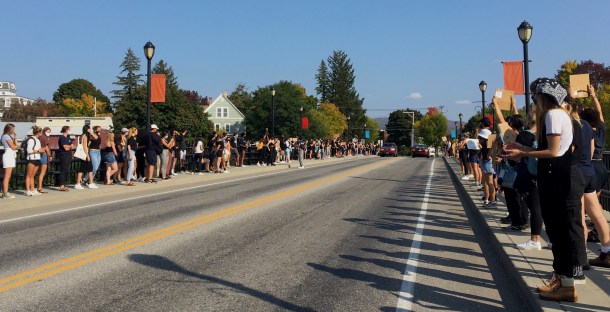
MIDDLEBURY — More than 500 college students and town residents joined a march through Middlebury on Friday afternoon calling for racial justice.
At about 2 p.m., hundreds of students gathered on Middlebury’s main quad and streamed down College Street to chants of “say her name” and “Black lives matter.” They paused at College Park, where town residents joined the crowd and organizers delivered speeches, before marching across Cross Street Bridge. They stood on the bridge for about 30 minutes, holding signs and continuing chants.
The march, organized by Middlebury College students, was sparked by a Louisville, Kentucky, grand jury decision Wednesday to indict just one of three police officers involved in the killing of Breonna Taylor, and only on minor charges. The decision led to protests around the country, with protesters calling for harsher measures for the two officers who shot Taylor; they face no charges.
One reporter for the Middlebury Campus newspaper counted more than 530 attendees at Friday’s march.
“The turnout was amazing — better than expected, honestly,” Kaila Thomas, a Middlebury senior and the lead organizer for the protest, told VTDigger. “The campus needs to start talking about this, and so does the whole community.”
Protests for racial justice and police accountability unfolded in nearly every corner of Vermont this summer, beginning in early June after the killing of George Floyd in Minneapolis. In Burlington, protesters have occupied Battery Park for weeks, demanding the city’s police department remove three officers for past violent infractions with citizens (a partial agreement was reached this week, though protesters say it’s not enough).
While Friday’s protest in Middlebury was spurred by the decision in Louisville, like other protests around the state in recent months, it led to discussion of systemic racism in Vermont and how to combat it.
“It is time for you to understand that just because you are not explicitly racist doesn’t mean you aren’t implicitly racist,” organizer Luka Bowen, a junior at the college, told the crowd at College Park.
Bowen and Thomas, who are Black, said one purpose of the protest was to urge their white peers at Middlebury to do more to battle racism.
“[As white people] you have to ask yourself the question, ‘what do I have to do to make sure the Black community feels included?’” Bowen told VTDigger. “It’s not that hard to answer — you have to do that thinking for yourself.”
In her speech at College Park, Thomas called on Middlebury College to direct more money toward anti-racism initiatives.
“This day was a great way to spread the word that this needs to be a topic that’s spread on campus and in the community — that race needs to be talked about more,” she said.
Thomas organized the protest in less than 24 hours, and much of the planning involved working through social-distancing protocols with college administrators. Students who congregated on the college quad were told to remain in groups of 10 before walking in pairs down College Street and across the bridge. The number of people who arrived at College Park at times led demonstrators to stand closer than 6 feet apart, but all who arrived wore masks.
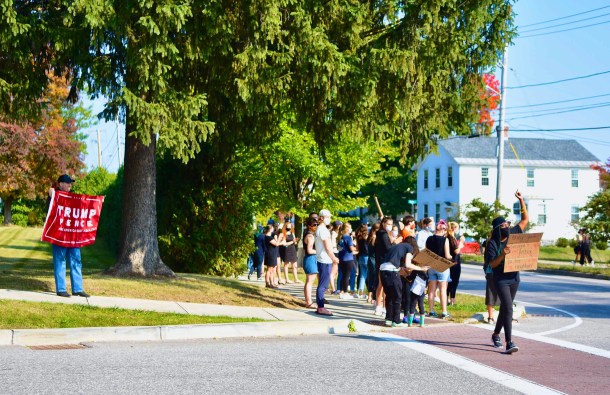
Streams of protesters slowed traffic while they passed through downtown Middlebury, but they nonetheless drew supportive honks from drivers all afternoon. One counterprotester was seen near Cross Street Bridge carrying a Trump/Pence flag.
While the majority of demonstrators were students, they were joined by town residents who have collaborated with college students on social justice protests in the past.
“This is just one more insulting indignity that people are being forced to deal with, and they’re angry about it, and rightly so,” said Jamie McCallum, a Middlebury sociology professor, of the ruling in the Taylor case. For Friday’s protest, McCallum helped put Thomas in touch with Middlebury residents in a local chapter of the organization Showing Up for Racial Justice.
Joanna Colwell, a member of the organization, joined the march, and said the day presented another chance for townspeople and students to reckon with their community’s relationship with race.
“Like many majority white communities around the U.S. that consider themselves to be liberal and progressive, I think Middlebury is reckoning with itself,” she said. “I think a lot of people did not have an understanding of how racism shows up in Vermont. And I do think a lot of people are listening and asking themselves, ‘How can I do better?’”