


It’s now been more than two weeks since protesters began their encampment at Battery Park. They say they won’t leave until three Burlington Police officers who have been accused of excessive force are removed from the department.
But city officials say that legally there’s nothing they can do, forcing them into a deadlock with protesters who say they need to do more. Officials point to the police union contract, employment protections and limitations written into the city charter when arguing that they’re prevented from taking further action.
But the city finds itself under increasing pressure to find a way to remove these officers, who many critics argue are a continued threat to public safety in Burlington.
At Tuesday night’s City Council meeting, there were discussions about the possibility of a severance agreement with the officers, which may be the only way the city could see them exit the force.
Use of force incidents
Jason Bellavance, Cory Campbell and Joseph Corrow are the three officers who protesters say they want removed from the Burlington Police Department due to past instances where they say they used excessive force.
In March 2019, Campbell punched a white man named Douglas Kilburn in the face outside the UVM Medical Center, causing injuries from which he later died. Although Kilburn’s death was ruled a homicide — a finding which means that Kilburn would not have died if he had not been punched by Campbell — Campbell was cleared of charges for Kilburn’s death.
After an internal investigation, Campbell was reprimanded in a letter from the Burlington Police Department in January 2020 for swearing at Kilburn during the encounter. He received retraining, but he was not disciplined for his use of force.
Bellavance and Campbell responded to a September 2018 incident, during which Bellavance shoved a Black man whose head slammed against a wall. Body camera footage captured the crack of the man’s head against the wall and his eyes rolling into the back of his head as he temporarily fell unconscious.
Bellavance was suspended for less than three weeks without pay after this incident was investigated for use of force violations by the BPD and the citizen police commission.
On another September night, Corrow responded to an incident where he tackled a Black man to the ground, which caused him to fall unconscious. Corrow was not disciplined for his actions.
Federal lawsuits have been filed against Corrow and Bellavance for these use of force violations, which are still pending.
Why can’t these officers be fired now?
As City Attorney Eileen Blackwood explained to councilors at Tuesday night’s emergency meeting, because these incidents have already been internally investigated by the BPD, they can’t be reopened.
“Once a matter has been adjudicated and it’s gone to a disciplinary matter, the government can’t take further action against the person arising out of that same incident,” Blackwood told councilors.
She also explained to councilors that the city can’t reimpose new disciplinary consequences on the officers after they’ve already been disciplined — that would violate “double jeopardy” protections within the police union contract.
That could only happen if “new facts or circumstances become known,” she said. “But in this circumstance, there aren’t new facts or circumstances the city didn’t know or should have known about.”
She gave a hypothetical: if one of the officers were to say they previously lied during the investigation while they were testifying in one of the federal lawsuits that are still pending, that could be a new fact, and could justify reopening a case against an officer.
If the city were to outright fire the officers, this would likely trigger an aggressive union defense. Richard Cassidy, an attorney for the Burlington Police Officers Association, issued a statement last week saying it would be a “gross violation” of the union agreement if any of the three officers were fired.
If they were terminated, he added, it’s likely the union would file a challenge that would cost the city “millions of dollars” in back pay and arbitration fees.
Still, the city doesn’t even have the power to fire the officers. According to the city’s charter, only the police chief has the power to hire and fire officers.
Prior to Tuesday night’s emergency City Council meeting, council President Max Tracy said he wants to find a way — despite the legal hurdles — to remove the officers.
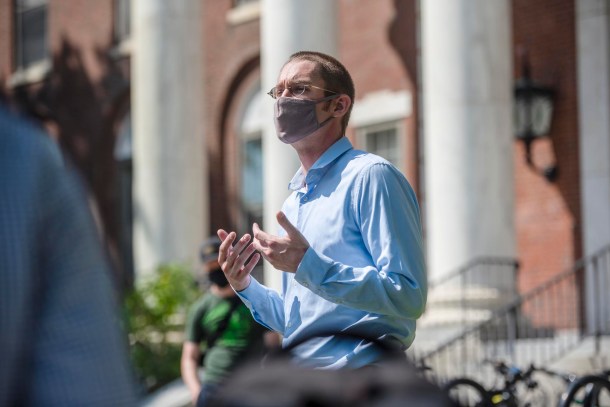
“We have to explore all potential legal avenues to get them off the force,” Tracy said.
The council passed a resolution at Tuesday night’s meeting to begin the process of a charter change, specifically to investigate who makes and reviews police disciplinary decisions that could lead to the firing of an officer.
But a charter change could take years. Tracy said that first the council would need to review a request to change the city’s charter. Then that request would be passed on to the Charter Change Committee, which would take testimony and review the change.
Then it gets voted back to the City Council, which would then vote on whether that charter change should be added to the Town Meeting Day ballot. If Burlington residents vote in favor of the charter change, then it heads to the Legislature for approval. If it passes through the Statehouse, it would still need the governor’s signature.
And, the charter change couldn’t retroactively apply to officers Bellavance, Corrow and Campbell.
In a statement provided to VTDigger, Burlington Mayor Miro Weinberger said he isn’t hiding behind legal obligations to keep these officers on the force. He said the city “must treat its employees fairly.”

“When we say it is illegal, inconsistent with our contracts, and inconsistent with the City Charter to take further employment action against the three officers, some people interpret this to mean that we are seeking to avoid accountability and that our hands are tied. That is not my point,” Weinberger said.
“Treating our employees fairly demands that we stay true to our rules, laws, contracts, and processes for employee discipline, even at a moment when doing so is not popular.”
Weinberger said his administration is also continuing to accelerate reforms around “police discipline, governance, training, and body camera footage policies.”
A severance agreement
City Attorney Blackwood said she couldn’t go into detail during Tuesday night’s meeting about how a severance agreement could work between the city and the three officers, at risk of prejudicing the ongoing lawsuits.
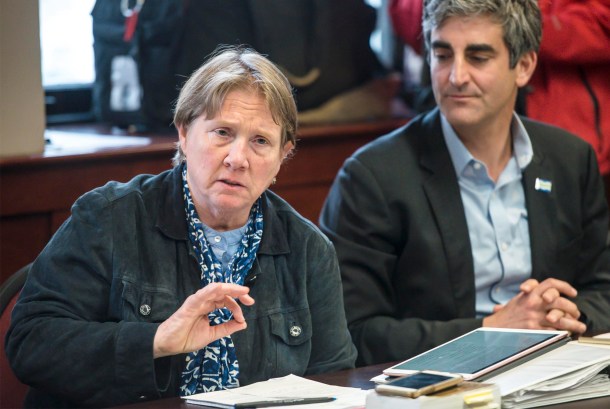
“A severance agreement requires that there be some payment to the employee or the employer,” Blackwood said. “It requires some kind of payment. And it requires that there be a meeting of the minds. So, both parties have to agree to what that looks like.”
And, she said, the city employee in question would have to be willing to leave voluntarily.
Employment lawyer John Franco also thinks a severance agreement would likely be the most favorable option for the city. He said there are too many legal boundaries that keep the city from firing the officers, whether that’s the charter or the police union agreement.
Even if city officials were to take the side of the protesters and say the cops were in the wrong and they should be fired, Franco said this could put the city at risk of losing its insurance coverage for the two pending federal lawsuits.
“The only way these guys can leave is under their own steam,” Franco said.
Weinberger declined to comment on whether he would support a severance agreement with the three officers. He is planning to announce further details regarding the protests, racial justice and Burlington policing later this week.
Three separate severance agreements could cost the city a substantial amount of money. But some say they’re comfortable with the costs if it means the officers would be leaving the force.
Jabulani Gamache, chair of the citizen police commission, said ideally he wants the city to buy out the officers in order to remove them from the force in the hopes that it may be the cheaper option.
But if it comes down to an expensive legal fight, he thinks the city should overrule the union and find a way to fire the officers.
“The narrative that they can’t fire them is, I find, false,” Gamache said. “It’s just that if they do fire them there will be significant financial repercussions.”
At Tuesday’s City Council meeting, many public commenters said they support the city spending money to remove Bellavance, Corrow and Campbell. Burlington resident Ashley Laporte likened the costs that will be associated with removing the officers to reparations to residents of color who have lived in fear of the police.
“I have heard many reports that this is legally not a viable option to fire them and that it will cost the city money,” Laporte said. “Consider it reparations for not doing the right thing the first time around.”


