

Editor’s note: Mark Bushnell is a Vermont journalist and historian. He is the author of “Hidden History of Vermont” and “It Happened in Vermont.”
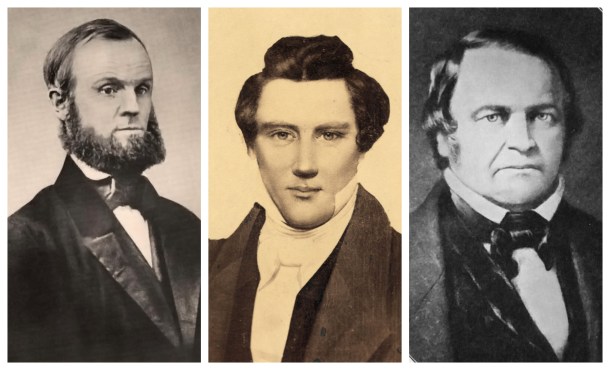
Vermont’s biggest contribution to the nation during the first half of the 1800s may have been religious prophets. Though it was a backwater of New England, this small state produced three men who launched some of the most successful religious movements this country has seen.
Religion was a vital part of daily life in Vermont during the early 1800s. People’s interest was sparked by a series of revivals that roiled the region. In what became known as the Second Great Awakening (the first had been in the early 1700s), barnstorming preachers warned New Englanders that Judgment Day was near. By the 1830s, fully 80% of Vermonters attended church regularly.
New England’s religious leaders traditionally sought to bring worshippers closer to God by removing the upper layer of church hierarchy. Evangelical religions took this further, declaring that worshippers needed no church hierarchy to find a direct connection with God. Vermonters John Humphrey Noyes, William Miller and Joseph Smith embodied this belief. Each individually proclaimed that they had found new paths to salvation for themselves and others to follow.
Mormon Prophet
Born in Sharon in 1805, Joseph Smith grew up in a family beset with financial troubles. As a consequence, the family moved frequently during his youth. His father, Joseph Sr., was a farmer and merchant who lost money speculating in ginseng. Like many New England farmers, the elder Smith suffered a severe financial setback during the record cold year of 1816, the “year without a summer,” and moved the family out of state in search of better prospects. This time it was to a spot outside Palmyra, New York, an area so afire with religious fervor that it was known as the “Burnt-Over District.”

In New York, the Smiths offered neighbors their services to locate lost items and buried treasure by using divining rods and “seer stones.” In 1826, Joseph Smith Jr., was arrested for allegedly defrauding a client. Court proceedings followed, but accounts differ over whether or not Smith was convicted.
By this time, Smith later stated, he had already made the discovery that would change his life and give birth to a new religious movement. Smith said he had unearthed, with the help of an angel, golden plates inscribed in an ancient Egyptian language that only he could decipher. He published his translation of the plates in 1830 as the Book of Mormon. That year he founded the Church of Jesus Christ of Latter-day Saints and became its first president.
In the wake of persecution, Smith moved west with his thousands of followers, many of them Vermonters. In 1844, Smith was murdered by a mob in Illinois. A power struggle ensued over who would control the church. Brigham Young ultimately won the battle and helped lead the Mormons west to settle in Utah. Young was also a Vermonter, having been born in the town of Whitingham.
Declaring Judgment Day
Growing up in Poultney, William Miller was reportedly an ardent atheist who mocked religion as mere superstition. Others claimed that Miller was a deist, like Ethan Allen and Thomas Paine, basing his religious beliefs on his powers of reason, not on the acceptance of biblical revelation.
If Miller had started as an atheist or a deist, something changed his worldview. Historians suggest it may have been his experiences during the War of 1812, when he witnessed the intense Battle of Plattsburgh and the resulting carnage. Or perhaps it was the experience of suffering a head injury that left him unconscious for days. Those brushes with mortality might have caused him to reconsider his religion.
For years Miller studied the Bible. Then, in May 1832, he made a stunning pronouncement: through careful reading various passages, he had determined that Judgment Day would come “around 1843.”
Miller explained his calculations in a series of articles published in Brandon’s Vermont Telegraph. Then he began preaching in Vermont and New York. In 1839, Miller traveled to Boston, where he met Joshua Himes, a Baptist pastor, who became a convert. Himes proved the perfect partner to spread the word. The Boston pastor publicizes Miller’s prophesy in the Signs of the Times newspaper in Boston and the Midnight Cry in New York. Himes announced that he would preach Miller’s word “as long as time lasted.”
As 1843 approached, people, particularly Baptists and Methodists, flocked to Miller’s cause. His followers declared that Judgment Day would come the first day of spring, March 21, 1843. Throughout the Northeast believers stopped making long-term plans. They gave away their property and didn’t bother planting their fields. If the Lord was coming, there was no need.
On the appointed day, Millerites everywhere gathered. In Wardsboro, a group assembled in the graveyard, crying and yelling in excitement. They brought with them the shrouded body of a recently deceased woman, believing that burying the dead would only delay their rendezvous with God. A selectman went to the graveyard to complain.
In Calais, Millerites climbed onto their church’s roof. There, dressed in white “ascension robes,” they prayed and waited. When the sun rose the next morning on an unchanged world, they descended to the hoots of amused onlookers. What was supposed to be Judgment Day became known as “the Great Disappointment.”
Miller responded to criticism by saying the date had been right but the year wrong. Judgment Day would come on March 21, 1844. When nothing otherworldly happened that day, Miller rechecked his figures and announced that the true date was Oct. 22, 1844.
Despite the multiple “Disappointments,” Miller’s prophecies later gave rise to a new denomination, the Seventh-day Adventists, who still revere Miller’s writings, if not his calculations, and, like the Mormons, count their numbers in the millions today.
Promoting Bible Communism
John Humphrey Noyes can’t claim as great a societal impact as either Miller or Smith, but he did leave a legacy. It was not a religious legacy, however, but a commercial one.
Born into a prominent Brattleboro family in 1811, Noyes was an almost pathologically shy man, particularly around women. “I fully believe that I could face a battery of cannon with less trepidation than I could a room full of ladies with whom I was unacquainted,” he once admitted.
Noyes’ religious awakening happened when he attended an evangelical revival meeting in Putney in 1831. He studied divinity at Yale, where he was drawn to the unorthodox Christian doctrine of Perfectionism, which argued that Christ returned to Earth during the lives of the Apostles. The millennium had long since come, Perfectionists argued, so Christians could attain a state of perfect holiness.
Noyes formed a community in Putney to practice Perfectionism. There he adopted something he called Bible Communism, which aimed to remove barriers between people. All property and profit were to be shared. But the sharing didn’t end there. Community members were expected to practice what Noyes called “complex marriage,” which detractors derided as “free love.”
Under complex marriage, all the community’s women were considered married to all the men, and vice versa. Traditional marriage was contrary to Bible teachings, Noyes argued, and promoted jealousy and selfishness. Noyes also wanted to free women from the suffering of frequent childbirth. His own wife, whom he married years before instituting complex marriage, had endured five painful pregnancies with only one baby surviving childbirth. To reduce the number of pregnancies, Noyes promoted a birth-control technique he called “male continence” or coitus reservatus.
Rejecting traditional marriage and inducing fewer pregnancies would help the group, Noyes believed, by allowing men and women to work side by side in community businesses. “Men and women will mingle like boys and girls in their employment,” Noyes said, “and labor will become sport.”
Between 1838 and 1847, Noyes drew a few dozen followers and organized them as the Putney Corporation or Association of Perfectionists. But all was not perfect. The group’s unorthodox social arrangements scandalized neighbors, who reported them to the county sheriff. Noyes was arrested for adultery and adulterous fornication. After posting bail, Noyes and other leaders fled to New York in 1847. “We left not to escape the law,” Noyes explained, “but to prevent an outbreak of lynch law among the barbarians of Putney.”
Noyes and other Putney Perfectionists resettled in Oneida, New York, and established manufacturing operations, making everything from hats to travel bags to furniture. The Oneida Community eventually grew to more than 300 members.
As he aged, and as outsiders criticized this odd community in their midst, Noyes lost control of the Perfectionists. In 1879, Noyes fled to Canada to avoid arrest for statutory rape, and community members decided to accept the social mores of the outside world. The next year, they dropped the last remnant of their biblical communism, transforming their business into a joint-stock corporation that still exists.
Today millions of Americans follow the teachings of Smith and Miller, while millions also eat their meals using silverware and dinnerware bearing the name Oneida.

