

Editor’s note: Mark Bushnell is a Vermont journalist and historian. He is the author of “Hidden History of Vermont” and “It Happened in Vermont.”
James Gordon Hindes had his summer all mapped out. Toting a 60-pound pack and wearing hobnailed boots, Hindes would spend most of July and much of August hiking north from the Massachusetts-Vermont line into Canada. The year was 1931 and Hindes planned to follow the entire 275-mile route of the just-completed Long Trail. Reading Hindes’ journal, which has been published by the Green Mountain Club, it is easy to get caught up in the adventure, the lure of the open trail, the profound satisfaction of living in the simpler world that the trail inhabits.
The Long Trail that Hindes and his hiking companion, Dartmouth College fraternity brother John Eames, explored was the newest trail through the Vermont wilderness. The state had, of course, seen its share of such trails before, starting with paths created along the main waterways by the Native Americans. Then came Revolutionary War routes, like the Bayley-Hazen Road and the Crown Point Road, that were slashed through the woods, followed by paths cut by early European settlers. But the Long Trail was a different thing entirely. It was Vermont’s, in fact the nation’s, first long-distance hiking trail, and would inspire the creation of the much longer and more famous Appalachian Mountain Trail.
The Long Trail was the brainchild of James P. Taylor, who got the idea one day in 1909 while hiking on Stratton Mountain and admiring the distant hills. Taylor, then assistant headmaster at the Vermont Academy in Saxton’s River, thought Vermonters would take better advantage of their mountainous wilderness if a trail were cut to make it more accessible. His dream of a trail running the length of the state was finally realized in 1930 with the completion of the section between Jay Peak and the Quebec border.
Though hundreds of hikers have written accounts of their time on the trail, Hindes deserved special attention, according to the late Reidun Nuquist, who was historian for the Green Mountain Club, which maintains the trail. In her introduction to the published journal, Nuquist noted that Hindes’ account is interesting both because it came so early in the trail’s history and because it contains many keen observations.
Though a Massachusetts native, Hindes had strong ties to Vermont. He spent most of his childhood summers at family cottages in Ferrisburgh and Pittsford. He spent his high school years as a student at Vermont Academy — Taylor had already left the school — and at nearby Dartmouth College.
July 4, 1931, marked a personal independence day for Hindes and Eames, as they put away their “civilian attire,” and hit the trail. They headed for Seth Warner Camp, the first hut north of the Massachusetts line. The wet underbrush soon soaked their clothes, but Hindes hardly seemed to notice. “It had stopped raining by then and the cool, fragrant, woods seemed [to] welcome … us,” Hindes wrote. “Songs of birds, a gentle whispering breeze, and our footsteps, muffled by inches of leaf-mould, were the only sound we heard. Seldom did we speak to break the impressiveness which surrounded us.”
That afternoon they passed a hunter’s cabin and were quickly invited to join the owner and his family that evening for songs, storytelling and beer. It was a taste of what lay ahead. The young men made friends easily along the trail, among them affable fire wardens, a free-spirited Danish man who was wandering the world and a pair of Boy Scout troop leaders who they accompanied on a successful, if gruesome, hunt for porcupines.
Hindes and Eames also experienced their share of discomforts, which came in a variety of forms: the swarms of black flies that grew so thick that Hindes found himself at a loss for words to describe them, the stomach ailment that afflicted Eames, which Hindes mercifully declined to describe in detail, and the rains, the never-ending rains. “Just before midnight … it started raining great dogs—gawd!” Hindes wrote. “It was a marvel to feel it pour in such quantities.”
But they enjoyed the simple comforts. Upon reaching one camp, Hindes wrote, “We built a roaring fire in the stove. Shoes made a peculiar sucking sound when they were drawn from our feet. Clothes, soaked by the wet, wandering path in the strange woods, gave off a ‘quaint’ odor. We didn’t mind. We were warm, had on dry garments, and a pot of coffee boiled joyously on the fire.”
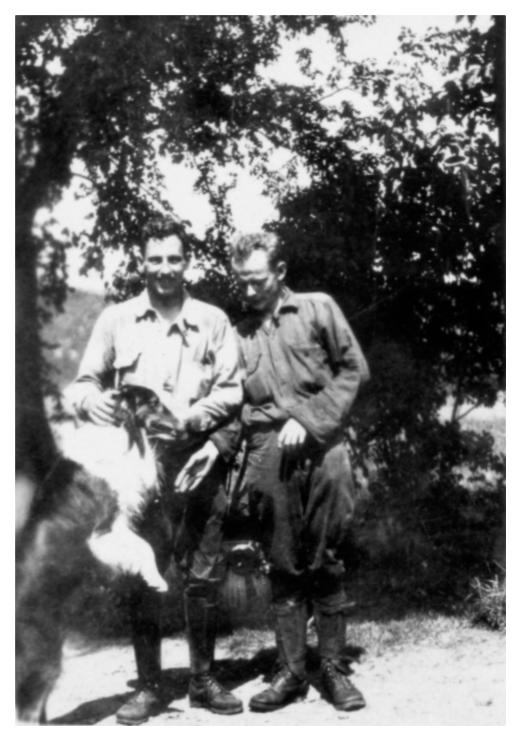
One morning, after a night of particularly heavy rain, Hindes and Eames rushed to a cabin they had seen a short way back. It was owned by a “fern picker,” a man who made a living by selling ferns to florists. The fern picker took them in. As their clothes dried, Hindes caught a nap while Eames went fishing with the man, returning with 25 trout for lunch.
That slow morning exemplified the hikers’ plan. “From the beginning of the trip our policy had been to get the most out of scenic marvels. As time has gone on, we have become more and more certain that this is the only method to hike the trails,” Hindes wrote a week and a half into the trek. “Those who rush along attempting to set records, those who are a bit afraid to come into camp an hour later than they had planned, lose the very heart of the trail. How nature can mean a great deal to them is beyond my powers of reason. Let roaring trains, straining automobiles, and soaring airships … accomplish extraordinary feats of speed, but let me wander through the mountains and feast on the beauties which abound on every stride!”
Though they made occasional forays into town to get supplies, or allow themselves the luxury of meeting friends or watching a movie, Hindes felt alienated from the tourists they encountered at the Long Trail Lodge near Sherburne Pass. “They all tried to appear strong,” he observed. “Men would strike their cramped chests. Awkward women in homely knickers strode about—why didn’t they remove their cosmetics?”
Despite the distance Hindes felt from the outside world, he admitted how happy he was to meet up with his parents at the Mount Mansfield Hotel, which then stood near the mountain’s summit. After staying three nights at the hotel, the young men pushed on. By now it was early August and the days were scorching. Despite their urge not to take their time, the Canadian border seemed dauntingly distant.
As they neared the border, Eames was suffering again from a stomach ailment. Hindes tried to let his father know they had fallen behind schedule. He used a family’s party-line telephone, which served 42 households, to ring the central telephone office, but to no avail. His hostess told him that the operator had gone home at 4:30 p.m. Hindes asked whether he might send a telegram, but was told the nearest telegraph office was 20 miles away.
But the emergency soon resolved itself: Eames recovered and the hikers continued their trek. They reached the summit of Jay Peak on Aug. 11 and pushed on until they spotted a marker in the midst of a clearing. They had reached the Canadian border. They were overjoyed. “We sat on the boundary stone, stood on the boundary stone, played leap-frog over it …,” Hindes wrote.
The elation he felt at completing the trail remained with Hindes the next spring, when he wrote a foreword for his journal: “If any man wishes to sincerely find himself, let him strap a pack on his back, turn to glories of nature and drink deeply. …Toil until the loftiest peaks are conquered, stand upon them and feel a careless wind sweep across your face, survey the vastness at your feet, and when eventide falls, make a bough-bed and let the stars watch over you!”
___________
James Gordon Hindes’ Long Trail Journal, “So Clear, So Cool, So Grand,” can be purchased from the Green Mountain Club.
Postscript from Hindes’ son
Editor’s note: After reading this column, Churchill Hindes, a son of James Gordon Hindes, contacted Mark Bushnell with a recap of Hindes’ life after the Long Trail.
James Gordon Hindes, known to his family as Gordon or Din, graduated from Dartmouth in 1932–directly into the emptiness of the Great Depression. His search for work led him to the oilfields in south Texas and into the Army. Dad retired from the military in 1961. His sickly hiking mate, Jack Eames, died within a few years of his college graduation.
To this day, Din’s Long Trail Diary provides priceless connection to a father relatively unknown to his children. As for so many of his companions, the Second World War left deep, though invisible, wounds that sapped him of much of his joie de vivre. His disabilities took him from us shortly after his 64th birthday.
Dad’s love of lakes and hilltops continues through his four children, nine grandchildren and eleven great-grandchildren. This past Saturday, during a family outing on Lake Champlain, I told his youngest great-grandchildren, Aya and Rye Yousey-Hindes, about one of my Dad’s favorite summer activities. As a teen, he would row out to the middle of the lake at sunset, rig a lantern to an oar and lash it upright as a signal to the night steamers, fall asleep rocked by the waves, and awaken at dawn delighted to see how far his boat had drifted during the night. I would not be surprised if one of them tries to do the same in a few years…

