


When Burlington city officials sat down for a call with CityPlace Burlington developer Brookfield to discuss proposed changes to the project’s development agreement July 16, an unexpected guest joined them in the meeting — developer Don Sinex.
Sinex, the minority partner in the project, had been the public face of the project for years as it mired in delays. But he was sidelined when Brookfield announced in January 2019 that they would manage the project, a shift welcomed by city officials who believed Brookfield could get the project back on track.
On the July 16 call, Brookfield changed their tone after more than a year of reassurances. The company told the city that it was taking steps to sell its interest and return management authority back to Sinex.
Sinex’s re-emergence has surprised and upset city leaders, including Mayor Miro Weinberger, based on the city’s history with Sinex.
“That history came as a result of attempting to make this work with Don, so we do have concerns about trying that again, for sure,” he said Wednesday.
The site has sat idle since August 2018, as the project has struggled to receive financing and construction restart dates have come and gone without action. Brookfield is the majority partner in the project, with 51% control, while Sinex’s Devonwood Investors has a 49% stake.
Weinberger sent Brookfield a default letter Saturday alleging “bad faith and fraud” and alleging that the company breached its development agreement with the city. He said the city was prepared to file suit against the company seeking damages and ownership of the portion of the land the city had planned to use to connect St. Paul and Pine streets through the site.
What happened?
Brookfield’s emergence in January 2019 as the manager and public face of the project was celebrated by the mayor, city councilors and project supporters. The New York-based company, one of the largest real estate companies in the world, had the expertise and financial heft to get the project moving, supporters argued.
“Knowing that there is a group with the technical resources and financial resources of Brookfield that is publicly fully committed to trying to get this in construction this spring is reassuring to me and I hope it’s reassuring to the people of Burlington,” Weinberger said at the time.
A year and a half later, any sense of optimism about the project has dissipated, leaving a pit in the heart of the city’s downtown with no sign of any movement on the project.
“For all intents and purposes, we are back to the drawing board,” Kelly Devine, the executive director of the Burlington Business Association, said Friday.
Signs of trouble with the new project leader started in October 2019, when Weinberger sent Brookfield a demand letter accusing the company of violating the development agreement and asking the company to make promised payments to the city. Brookfield made the requested payments.
Sinex’s original plan called for a $220 million, 14-story project. So when Brookfield announced a scaled-down, $120 million, 10-story project late last year, it was welcomed by the community. The company said construction would start in 2020 and be complete in 2023 under its timeline. In January, Brookfield held public forums reiterating their commitment to the project.
But despite the company’s public reassurances, it did not move forward with filing for permits for the project, and had been slow to adequately respond to proposed amendments to its development agreement with the city, said consultant Jeff Glassberg, who is working on the project for the city.
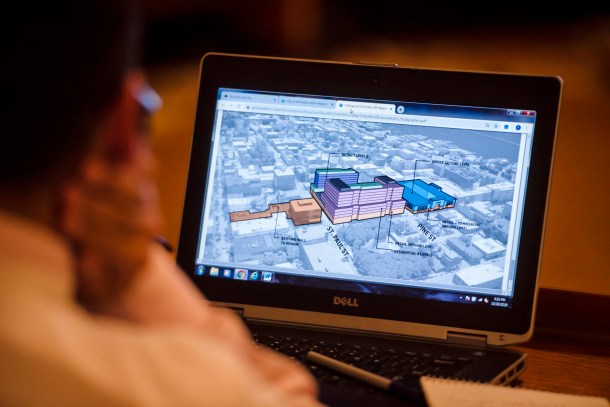
In November, Brookfield worked collaboratively with the city to provide materials about its revised project to the Vermont Economic Progress Council, which oversees the use of Tax Increment Financing. The city is using TIF funding for the public improvements associated with the project, primarily connecting St. Paul and Pine streets through the site.
At that time, the company agreed to negotiate an amendment to the development agreement due to fixed TIF deadlines, Glassberg said. The city is required to issue debt on the public improvements by the end of June 2021.
The city sent Brookfield a markup of the development agreement in February but did not receive a substantive response until last week, Glassberg said. Specifically, the company did not move fast enough to identify a funding source to service the TIF debt, he said.
“We had waited an awfully long time, spent time and energy to advance the project, and the response was to step away from commitments they had made in writing and orally,” Glassberg said.
And Brookfield further complicated the issue by alerting the city of their plans to walk away from the project.
“As part of the review of that markup last week, they added that to those discussions,” Glassberg said. “It was not expected.”
In the default letter, attorney Jeremy Farkas wrote that Brookfield had told the city that it was leaving the project to settle “its ongoing partnership dispute with Devonwood Investors LLC.”
The specifics of the disputes between Brookfield and Sinex are not clear.
“It’s not the city’s responsibility to referee the relationship between professionals,” Glassberg said. “We need them to figure it out and do what was promised.”
Sinex declined to comment Friday, saying he would have no comment until he issues a statement on the project either next week or the following week. Brookfield declined to comment through spokesman Ken Liatsos Wednesday.
Frustration and disappointment from city officials
This week’s announcement was met with frustration and disappointment, though not quite surprise in a city used to bad news about the project.
John Franco, a lawyer who represents project opponents, said he wasn’t surprised by Brookfield’s decision, especially considering the economic uncertainty caused by the pandemic.
“I couldn’t imagine, if they couldn’t get financing before, how were they going to put together any kind of proposal that a bank was going to look at given all the uncertainties about what the economy is going to look like after this pandemic is over, and what Burlington is going to look like after this pandemic is over,” he said.
Sinex has worn out his welcome in the city, Franco said.
“All the promises, all of the overselling, all of the representations that things were happening, that they had financing and stuff, were all not true,” he said. “I think Brookfield came forward as a new face and someone the city could have more confidence in, but if Don is the face of this thing, I don’t see it getting very far at any level.”
Devine said that she was also not surprised that Brookfield was pulling back amid the pandemic.
“Brookfield’s a big company, so part of me hoped that they had the bandwidth to hold on,” she said. “I don’t want it to be lost that this may reflect on the fact Burlington is not an easy town to do real estate development in.”
City Council President Max Tracy, P-Ward 2, said he hoped the city could retain the ability to re-connect the streets. He said he believes the city should have taken legal action against Brookfield a long time ago.
“It’s frustrating that it’s taken us this long to get to the point of taking a harder line on Brookfield,” he said. “Had we done so much sooner, as I had been advocating for, we might be in a very different place.”
Glassberg said that he stood by his position that the most direct route to construction and the public improvements the city was seeking was working with the developers to get them to fulfill their side of the agreement, not pursuing litigation.
“I’m disappointed, but I don’t think it was the wrong decision,” he said. “I think it would have been premature if the city moved immediately to litigation.”
Tracy said that he did not believe it was accurate to blame the pandemic for Brookfield’s decision to leave the project.
“I don’t doubt that the pandemic has had some impact, but to blame it all on the pandemic is not accurate,” he said. “It’s pretty clear there were big problems for this project going back years.”
The developers have not shown that the project is fully funded or economically viable, Tracy said.
“The city has given them numerous opportunities to forward a viable concept, and they have yet to do so,” he said. “I think we are looking at a situation where, unfortunately, nothing is going to happen at that site for a while.”
