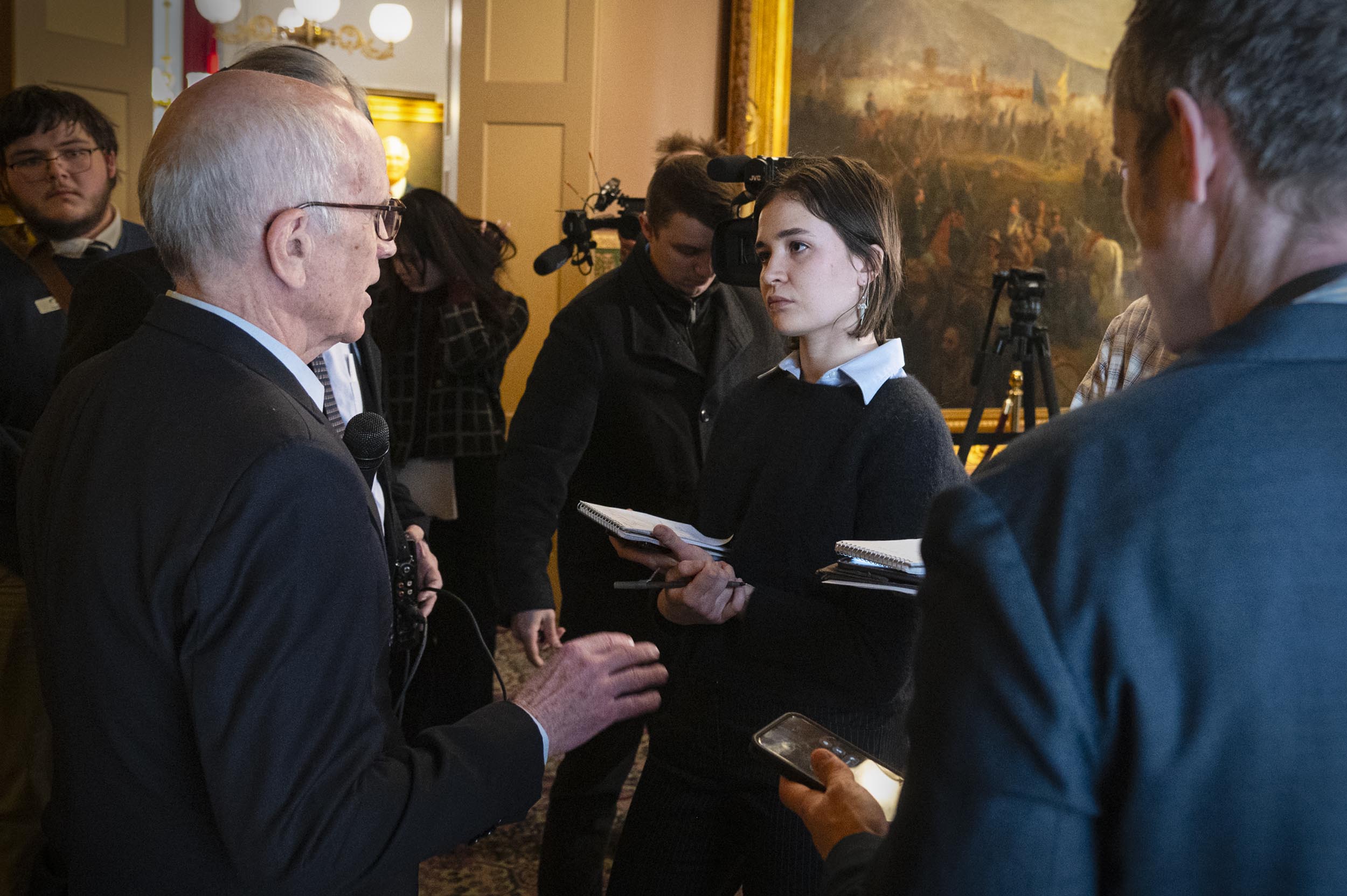
Bill Schubart, a retired businessman, is a regular columnist for VTDigger.
In the Morrisville of the 1950s where I grew up, we had limited but vibrant media access. Clyde Limoge’s News and Citizen came into our home weekly, purveying all the local joys and tragedies, police blotter, library events, home-team wins and losses, civic meetings, crop reports, and our neighbors’ births, graduations, retirements, and obituaries. Enriched by a network of “correspondents” from Elmore, Centerville, Wolcott, Hardwick, Eden Mills, Hyde Park, and Mud City, The News and Citizen brought us news from surrounding communities. My all-time favorite was a terse item stating that “Mrs. Glenna Bumps had received friends and neighbors for tea and cards to celebrate her new teeth. Fun was had by all.”
In addition, my brother, sister, and I each had bedside radios. I listened to Lloyd Squier’s WDEV: The Green Mountain Ballroom, The Hermit of Hunger Mountain, The Morning Trading Post, and, on Saturday, Music to Go to the Dump By, doing remotes from local dumps around Waterbury. Late at night, I could tune in border radio from Texas and hear Bob Will and the Texas Playboys and Lydia Mendoza.
We were late to TV, so in the early ‘50s we gathered at our neighbors in the glow of their Dumont TV to watch the snowy signals coming off Mount Washington on Channel 8 and later Red Martin’s Channel 3 off Mansfield. Occasionally, Dad brought home dated state or national newspapers, but in 1959 he acquiesced and lugged home an Admiral TV set that alone could heat the room it sat in. We watched nightly news from Edward R. Murrow and later Walter Cronkite or Huntley and Brinkley.
In my 75 years, I’ve seen a two-generation evolution in the Vermont media landscape. Today, our statewide news organizations of record – VTDigger.org, VPR, and Seven Days dominate the in-depth state news cycle. The terrestrial broadcasters, WCAX, WPTZ, and WVNY, commingle state, local, and national news, while Vermont PBS in its 50-year history, has largely ignored state and local news except for occasional documentaries, interview shows, and panel discussions.
Hobbled by the collapse of the old ad-revenue model that sustained them when the internet began to offer more views, better targeting, and click-to-buy-options, the regional-statewide papers – Bennington Banner, Brattleboro Reformer, Rutland Herald, Times Argus, Burlington Free Press, St. Albans Messenger, Caledonian-Record, and the Addison Independent – either downscaled to a sustainable community presence under independent ownership or sold out to larger news chains like Gannett/ Gatehouse Media (250), McClatchy (30), Lee Enterprises (75).
As the New York Times reports, newspaper chains are slowly being acquired by billionaires and hedge funds – not good news for news, as hedge funds routinely profit whether their acquisitions succeed or fail and have little vested interest in the health of the news biome unless it’s to use the opinion pages for their own political ends.
Given the success of in-depth online and broadcast state coverage, I’m less concerned about the fortunes of Vermont’s few statewide papers than I am about the vitality of the more than 30 local and regional papers that dot our community landscape. Like schools, local shops, and churches, they provide a critical and cohesive civic and social fabric that sustains our threatened small towns.
As a co-founding chair of the Vermont Journalism Trust, a 501(C)(3), which merged with and became the legal framework for VTDigger, I’m occasionally asked by local papers under economic stress about the feasibility of becoming a nonprofit. But every town is different and there are pros and cons for both models – no easy answers, as either way the community must support them. The success of either will depend on a community’s commitment to its local paper, as well as the competitive chaos wrought by hyper-targeted ad companies like Facebook.
The current international Facebook boycott is an effort to constrain its lack of any editorial ethos other than profit and its corrosive effect on other media. Facebook, after all, is not a news organization. If it “wins” by destroying local journalism, civil discourse and democracy will both be at risk. Technology, massive lobbying, and influence peddling have all tilted the playing field in media and we’re feeling its effects in Vermont. So it becomes vital to the well-being of our communities that whether for profit or for mission, we support our small local papers. They are the connective tissue in our small towns.
Also, to fully understand media, we must recognize that content is indeed king and delivery medium increasingly lacks relevance. Newsprint, internet, and cable and terrestrial broadcast radio and TV are no more than delivery systems. Most modern news outlets use print, audio, and video on their websites. VTDigger’s primary medium is online. VPR’s is broadcast and online. And Sevens Days’ is print and online.
Electronic news-gathering journalists are now expected to capture with their hand-held cameras broadcast quality audio and video for later production use in all delivery channels. The typical multimedia news segment is designed for print, radio, TV, and web content. VTDigger, Seven Days, VPR, and the network broadcasters all deliver multimedia content on their web platforms.
A byproduct of growth can also be consolidation. As VPR continues to develop its news muscle and VT-PBS considers its own, might it make sense to consolidate the two into a joint-licensee operation? Both are sustained by members and sponsorship, receiving little in the way of government funding. They produce and deliver significant Vermont programming. The only lingering differences are their delivery medium and locations. Such a merger would save operating and infrastructure costs that could be invested in rich content production.
Vermonters (and Canadians) are generous to both, but Vermont’s philanthropic capacity has limits, especially in a pandemic. Many larger state public broadcasting entities are joint licensees. A 2016 issue of Current Magazine outlines the challenges and opportunities of combined operations.
Exciting, as well, to see in all this change is that the signature news organizations are beginning to collaborate on content to the benefit of all Vermonters.
I believe the two most significant imperatives in the Vermont media landscape today are the health and vigor of our community newspapers and the continued growth and collaboration of our major Vermont news producers. The difference between for profit and for mission is often cited as an impediment, but if the goal is high integrity journalism for all Vermonters, the legal and financial frameworks become secondary.