

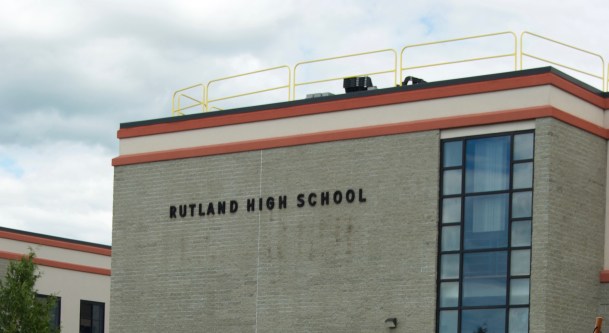
RUTLAND — About 200 Rutland High School alumni, students and community members are drafting a petition calling on school officials to remove the name and arrowhead imagery of the school’s mascot, the Rutland Raiders.
The group, led by RHS 2010 alumna Amanda Gokee, cites appropriation of Native American culture.
Gokee, who identifies as Ojibwe a tribe from the Midwest, wrote an opinion piece published Wednesday in the Rutland Herald that details her concerns about the mascot.
“Native Americans have survived periods of relocation, termination and assimilation, policies deployed as a means of solving what was referred to as the ‘Indian problem,’ which we could call the Raider problem,” she wrote. “It is the Raider image and stereotype—the idea of a violent savage—that made the ‘Indian problem’ urgent and justified these policies.”
Gokee said the conversation started two weeks ago following discussions that took place between alumni over Instagram. On Friday, the number of supporters engaged over email neared 200.
The group is drafting a petition to abolish the mascot. In addition, they are discussing other requests, like flying an Abenaki flag, taking a moment before sporting events to acknowledge that the game is taking place on land that formerly belonged to Abenaki people, and including more of Vermont’s Native American history in RHS’s curriculum.

Jenna Montgomery-Concha, a rising junior at the school, has been talking about the issue with other students since she arrived at RHS. Ideally, she said, she’d like to see more sweeping changes to the school’s curriculum, including an inclusion of more local history.
“We didn’t really learn much about Vermont’s deplorable past, with state-sponsored eugenics and refusing to acknowledge the Abenaki as a tribe of Vermont.”
Gokee said the mascot suggests that Native American culture is part of the past.
“It is sort of saying, here’s this emblem of a culture that’s no longer here, that’s gone,” she said. “And that makes it OK for white people to use that as freely as they would like. I think that changing the mascot recognizes the contemporary existence of Native peoples here.”
The group of students and alumni have had preliminary conversations with Superintendent Bill Olsen, who will meet with them next week.
Olsen said the school has slowly shifted away from using images of Native Americans in headdresses, and changed the mascot name from the “Red Raiders” to the “Raiders” a number of years ago.
Olsen commended the group for beginning the discussion.
“I’m really impressed with our kids, because they really do try to use what they’re learning to do the right thing, and I think this is what they’re trying to do,” he said. “It’s neat to see how some of this principle learning is taking place in the real world.”
Together with RHS Associate Principal Greg Schillinger, Olsen is conducting an initial assessment of what it would take, financially and otherwise, to change the mascot. He’s also open to other changes, like acknowledging that sports games are taking place on land that belonged to Abenaki, or changes to the curriculum.
“The curriculum topics, I think, are always worth considering and doing,” he said.
Gokee said responses to her commentary in the Herald have been almost entirely positive so far.
Controversy has arisen in other communities in Vermont over local school mascots. In 2017, there was a backlash after a group of students, staff and faculty pushed to change South Burlington High School’s mascot from the Rebels, which was associated with the Confederacy and slavery by extension. The argument eventually reached the Vermont Supreme Court.
Orange Southwest School District superintendent Layne Millington sent a letter to community members about his decision earlier this year to change the imagery of Randolph Union High School’s mascot, the Galloping Ghost because the most recent representation closely resembled a Ku Klux Klan rider.
“There are few things that can tear a school community apart like fighting over the change of a Mascot,” Millington wrote in his letter.
Rutland High School world history teacher Claire Groby values the evolving discussion. She anticipates a two-sided conversation, and imagines some will want to hold fast to the Raider.
She weighed the value of the mascot’s loss — school spirit, community, unity — against its perceived harm.
“It’s a really tough thing to balance,” she said. “On the one hand, changing something that’s historically meaningful because it’s giving you school spirit, to me, that’s maybe more of an inconvenience, whereas changing something because it’s harmful — that might be more important.”
Montgomery-Concha believes that this is the right moment to raise the issue, following the protests against racism that erupted worldwide after the killing of George Floyd.
“I think that a lot more people are becoming more socially aware, and more politically and socially educated,” she said. “And we think that they’ll be more receptive now that people have a better idea of what’s actually going on in the world.”
Gokee echoed that sentiment in her op-ed.
“It is clear that, as Vermonters, we cannot avoid the fact racism is a problem in our state, as in our country as a whole,” she said. “Now is the time to look closely at our own communities and to do better, so the same patterns of harm are not perpetuated in the future.”
