

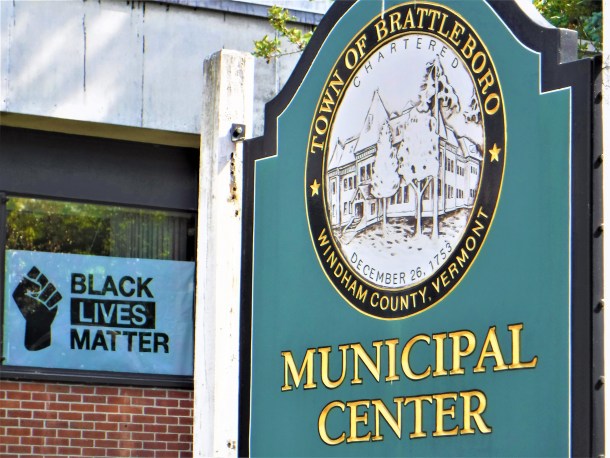
BRATTLEBORO — Local leaders and advocates for defunding police, debating publicly for nearly five hours Tuesday, have yet to agree on how to hold a long-delayed 2020 town meeting and set up a committee to study municipal law enforcement.
The Brattleboro Selectboard, having postponed this year’s March town meeting due to Covid-19, thought its biggest challenge was figuring out how to gather several hundred residents while complying with current state guidelines that limit a crowd to 75 people indoors or 150 outdoors.
But recent Black Lives Matter protests have added a complicating challenge: How to also review the police budget in a way that’s fair to people who believe it should be reformed or rejected and others who want protection in a town where opioid-overdose deaths top state tallies and racial justice events have drawn verbally abusive opponents now facing charges of hate-motivated disorderly conduct.
Local leaders have considered a myriad of ways to hold a town meeting in person, only to hear from some residents who say they won’t attend no matter what the arrangement. The town also has explored video conferencing, only to be told other people don’t have access to the internet.
Administrators therefore have proposed a hybrid Plan B: an online town meeting as early as August that would feature discussion also broadcast on Brattleboro Community TV, followed by a weeklong opportunity to cast Australian ballots at home.
The catch: Because the town would print and distribute both an agenda and ballots before the meeting, representatives won’t be able to propose amendments but instead simply vote yes or no.
“We recommend the procedure set forth,” six top officials have written the Selectboard, “which sacrifices the ability of representative town meeting to amend articles on the warning in favor of ensuring that every member will be able to vote.”
Most Vermont communities decide budgets at town meetings held in early March. Brattleboro, the state’s seventh most populous locality with about 11,000 people, aims to keep attendance manageable by electing 140 representatives who wait until later that month to debate an annual spending plan.
Local leaders had hoped to hold a town meeting before July 1, but found themselves unable to schedule one because of the pandemic. As a result, the Selectboard turned to a temporary state measure that allows it to adopt a budget to ensure municipal operations continue.
Even so, Brattleboro still has 18 other agenda items that require town meeting attention.
“We all see this as the least bad option at the moment,” Selectboard Chairman Tim Wessel said of the hybrid town meeting plan.
But several residents, speaking to the board online, oppose the temporary curb on amendments.
“Maybe we’re not being disenfranchised, but certainly the franchise is being diluted,” Art “Fhar” Miess said. “It’s as if you’ve said, ‘OK, everybody can have coffee, but you all have to drink decaf.’”
The Selectboard, in voting 3-2 last month for an $18.4 municipal budget that includes $2.3 million for police, also decided to review law enforcement spending for the future.
Selectwoman Elizabeth McLoughlin and a group of local social justice organizations unveiled separate proposals Tuesday that center on the creation of a citizens committee.
Several board members said the plans appeared similar enough to be combined into one. But advocates said that wasn’t possible because McLoughlin, in calling for a study in a public letter “to see if or where racism exists,” went on to write, “I believe we need a police department, as Brattleboro has real crimes and violence in our midst, including hate motivated crimes.”
Said one defunding advocate: “If that’s a presupposition of the forums that we’re going to be using to collect feedback, it is not truly inclusive.”
McLoughlin may be in a minority as one of only two women on the five-member Selectboard, but several advocates asked her to withdraw her proposal in deference to people of color.
“Show us all some cultural humility,” one told McLoughlin.
Instead, the board voted to continue the conversation at a meeting July 21.
