


VTDigger and the University of Vermont Center for Research on Vermont compiled budget data from 141 towns and cities, representing 83% of the state’s population, into a searchable database that provides a comparative information about police spending as officials in Burlington and in jurisdictions across the country consider criminal justice reforms and funding cuts for police departments.
Although the racial justice protests that followed George Floyd’s death on May 25 have mostly subsided in Vermont, conversations about police spending are flaring up in towns and cities across the state.
In Burlington, after hundreds of racial justice advocates stormed public comment sessions, the City Council voted this week to reduce police staffing by 30% through attrition. In other cities, from Brattleboro to Barre to Winooski, political leaders are confronting calls to “defund the police,” largely through shifting much of the current work of police to professionals in mental health or addiction counseling.
The conversation happening nationally is taking on local contours in each of these Vermont communities, depending on the budget and reputation of local police departments.
There is a tremendous variance between Vermont’s cities and towns when it comes to local police spending, from Dover, where each resident spends an average of $623 on police per year, to Peacham, which they spend next to nothing (the whole town spends $250 per year). In many towns, there is no local police department at all. In those places, the Vermont State Police provide coverage.
A new database compiled by VTDigger and the University of Vermont Center for Research offers new insight into how towns and cities stack up on police spending.
Overall, police department budgets have continued to grow despite declining criminal activity.
The database, which is a working document that will be expanded in the weeks ahead, was compiled by student researchers at the University of Vermont’s Legislative Internship Center, which compiles research for policymakers, using publicly available budget information.
Among the 141 towns included as of publication of this article, the database shows that police budgets have increased $3 million in fiscal year 2020, compared to 2019, a 4% increase across the board.
It also highlights pockets in the state where there are no local police departments, or little spending to “defund” even if local leaders so desired.
The police chiefs VTDigger spoke with were largely opposed to the “defund the police” movement. They warned that if resources are taken away from their departments, crime could rise.
But advocates say that by reinvesting a portion of police budgets into social and community services, problems that could lead to crime could be solved before police ever enter the picture.
Vermont’s policing holes
Charlotte is among the many Vermont towns that never adapted to a modern police department, instead relying on partnerships with local sheriffs, constables or state police. The Chittenden County town plans to spend $30,000 next year on police, as part of its partnership with the Vermont State Police.
But just one town over, Hinesburg — with a population of 4,500 compared to Charlotte’s 3,800 — does have its own police force. Hinesburg spent $574,000 on its force in fiscal year 2020, which amounts to about 15% of the town’s total budget and $126 in per capita spending (compared to $8 per year for Charlotte residents).
Charlotte Selectboard Chair Matt Krasnow says the town’s low police spending is perhaps a result of its reliance on trusty constable Hugh “Cowboy” Lewis, who spent 35 years as a public servant for Charlotte’s residents before he died in 2009.
“The amount of stories I could tell you about Cowboy,” said Krasnow, who was born in Charlotte. “He helped someone change their tire on their car by lifting it up with his bare hands.”

Krasnow said Charlotte frequently comes under budget, because the state police use the money as an overtime fund for their officers when they have to respond to calls in Charlotte. Krasnow said the town gets the bill from the police, and revenue from fines and tickets that amounts to $5,000 to $9,000 a year.
Krasnow said he’s never heard complaints from his constituents that the state police hadn’t responded in a timely manner because they don’t have a home base in the town.
“The state police’s response to crime in Charlotte is exemplary and their community policing strategies are commendable,” he said.
Hinesburg Police Chief Anthony Cambridge said his department is one of the newest in the state. It was established in the 1990s because residents felt their old model, which relied on a contract with state police, wasn’t delivering the level of service they wanted, he said.
Cambridge said that crime rates are low in the town, thanks to the police presence, and he even spoke of times when a small uptick in burglaries in Charlotte didn’t extend into Hinesburg, possibly because of the deterrent to criminal activity in his town. (Krasnow didn’t agree.)
Like other chiefs who spoke with VTDigger, Cambridge said his department’s budget is appropriate for the need met by officers.
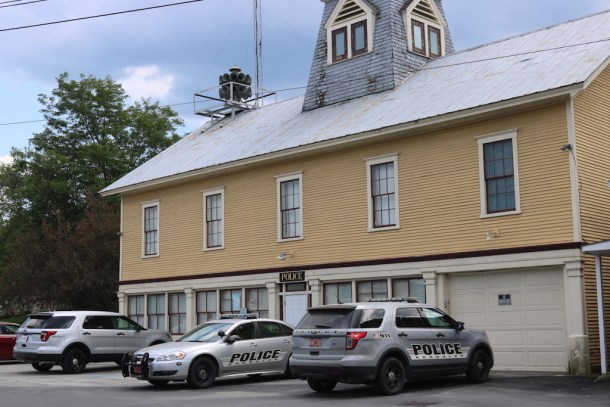
Randolph is another Vermont town that doesn’t rely on a formal police department. In 2018, the Randolph Police Department disappeared after all of its officers took jobs elsewhere. Instead of reestablishing a department, Randolph, with a population of about 5,000, decided to disband it and partner with the Orange County Sheriff instead.
The savings kicked in this year — in fiscal year 2019, Randolph spent $433,000 on its policing. In fiscal year 2020, that price tag dropped to $329,000, resulting in a 23% decrease in spending. That makes Randolph an outlier in a state, and country, where police spending has historically tended to rise.
“I do believe we were ahead of the curve,” said Trini Brassard, chair of the Randolph Selectboard. While these savings haven’t been reallocated to social services in the town, she said residents are seeing these savings in their taxes.
Big budgets for small towns
While the data compiled by UVM and VTDigger reveals millions of dollars in spending, it doesn’t encompass the entire budget of local police departments.
Many departments get revenue independent of town budgets from tickets, grants, and contracts with private companies, said Doug Hoffer, the state auditor, whose office put out a report in 2017 on state-level public safety spending.
There is also a variety of policing arrangements statewide. Smaller towns often contract with county sheriffs, the Vermont State Police, or a mix of both, said Katie Wynn, the UVM student lead on the project. In those cases, the team recorded any money spent on law enforcement they could find, including contracts.
Even with those stipulations, the broad disparities in how much towns spend on policing are clear, and don’t always follow population or demographic lines.
Both Newport (population 4,300) and Burlington (population 42,000), spend more than $400 per resident, placing them in the upper end of the statewide spectrum. (Burlington’s per capita police spending is $421 per person; Newport’s is $408.)

Police Chief Travis Bingham, who was recently sworn in to the job after the previous chief resigned in April, said Newport’s budget is higher than towns with comparable population numbers because it’s a regional hub. Newport employs many Vermonters from surrounding areas, which Bingham estimated raises the daytime population to about 6,000.
The city recently instituted its own 24/7 dispatch service, which added about $150,000 to the budget when it was first instituted in 2019, said Newport City Mayor Paul Monette.
The police department’s budget appears to have seen a big increase in 2020, though that reflected an accounting change, according to Monette. The city had moved its benefit expenditures into the department’s budget for fiscal year 2020, which were previously accounted for elsewhere in the city’s budget.
Bingham said he thinks the budget is the right amount given the need his department is seeing. The new dispatch system is seeing calls go up, and if any money were to be reallocated from his department, he worries public safety would be sacrificed.
“It doesn’t make any sense,” Bingham said. “If anything it’s going to hurt the community by not having a strong police department supporting the community. At the end of the day, who are they going to call when things are going sideways? They’re going to call the police department.”
Dover leads the state with the highest police budget per capita, according to the VTDigger/UVM database. Its budget for fiscal year 2020 was about $780,000, which is $623 per resident in the approximately 1,200-person town.
Dover Police Chief Randy Johnson said the spending takes into account Dover’s inflated tourist populations in the winter and summer months. At Dover’s peak, Johnson estimated the town could see a population of 15,000. That justifies the size of the town policing budget, he says.
Johnson said his department is staffed and budgeted appropriately for the demand his office is seeing. “Are there times we’re overwhelmed? Yes. Are there times when we’re underwhelmed? Yes,” Johnson said. “You can’t predict crime.”
While Johnson said he supports reforms for police departments more broadly, he thinks the idea behind the “defund the police” movement would set his department back and cause crime to rise.

“I have no money in my budget to take money out and allocate it somewhere else,” Johnson said. He agrees there should be more money allocated to mental health support structures, but not from his budget. That money should come from the state, or county, he said.
Dover Selectboard Chair Josh Cohen agreed with Johnson that the larger tourist population in Dover justifies the need for a larger police department. “We are full of foreign plates,” Cohen said.
While Cohen says the current budget is appropriate, he would consider conversations about what defunding the police could mean for a small town like Dover. More research should be done in small towns like Dover, he says, to better understand what a reallocation would look like.
“On one hand, I can understand the need to reallocate funds from the police to social services,” Cohen said. “In general I don’t know if the police should be doing everything that they do. Because they’re police officers, they’re not social workers, they’re not welfare officers.”
The perception of police has changed dramatically in recent decades, said Paul Cillo, founder and president of Public Assets Institute, a Montpelier-based think tank.
Recent data shows a clear racial bias in policing.
A 2019 report found that Black and Hispanic drivers are more likely to be stopped by police forces by police in Vermont. A 2018 report found that at the time, Black people made up almost 1% of Vermont’s population but made up 8.5% of the state’s prisoners.
“You have to look at why is that happening,” Cillo siad, referring to this data. “I think what’s interesting with this whole movement is that individuals, citizens and taxpayers, I think people are tired of the racism that’s built into the system and want to see some change. The one thing they can impact is how the money is spent.”
Clarification: This story has been updated to clarify that Newport Police Department’s budget increase reflects a change in accounting of benefits, rather than new spending.

